Facts
The Appellant (complainant) filed an FIR alleging that Respondent No. 2 (Monika Dwivedi) and her family members fraudulently induced him into an agreement to sell a residential property in Lucknow for ₹4.30 Crores.
Source reference: p. 2Despite receiving ₹3.55 Crores, the accused allegedly executed a sale deed in favor of a third party and threatened the Appellant when a refund was demanded.
Source reference: p. 2Respondent No. 2’s previous writ petition to quash the FIR was dismissed by the High Court, noting her criminal antecedents and a prima facie case of fraud.
Source reference: p. 3Subsequently, after the Sessions Court rejected her anticipatory bail, she approached the Allahabad High Court via Section 482 BNSS.
Source reference: p. 3The High Court granted anticipatory bail on October 06, 2025, primarily observing that the dispute appeared civil because the agreement was only notarized, only partial payment was made, and the refund was sought in the FIR.
Source reference: p. 3-4The Appellant approached the Supreme Court seeking cancellation of this protection.
Source reference: no citationIssues
1. Whether the High Court was justified in granting anticipatory bail by characterizing a prima facie case of financial fraud as a dispute of a civil nature.
Source reference: p. 4, para. 142. Whether the non-consideration of criminal antecedents and the nature of an economic offence vitiates the discretionary exercise of granting anticipatory bail.
Source reference: p. 6, para. 19Law Applied
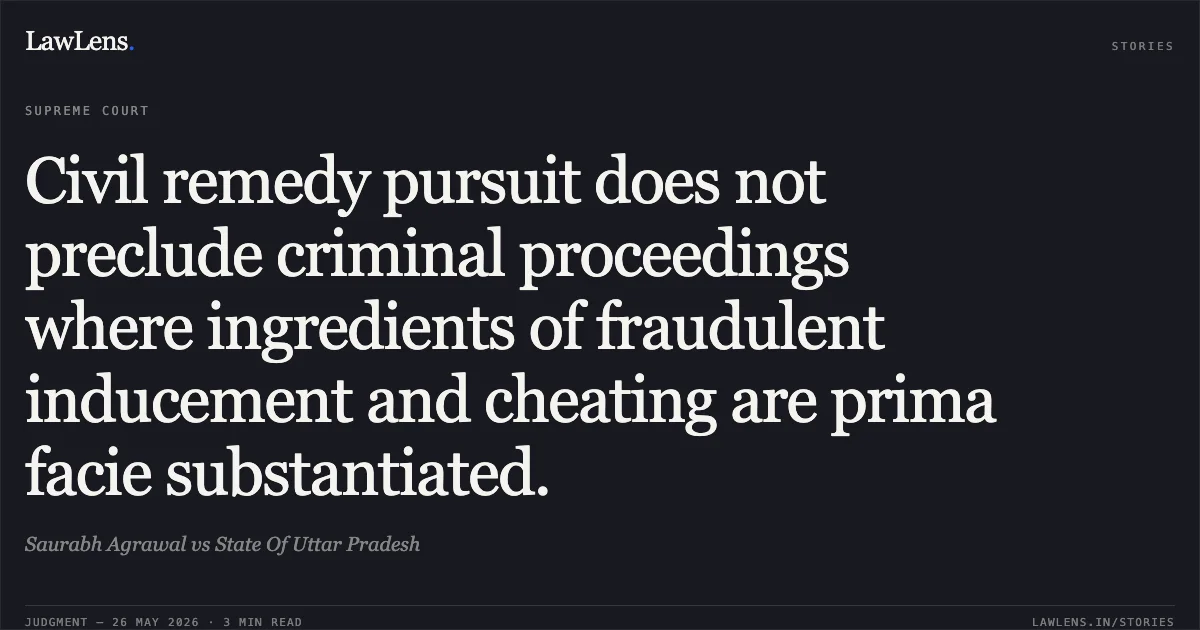
The Court applied the principles governing Section 438 of the CrPC (now Section 482 of the BNSS) regarding anticipatory bail, emphasizing that the existence of a civil remedy does not preclude criminal proceedings if the ingredients of an offence are prima facie met.
Source reference: p. 6The Court underscored that in economic offences involving substantial sums, the court must consider the nature of the accusation, the conduct of the accused (such as absconding), and criminal antecedents as germane factors for exercising discretion.
Source reference: p. 6-7It reiterated established jurisprudence that the form of a contract (notarized vs. registered) does not neutralize alleged criminality if fraudulent inducement is present.
Source reference: p. 5Reasoning
The Supreme Court held that the High Court’s reasoning was flawed as it relied on peripheral factors rather than the core allegations of deception.
Source reference: no citationThe Court clarified that the fact that one co-owner was abroad or that the agreement was notarized does not dilute the allegation of "inducement" at the inception of the transaction.
Source reference: p. 5The High Court erred in viewing the Appellant's request for a refund as indicative of a purely civil dispute, noting that restitution claims do not efface charges of cheating.
Source reference: p. 6The Supreme Court found the High Court order "unsustainable" because it was completely silent on the Respondent’s criminal antecedents and the fact that she had previously absconded to evade investigation—factors that both the Sessions Court and a different bench of the High Court had previously recorded.
Source reference: p. 6-7The Supreme Court concluded that the High Court failed to apply its mind to the requirements of an effective investigation in a large-scale economic fraud.
Source reference: p. 7Holding
The Supreme Court answered the issues in the negative, holding that the grant of anticipatory bail was not warranted given the magnitude of the fraud and the conduct of the accused.
The Court set aside the High Court’s order dated October 06, 2025, and officially cancelled the anticipatory bail granted to Respondent No. 2, Monika Dwivedi.
Source reference: p. 7-8The appeal was allowed, with a clarification that these observations would not influence the trial on merits.
Source reference: p. 8Acts & Sections Cited
1 provisions across 1 statute referred to in this judgment. Each provision opens on LawLens.
Bharatiya Nagarik Suraksha Sanhita, 20231
Original Court PDF
Saurabh AgrawalvsState Of Uttar Pradesh
Click to open original judgment
Original judgment, available to read, download and summarize on LawLens.in