Facts
The appellants-plaintiffs claimed ownership and possession of lands in Village Sardarpura covered by a land-acquisition process initiated through a notification under Section 4 of the Land Acquisition Act, 1894, dated 14 May 1997, followed by a Section 6 declaration dated 28 August 1998. An award under Section 11 was subsequently made on 30 October 2001.
Source reference: pp.2–4, paras 2.2–2.7The plaintiffs alleged that possession had not been taken from them, that the lands were no longer required for GIDC purposes, and that they were entitled to de-acquisition, protection of possession, and declaration of title by adverse possession.
Source reference: pp.2–4, paras 2.2–2.7Some of the plaintiffs or other landowners had previously pursued writ proceedings challenging the acquisition, including Special Civil Application No.18201 of 2003, which was dismissed after the Court noted the award and taking of possession.
Source reference: pp.15–17, paras 7.3–7.5The plaintiffs thereafter instituted Regular Civil Suit No.101 of 2011 seeking declarations, permanent injunctions, and directions for de-acquisition. The trial court allowed the defendants’ application under Order VII Rule 11(a) and (d) CPC and rejected the plaint on 29 July 2017. The present appeal challenged that order.
Source reference: pp.1–6, paras 1–2.9Issues
Whether the civil suit challenging the validity, effect, or continuation of completed land-acquisition proceedings was maintainable before a civil court, or was barred by the scheme of the Land Acquisition Act and Section 9 CPC.
Source reference: pp.5–7, para 5; pp.17–26, para 7.6Whether the plaint disclosed a genuine and legally sustainable cause of action under Order VII Rule 11(a) CPC.
Source reference: pp.7–14, paras 6–6.5; pp.27–30, paras 9–12Whether the suit was liable to be rejected under Order VII Rule 11(d) CPC as barred by law.
Source reference: pp.7–8, para 6; pp.26–30, paras 8–12Whether the plaintiffs could claim title by adverse possession merely on the basis of alleged long possession after issuance of the acquisition notification.
Source reference: pp.29–30, paras 11–11.4Law Applied
Order VII Rule 11(a) and (d) CPC requires rejection of a plaint that does not disclose a cause of action or whose statements show that the suit is barred by law; at this stage, the court must examine the plaint as a whole and ordinarily accept its material averments as true, without considering the defence or conducting a merits-based inquiry.
Source reference: pp.7–14, paras 6–6.5The Land Acquisition Act, 1894 constitutes a complete statutory code, and by necessary implication the jurisdiction of the civil court under Section 9 CPC is excluded in relation to challenges to acquisition notifications and consequential proceedings; such challenges may be examined by constitutional courts under Articles 226 and 136, subject to the applicable limitations.
Source reference: pp.17–26, para 7.6A person claiming adverse possession must specifically plead and prove the date and nature of entry, continuity, publicity, hostility, knowledge of the true owner, and uninterrupted possession—nec vi, nec clam, nec precario.
Source reference: pp.29–30, para 11.4A civil court cannot compel the Government to withdraw or de-notify an acquisition; the statutory remedies include seeking compensation or enhancement through the mechanisms under the Land Acquisition Act.
Source reference: pp.20–26, para 7.6The court relied on Shri Mukund Bhavan Trust v. Shrimant Chhatrapati Udayan Raje Pratap Singh Maharaja Bhonsle, (2024) 15 SCC 675; Sopan Sukhdeo Sable v. Assistant Charity Commissioner, (2004) 3 SCC 137; Saleembhai v. State of Maharashtra, (2003) 1 SCC 557; State of Bihar v. Dhirendra Kumar, (1995) 4 SCC 229; Laxmi Chand v. Gram Panchayat, Kararia, (1996) 7 SCC 218; BDA v. K.S. Narayan, (2006) 8 SCC 336; BDA v. Brijesh Reddy, (2013) 3 SCC 66; Rajasthan Housing Board v. Chandi Bai, 2018; H.N. Jagannath v. State of Karnataka, (2018) 11 SCC 104; and Chatti Konati Rao v. Palle Venkata Subba Rao, (2010) 14 SCC 316.
Source reference: pp.7–30, paras 6–11.4Reasoning
The High Court held that the acquisition process had culminated in the Section 4 notification, Section 6 declaration, and Section 11 award, and that the plaintiffs had already unsuccessfully invoked writ jurisdiction against the acquisition.
Source reference: pp.15–17, paras 7.3–7.5The reliefs seeking declarations that the State could not take possession, that the lands should be exempted or de-acquired, and that the plaintiffs were entitled to injunctions directly questioned the acquisition and its consequences. Applying the settled rule that the Land Acquisition Act is a complete code, the Court found that the civil court lacked jurisdiction to grant such reliefs.
Source reference: pp.17–26, paras 7.6–8The plaint also contained an illusory and unsupported cause of action: its allegations concerning representations, continued possession, and alleged surplus land did not create a legally enforceable right against a completed acquisition.
Source reference: pp.27–30, paras 9–12The adverse-possession claim was independently defective because the plaintiffs neither pleaded the essential ingredients of hostile, open, continuous, and adverse possession nor could logically claim both that they remained owners entitled to retain possession and that they had acquired title adversely to the State. The Court therefore treated the claim as contradictory and incapable of sustaining the suit.
Source reference: pp.29–30, paras 11–11.4Holding
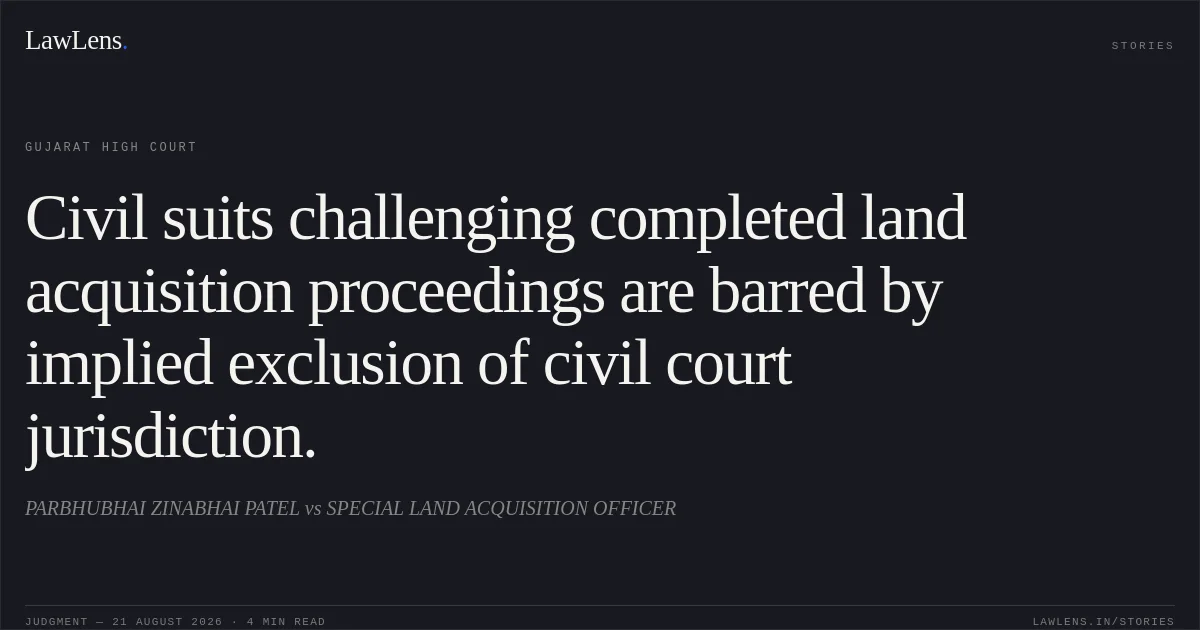
The appeal was dismissed. The High Court affirmed the trial court’s order rejecting the plaint under Order VII Rule 11(a) and (d) CPC, holding that the suit was barred because it sought to challenge completed land-acquisition proceedings within the jurisdiction of the civil court and did not disclose a genuine cause of action.
The plaintiffs’ claims for de-acquisition, restraint against taking possession, and declaration of title by adverse possession were rejected.
Source reference: p.31, para 12The connected civil application for stay was accordingly disposed of, and the record and proceedings were directed to be returned to the concerned court.
Source reference: p.31, para 12Acts & Sections Cited
4 provisions across 2 statutes referred to in this judgment. Each provision opens on LawLens.
Code of Civil Procedure, 19083
Maharashtra Regional and Town Planning Act, 1966.1
Original Court PDF
PARBHUBHAI ZINABHAI PATELvsSPECIAL LAND ACQUISITION OFFICER
Click to open original judgment
Original judgment, available to read, download and summarize on LawLens.in