01Facts
On 03.11.2005, the claimant Kamal Piyada and one Makaddesh Baidya were walking on the western non-metalled portion of the Diamond Harbour–Kakdwip Road near Chandipore Bus Stoppage when Trekker No. WB-19C-3010 struck them from behind, causing injuries and permanent disablement.
p. 2The claimant filed a claim under Section 163A of the Motor Vehicles Act, 1988 (MAC Case No. 29/2007), alleging rash and negligent driving. The owner (OP No. 1) did not contest and was proceeded ex parte. The insurer (OP No. 2, United India Insurance Co. Ltd.) contested.
p. 2The Additional District Judge, 10th Court, Alipore, by award dated 19.12.2007, granted Rs. 12,900 with 6% interest, payable by the insurer.
pp. 2–3The claimant assessed his disability at 30% through a private doctor's certificate, not a Medical Board certificate.
p. 8He appealed on quantum and sought leave to convert the claim to Section 166.
pp. 3–4The insurer contended that the conversion request, raised about 19 years after institution, was unexplained, that Section 163A requires no proof of negligence, that the trial court made no finding on rash or negligent driving, and that the victim had not suffered permanent disability within the meaning of Section 163A.
pp. 4–502Issues
i.1. Whether the claim, filed and decided under Section 163A of the Motor Vehicles Act, 1988, can be converted into a claim under Section 166 at the appellate stage.
pp. 5–6ii.2. Whether the compensation of Rs. 12,900 awarded by the Tribunal is just and reasonable, and whether the claimant is entitled to the benefit of the subsequent statutory amendment to the compensation quantum.
pp. 8–1003Law Applied
The Court relied on Section 163A (structured no-fault compensation), under which the claimant need not prove negligence, and Section 166 (fault-based liability), which requires the claimant to establish actionable negligence.
p. 5The Court applied Deepal Girishbhai Soni v. United India Insurance Co. Ltd. (MANU/SC/0246/2004), which holds that Sections 163A and 166 are final, independent and mutually exclusive remedies, so a claimant must elect one and cannot pursue both; the schemes are distinct, and no adjustment or refund mechanism exists between them.
pp. 6–8The Court relied on Mamta v. Happy (2024 ACJ 2380), which emphasised the purposive, beneficial character of motor accident legislation and the need for substantive justice.
p. 9The Court applied Section 164 of the MV Act, as amended in 2019, which consolidated no-fault compensation and fixed a sum of Rs. 2.5 lakh for grievous hurt, and which does not require proof of wrongful act or negligence.
pp. 9–10Provisions in the judgment · 7 · Linked ones open on LawLens
Motor Vehicles Act, 1988 Section 140Section 141Section 161Section 163Section 164Section 166Section 168
04Reasoning
On the first issue, the Court noted that the trial court had recorded only that an accident occurred and caused injury, without any finding that the driver acted rashly or negligently. Because the claim was pursued and decided under the no-fault regime, and Section 166 is premised on proof of fault, the Court held that there was no scope to convert the proceeding at this stage, relying on the election principle in Deepal Girishbhai Soni.
pp. 6–8On the second issue, the Court accepted that the 30% disability certificate, though issued by a private doctor and not a Medical Board, should not be wholly discarded, given that the assessed disability is below 40%.
p. 8It then considered that the claim had been pending for about 19 years, during which the amended quantum provisions came into force. Treating the Motor Vehicles Act as beneficial legislation, the Court held that the claimant should receive the benefit of the amendment.
pp. 8–9Applying the amended Section 164 and weighing the percentage of disability and the pain and suffering, the Court found Rs. 1,50,000 to be just and reasonable.
p. 1005Holding
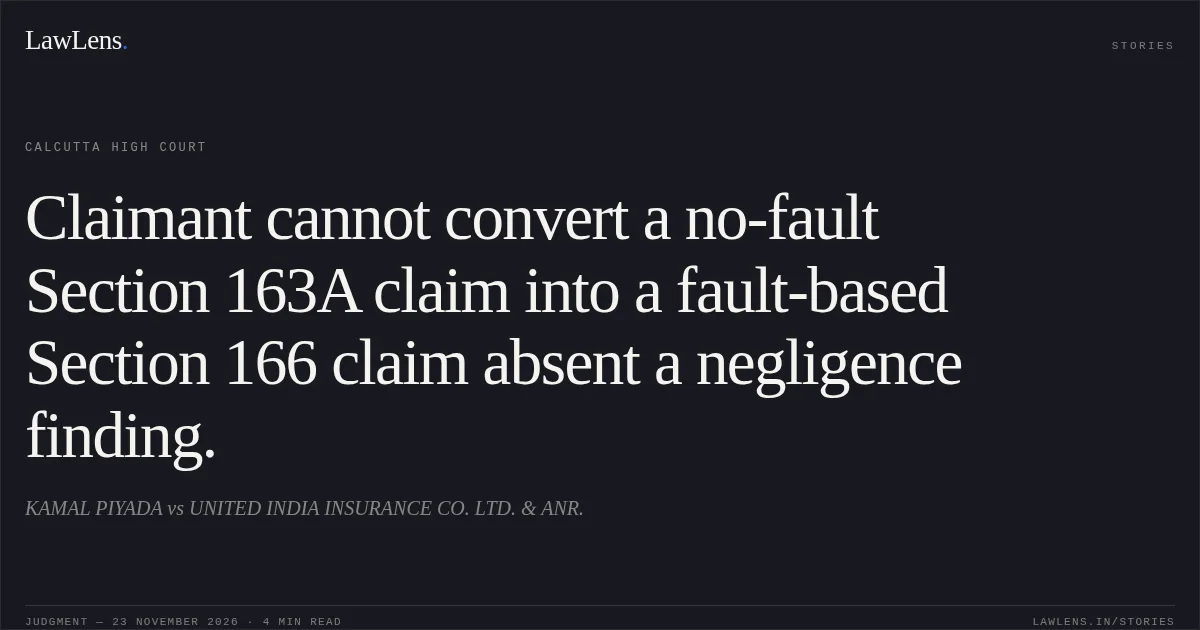
The Court held that conversion from Section 163A to Section 166 is not permissible on these facts, since no finding of negligence was recorded and the remedies are mutually exclusive.
pp. 6–8The Court held that Rs. 1,50,000 is the just and reasonable compensation, applying the amended Section 164. The appeal was disposed of and the award modified. The insurer must deposit Rs. 1,50,000 with 6% interest, stated as running "from date of filing claim case today", before the Registrar General, High Court at Calcutta, within eight weeks of communication of the order. Any compensation already paid or deposited under the trial award is to be adjusted, and the balance deposited. The claimant may withdraw the amount on compliance with formalities and payment of deficit court fees. The Trial Court record is to be returned.
pp. 10–11Original Court PDF
KAMAL PIYADAvsUNITED INDIA INSURANCE CO. LTD. & ANR.
Click to open original judgment
Original judgment, available to read, download and summarize on LawLens.in