Facts
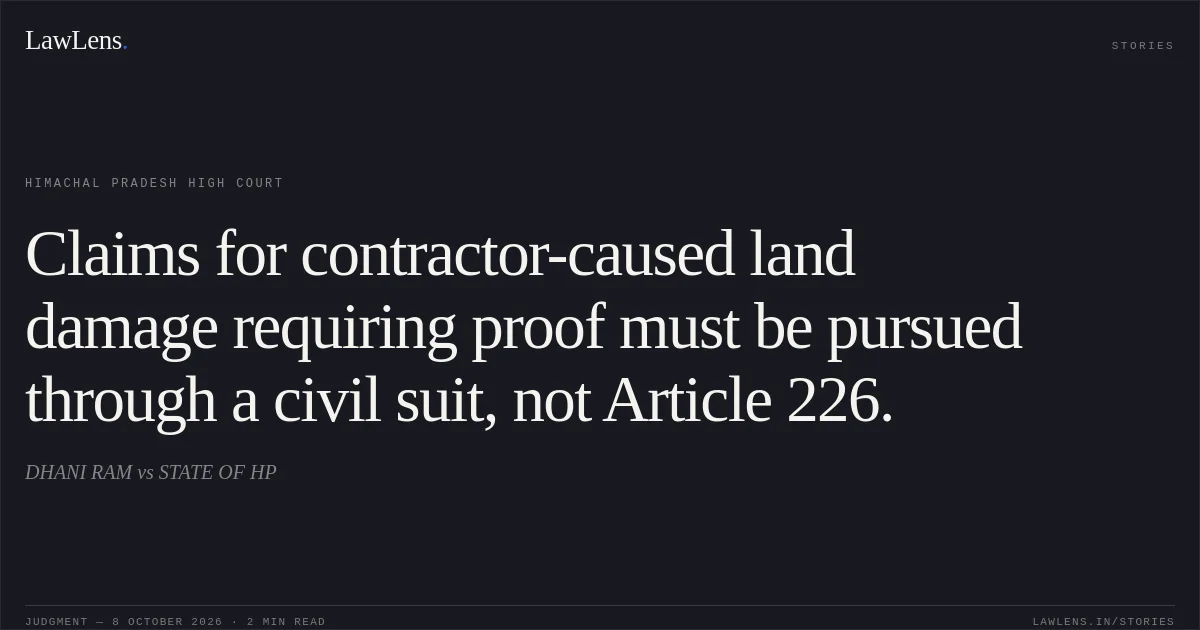
The petitioner claimed ownership of land in Village Salana and alleged that, during construction of the Shoghi–Salana Sari Road, the contractor dumped debris and boulders on it, causing damage.
Source reference: para. 2–4, 7He sought compensation or, alternatively, acquisition of the damaged land.
Source reference: para. 2–4, 7The State denied liability, relying on a contract term making the contractor solely responsible for damage to public or private property; the contractor denied causing damage.
Source reference: para. 2–4, 7The road work was completed on 31 December 2008, and the writ petition was filed on 10 December 2013.
Source reference: para. 2–4, 7The petitioner relied on photographs, communications concerning possible compensation, and an architect’s report; the respondents disputed the alleged damage and the report.
Source reference: para. 2–4, 7Issues
1. Whether the petitioner’s claim for compensation for alleged damage to his land could be adjudicated under Article 226 where the fact and extent of damage were disputed and required proof.
Source reference: para. 6(i)–6(v), 72. Whether the petitioner could obtain a direction for acquisition of the land when it was not shown to have been used by the State for a public purpose.
Source reference: para. 7Law Applied
Article 226 jurisdiction is discretionary and is ordinarily not exercised as a substitute for a civil remedy where resolution of the claim requires detailed assessment of disputed facts and oral or documentary evidence (Thansingh Nathmal v. Superintendent of Taxes, Smt. Gunwant Kaur v. Municipal Committee, Bhatinda, Joshi Technologies International Inc. v. Union of India, Punjab National Bank v. Atmanand Singh, and M.P. Power Management Co. Ltd. v. Sky Power Southeast Solar India Pvt. Ltd.).
Source reference: para. 6(i)–6(v)A claim for damages arising from alleged injury to private property during construction, where causation and loss are disputed, is appropriately pursued before a civil court (Jai Dutt Sharma v. State of H.P.).
Source reference: para. 6(vi)The Court also noted that acquisition must be for a public purpose and rejected the acquisition claim as misplaced under the Right to Fair Compensation and Transparency in Land Acquisition, Rehabilitation and Resettlement Act, 2013, in the circumstances of this case.
Source reference: para. 7, 9(ii)Reasoning
The Court found no conclusive proof that the contractor’s work caused damage to the petitioner’s land; the respondents denied the allegation, and the material relied on by the petitioner, including photographs, did not resolve the factual dispute.
Source reference: para. 7Determining damage, causation, and compensation would require evidence and was therefore unsuitable for writ adjudication.
Source reference: para. 7The Court also considered that the claim principally lay against the contractor in the realm of private law, that a civil remedy was available, and that the petition was brought about five years after completion of the road work.
Source reference: para. 7Acquisition was unwarranted because the record did not show that the State had used the land for a public purpose.
Source reference: para. 7Holding
The Court dismissed the writ petition.
It declined to adjudicate the compensation claim under Article 226, but reserved the petitioner’s liberty to pursue a civil remedy.
Source reference: para. 9It rejected the alternative claim for acquisition of the land and directed the parties to bear their own costs.
Source reference: para. 9Acts & Sections Cited
1 provisions across 1 statute referred to in this judgment. Each provision opens on LawLens.
Code of Civil Procedure, 19081
Original Court PDF
DHANI RAMvsSTATE OF HP
Click to open original judgment
Original judgment, available to read, download and summarize on LawLens.in