Facts
The Appellant, a manufacturer of polypropylene leno bags made from plastic granules, originally classified its products under Chapter Heading 3923 2900 of the Central Excise Tariff Act, 1985, and enjoyed duty drawback benefits
Source reference: p.2Following the introduction of the GST Act, 2017, the Appellant sought a change in classification to Chapter Heading 6305 33 00 (textile category) to benefit from different tax rates
Source reference: p.2-3The West Bengal Authority for Advance Ruling (AAR) initially ruled in favor of the Appellant on July 6, 2018, provided specific manufacturing criteria regarding strip width were met
Source reference: p.3However, the Appellate Authority for Advance Ruling (AAAR) set aside this order on October 25, 2018
Source reference: p.3The Appellant challenged the AAAR order via a writ petition (WPA 3667 of 2019), which was dismissed by a Single Judge on February 10, 2023
Source reference: p.1-2The present matter is an appeal against said dismissal.
Source reference: p.1-2Issues
1. Whether polypropylene leno bags manufactured by the Appellant are correctly classified under Chapter Heading 6305 33 00 (Textiles) or Chapter Heading 3923 2900 (Plastics)
Source reference: p.10/para. 252. Whether the Appellant is estopped from seeking a new classification after having voluntarily declared the product under the plastic category for exports and excise benefits
Source reference: p.11/para. 28Law Applied
The Court applied Note 1(g) of Section XI of the Customs Tariff Act, which excludes plastic strips exceeding 5mm in width or monofilaments exceeding 1mm in cross-section from the definition of "textiles"
Source reference: p.11-12It relied on the precedent of Raj Pack Well Limited Vs. Union of India, which established that HDPE/polypropylene bags are commonly understood as "plastic woven sacks" in trade parlance and emphasized denier and cross-sectional dimensions as the criteria for "synthetic textile" classification
Source reference: p.12-13Furthermore, relying on Dunlop India Limited Vs. Union of India, the court affirmed that there is no estoppel against the correct legal classification of a product, despite previous voluntary declarations by the assessee
Source reference: p.11Reasoning
The Court reasoned that for the bags to be classified as textiles under Heading 6305, the constituent polypropylene strips must meet specific technical parameters defined in Section XI
Source reference: p.13Although the Appellant argued that the weaving process converted plastic into a textile material (leno fabric), the Court found no evidence to overturn the concurrent findings of the AAAR and the Single Judge that the strips used did not qualify as synthetic textiles
Source reference: p.13-14The Court applied the "common parlance test," noting that in the industry and market, these products are known and traded as "plastic bags" rather than "textile bags"
Source reference: p.14While the Court acknowledged that the Appellant was not legally barred by estoppel from seeking a re-classification, it held that the specific technical composition (approx. 92-94% polypropylene) and the dimensions of the strips used mandated classification under the plastics category (3923) rather than the textile category (6305)
Source reference: p.5, 13-14Holding
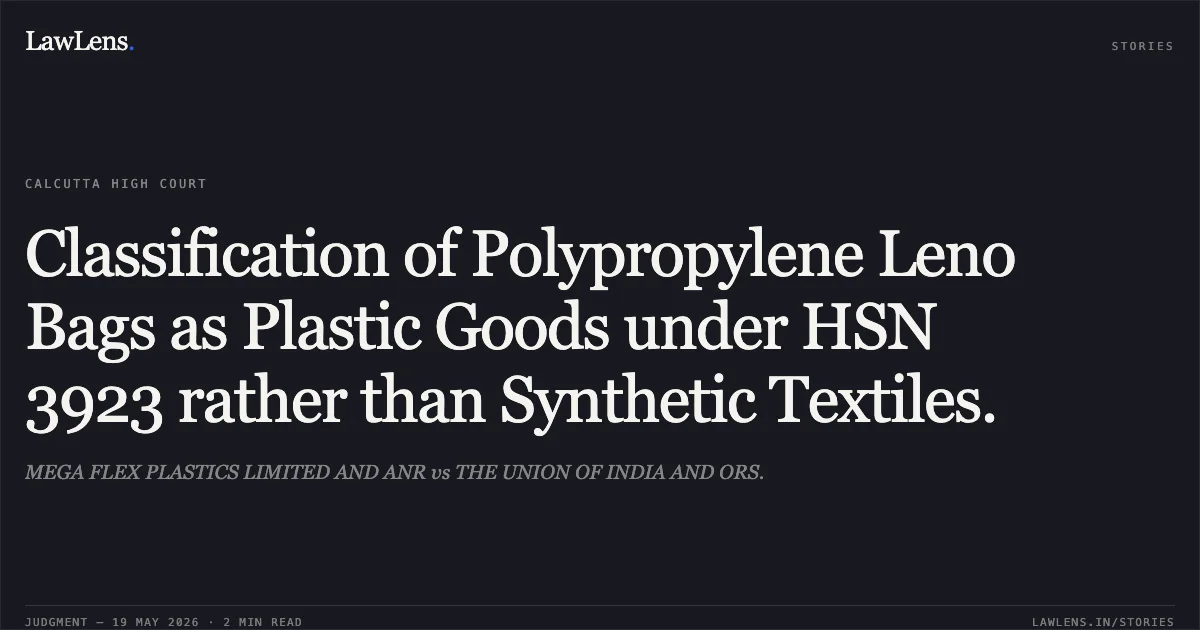
The Court held that the polypropylene leno bags are correctly classified under Chapter Heading 3923 2900 and do not satisfy the criteria to be treated as textile articles under Chapter 6305
The High Court dismissed the appeal and upheld the order of the learned Single Judge. No costs were awarded
Source reference: p.14/para. 34Acts & Sections Cited
1 provisions across 1 statute referred to in this judgment. Each provision opens on LawLens.
Customs Tariff Act, 19751
Original Court PDF
MEGA FLEX PLASTICS LIMITED AND ANRvsTHE UNION OF INDIA AND ORS.
Click to open original judgment
Original judgment, available to read, download and summarize on LawLens.in