01Facts
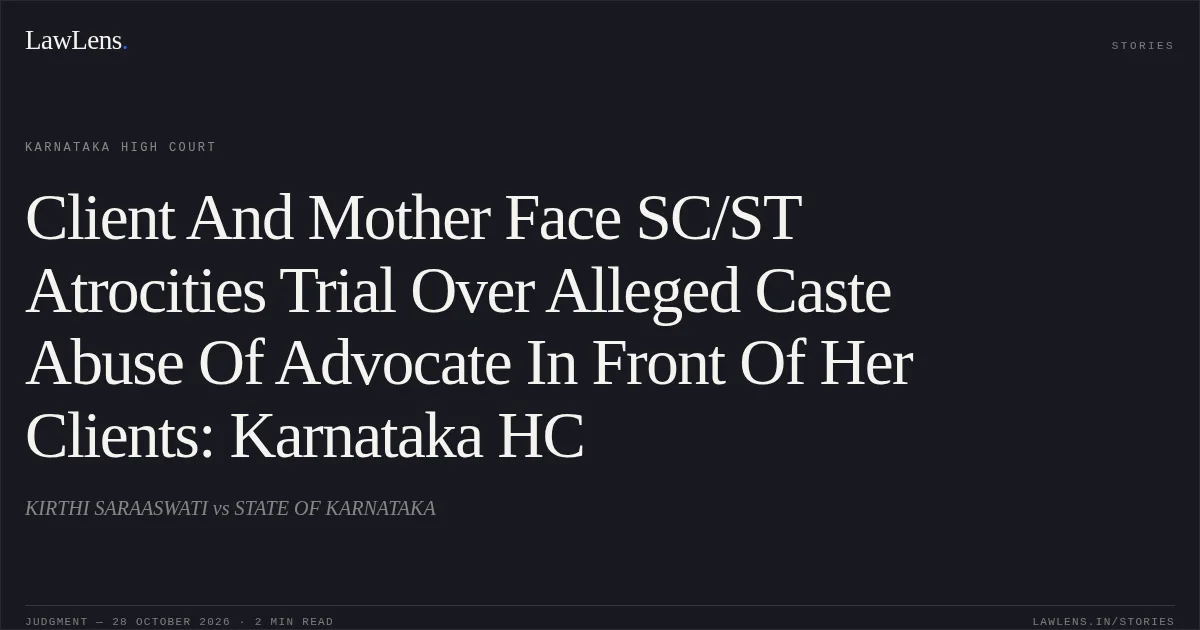
The petitioners, accused Nos. 1 and 2, sought to quash proceedings in Special Case No. 2163 of 2025, arising from a complaint by the first petitioner’s former advocate.
¶ 1 · p. 3The complainant alleged that the petitioners abused and humiliated her by referring to her Scheduled Caste status at her office in the presence of clients, and also made caste-based and defamatory online reviews.
¶ 3–5, 8 · pp. 3–5, 13–14Police investigated and filed a charge sheet alleging offences under Sections 3(1)(r) and 3(1)(s) of the Scheduled Castes and Scheduled Tribes (Prevention of Atrocities) Act, 1989, and Section 352 read with Section 3(5) of the Bharatiya Nyaya Sanhita, 2023.
¶ 3–5, 8 · pp. 3–5, 13–14The petitioners sought quashing on the ground that the allegations did not disclose the ingredients of the offences.
¶ 3–5, 8 · pp. 3–5, 13–1402Issues
i.1. Whether the complaint and charge sheet, taken at face value, disclosed offences under Sections 3(1)(r) and 3(1)(s) of the SC/ST Act, including the requirement that the alleged conduct occur in a place within public view.
¶ 8 · pp. 14–15ii.2. Whether the proceedings should be quashed where the alleged caste-based abuse and its context, including the complainant’s intention to humiliate, required evidentiary assessment at trial.
¶ 8–11 · pp. 15–1803Law Applied
Sections 3(1)(r) and 3(1)(s) of the SC/ST Act penalise, respectively, intentional insult or intimidation intended to humiliate a member of a Scheduled Caste or Scheduled Tribe, and abuse of such a person by caste name, in a place within public view.
¶ 8 · p. 14In Swaran Singh v. State, the Supreme Court distinguished a “place within public view” from a “public place”: a privately owned place may qualify if members of the public are present, and whether the words were used with intent to insult or humiliate is ordinarily a question of evidence.
¶ 9 · pp. 15–17The Court considered the petition under its inherent jurisdiction, referring to Section 482 of the CrPC.
¶ 11 · p. 18Provisions in the judgment · 13 · Linked ones open on LawLens
Bharatiya Nagarik Suraksha Sanhita, 2023 Section 528
Bharatiya Nyaya Sanhita, 2023 Section 352Section 3Section 351Section 356Section 79Section 308
Scheduled Castes and the Scheduled Tribes (Prevention of Atrocities) Act, 1989 Section 3
Hindu Marriage Act, 1955 Section 13
Protection of Women from Domestic Violence Act, 2005 Section 19
Indian Penal Code, 1860 Section 506
Information Technology Act, 2000 Section 67
Code of Criminal Procedure, 1973 Section 482
04Reasoning
The Court considered that the complaint and charge sheet alleged caste-based abuse at the complainant’s office in the presence of clients.
¶ 8–11 · pp. 14–18Although the office was not necessarily a public place, the presence of clients could bring the alleged conduct within “public view”; whether the petitioners used the words with the requisite intent required evidence.
¶ 8–11 · pp. 14–18The Court also noted allegations of caste-based content in online reviews.
¶ 8–11 · pp. 14–18Applying Swaran Singh, it held that these allegations prima facie disclosed offences under the SC/ST Act and that the petitioners’ defence should be tested at trial.
¶ 8–11 · pp. 14–18It likewise declined to quash the allegation under Section 352 read with Section 3(5) of the BNS.
¶ 8–11 · pp. 14–1805Holding
The Court held that the allegations, taken at face value, disclosed prima facie offences and that the disputed circumstances required a full trial.
¶ 8, 11–12 · p. 15, 18It found no basis to exercise its quashing jurisdiction and dismissed the writ petition, leaving the petitioners to present their defence before the trial court.
¶ 8, 11–12 · p. 15, 18Original Court PDF
KIRTHI SARAASWATIvsSTATE OF KARNATAKA
Click to open original judgment
Original judgment, available to read, download and summarize on LawLens.in