01Facts
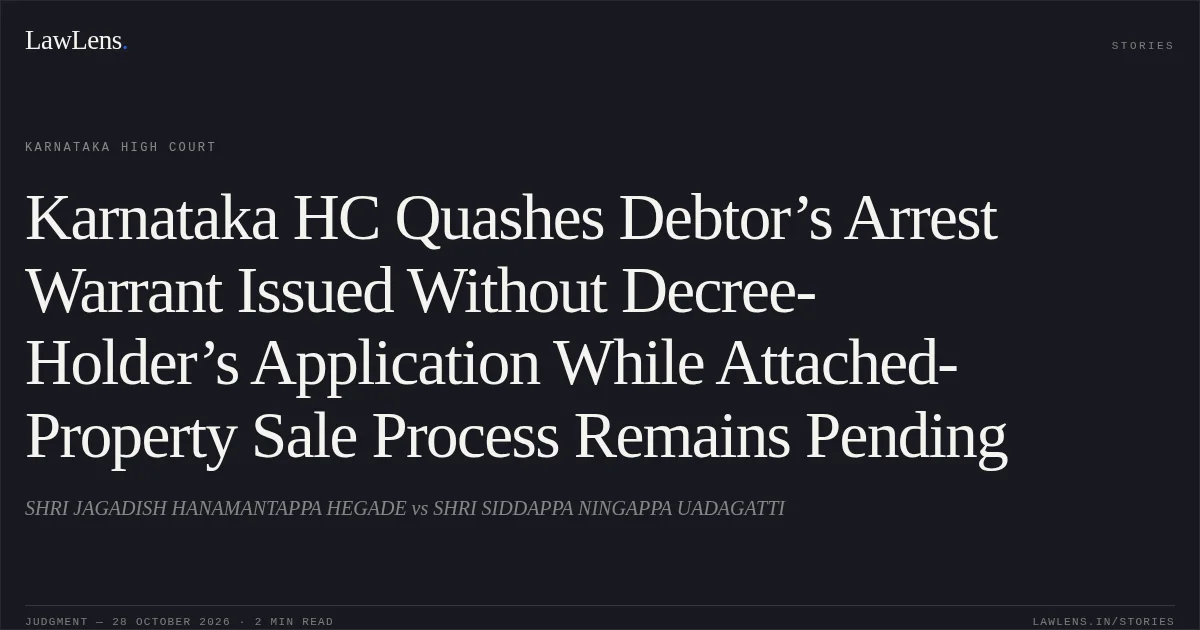
The petitioner was the judgment debtor in Execution Petition No. 23/2023. The decree-holder obtained attachment of the petitioner’s property, and the Executing Court directed the Tahsildar to sell it and deposit the proceeds towards the decree.
pp. 2–4While steps for sale remained pending, the Executing Court issued an arrest warrant against the petitioner on 3 October 2026. The petitioner challenged the warrant, contending that no application for arrest had been made and that the procedure governing arrest in execution had not been followed.
pp. 2–402Issues
i.1. Whether the Executing Court could issue an arrest warrant against the judgment debtor without an application seeking arrest and without following the procedure under Order XXI Rule 37 and Section 51 of the Code of Civil Procedure, 1908 (CPC).
pp. 4–5ii.2. Whether the arrest warrant should stand where attachment and sale of the judgment debtor’s property were already being pursued to satisfy the decree.
pp. 4–503Law Applied
Section 51 of the CPC and Order XXI Rule 37 govern arrest and detention of a judgment debtor in execution of a money decree; such coercive action must comply with the prescribed procedure and statutory safeguards.
pp. 5–7In Jolly George Varghese v. Bank of Cochin, AIR 1980 SC 470, the Supreme Court held that a person may not be imprisoned merely because of poverty or inability to pay: the law requires consideration of whether the failure to pay was wilful despite sufficient means, consistently with Article 21’s protection of dignity and fair procedure.
pp. 5–7Provisions in the judgment · 2 · Linked ones open on LawLens
Code of Civil Procedure, 1908 Section 51Section 21
04Reasoning
The order sheet showed that the Executing Court had already directed attachment and sale of the petitioner’s property, and that the sale process remained pending when the warrant was issued.
pp. 3–4The High Court considered the warrant against the procedural requirements of Section 51 and Order XXI Rule 37, together with the safeguards explained in Jolly George Varghese. It set the warrant aside and left open the possibility of a later arrest application, which the Executing Court would have to determine in accordance with law.
pp. 5–805Holding
The High Court allowed the writ petition and quashed the 3 October 2026 arrest-warrant order in Execution Petition No. 23/2023.
p. 8It directed the Executing Court to proceed with the existing attachment and sale orders. If an application for arrest is filed, the Executing Court must consider it in accordance with law and the principles in Jolly George Varghese.
p. 8Original Court PDF
SHRI JAGADISH HANAMANTAPPA HEGADEvsSHRI SIDDAPPA NINGAPPA UADAGATTI
Click to open original judgment
Original judgment, available to read, download and summarize on LawLens.in