01Facts
The petitioners claimed through 12 families of Sevadars to be entitled to land said to have been allotted jointly to 18 Sevadars by a Land Tribunal order dated 1 December 1981.
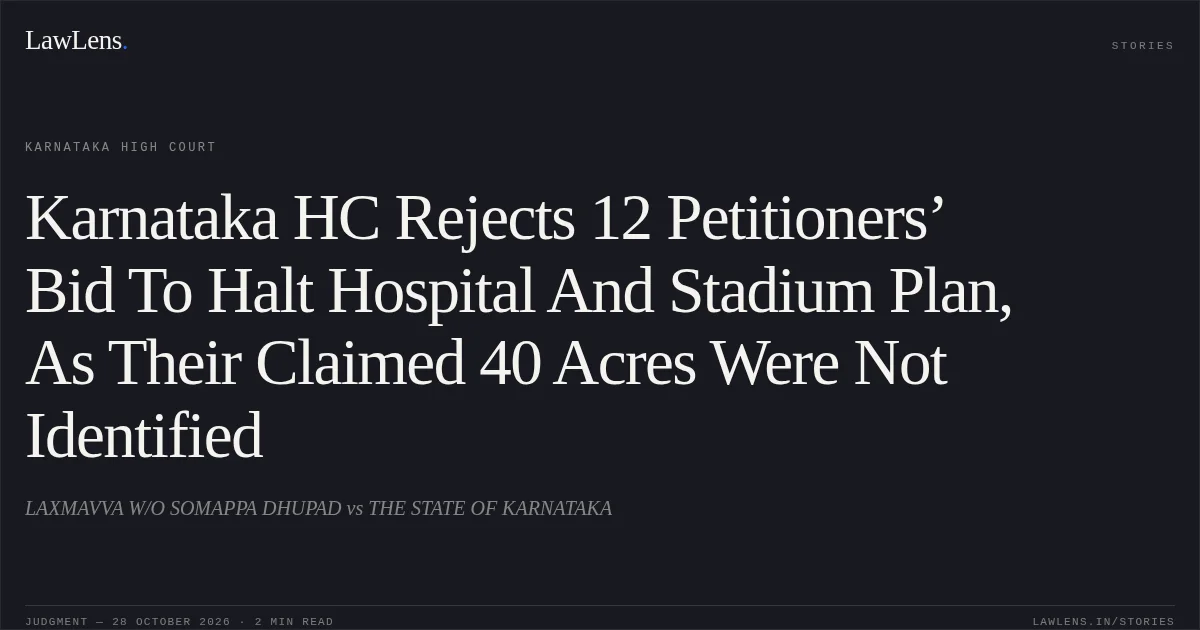
¶ 1–2.15They sought to quash a Government order dated 17 March 2026 and related survey maps, alleging that the State proposed to use land claimed by them for a hospital and stadium.
¶ 1–2.15The State disputed their tenancy, possession and title, and contended that the claimed land was not adequately identified and that no individual Form II occupancy certificates had been produced.
¶ 3.1–3.14The petitioners relied on the Tribunal order, mutation records, RTC extracts and an earlier State submission; the State disputed the effect of those materials.
¶ 4.1–4.7, 5.1–5.902Issues
i.1. Whether the petitioners established a prima facie right to specifically identifiable land sufficient to obtain relief under Articles 226 and 227 of the Constitution.
¶ 14–19ii.2. Whether the impugned Government order and survey maps should be quashed, or the State restrained from using the land, when the petitioners’ claimed rights, possession and the location of the land were disputed.
¶ 20–21, 29–3003Law Applied
Section 5 of the Karnataka Certain Inams Abolition Act, 1977, provides for registration as an occupant, subject to the statutory requirements, for qualifying tenants and persons rendering service to a religious institution who personally cultivated the land for the prescribed period.
¶ 22Rule 5 of the Karnataka Certain Inams Abolition Rules, 1979, contemplates a Form II certificate of registration identifying the land and relevant particulars.
¶ 24–25In proceedings under Article 226, a claimant seeking relief concerning land must establish a prima facie right to land that is sufficiently identified; disputed questions of title and possession may require adjudication by a competent civil court.
¶ 15, 19, 23, 31Provisions in the judgment · 1 · Linked ones open on LawLens
KARNATAKA CERTAIN INAMS ABOLITION ACT, 1977 Section 5
04Reasoning
The Court found that the 1981 order did not identify the location of the purported 40-acre allotment, while the petitioners’ records did not establish their individual entitlements or connect them to particular land within the larger survey extent.
¶ 8, 10–15The RTCs showed the Temple Committee and 18 Sevadars in joint possession, but did not identify the petitioners or specify their respective shares; the petitioners also produced no Form II certificates.
¶ 11–13, 24–26The earlier State sketch had been withdrawn, and the Court considered it insufficient to resolve the uncertainty in the land’s identification.
¶ 16, 19Given the disputed rights and absence of a prima facie case concerning a specifically identifiable parcel, the Court declined writ relief; it left any claim to be proved in civil proceedings and any compensation claim to follow if ownership were established.
¶ 19–21, 29, 31–3205Holding
The Court dismissed the writ petition and declined to quash the Government order or grant the requested restraint.
¶ 30It left the petitioners at liberty to establish their rights, title, interest and possession before a competent civil court and, if held to be owners in possession, to seek compensation in accordance with law.
¶ 31–32Original Court PDF
LAXMAVVA W/O SOMAPPA DHUPADvsTHE STATE OF KARNATAKA
Click to open original judgment
Original judgment, available to read, download and summarize on LawLens.in