Facts
An FIR was registered against respondents Nos. 2 and 3 under Sections 304-A, 427 and 34 IPC after the collapse of a room in the petitioner’s house during construction allegedly undertaken by the respondents, resulting in the death of the petitioner’s wife and injuries to a labourer.
Source reference: p.2During trial, the respondents examined a building expert and another defence witness, DW2 Birender Singh, and relied upon site plans to contend that the construction had been raised in accordance with a sanctioned site plan in 2005, rather than in 2014.
Source reference: p.2–3After the examination of DW2, the petitioner moved an application under Section 311 Cr.P.C. seeking examination of the record keeper of the District and Sessions Court, Rewari, along with the file of a contempt petition, and Rajesh Yadav, Advocate, who had acted as the local commissioner.
Source reference: p.3–4The trial Court dismissed the application on the ground that the prosecution had already been granted several opportunities to conclude its evidence and that the application was filed at a belated stage.
Source reference: p.4, 16The petitioner challenged that order under Section 482 Cr.P.C. before the High Court.
Source reference: p.1Issues
Whether the trial Court was justified in dismissing the application under Section 311 Cr.P.C. solely on the ground that the prosecution had been granted several opportunities and that the application was filed at a late stage?
Source reference: p.16–17Whether the evidence of the proposed witnesses and production of the relevant court record appeared essential for the just decision of the case?
Source reference: p.17–18Whether the High Court should exercise its inherent jurisdiction under Section 482 Cr.P.C. to set aside the trial Court’s order?
Source reference: p.1, 16–18Law Applied
The Court applied Section 311 Cr.P.C., which empowers a criminal court, at any stage of an inquiry or trial, to summon, examine, recall or re-examine a witness; where the evidence appears essential to the just decision of the case, the latter part of the provision imposes a mandatory obligation on the Court.
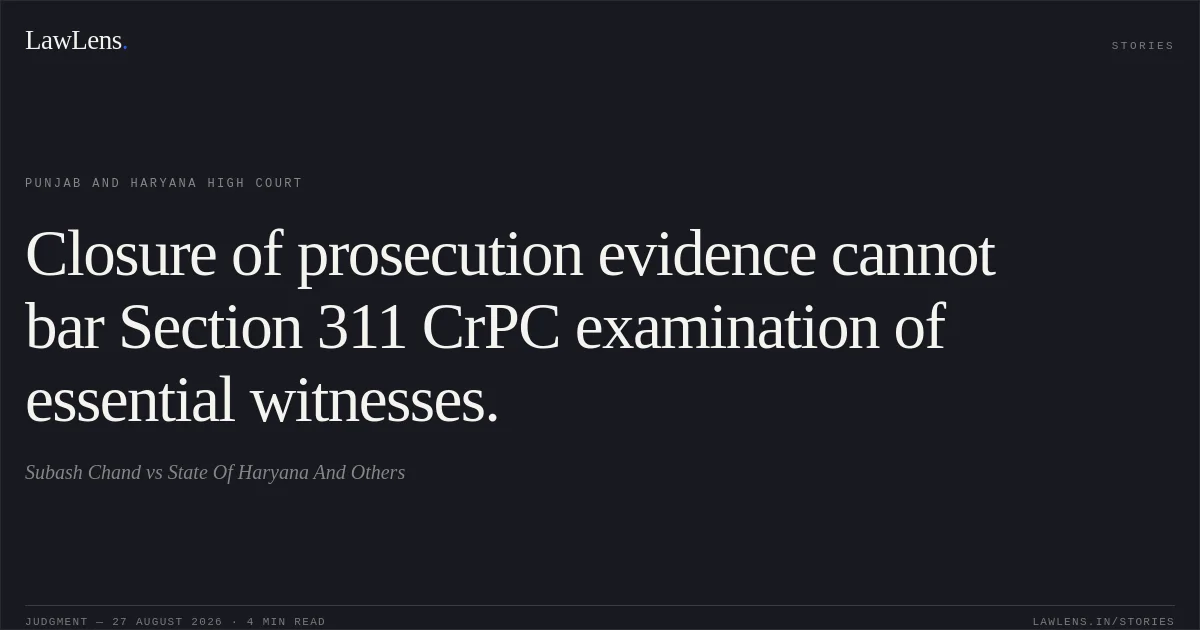
Source reference: p.5–6Relying principally on Varsha Garg v. State of Madhya Pradesh, Criminal Appeal No. 1021 of 2022, and the principles in Mohanlal Shamji Soni v. Union of India, Zahira Habibullah Sheikh v. State of Gujarat, Rajendra Prasad v. Narcotic Cell, and related authorities, the Court held that the power under Section 311 is available at any stage, even after closure of evidence, and that the decisive test is the essentiality of the proposed evidence for a just decision, not the mere belatedness of the application or the possibility that it may expose a lacuna.
Source reference: p.6–15The power must nevertheless be exercised judicially, cautiously and in furtherance of truth and fair trial, without permitting an abuse of process, retrial or serious prejudice to the accused.
Source reference: p.6–15The High Court’s inherent jurisdiction under Section 482 Cr.P.C. may be exercised to correct an unjust or non-speaking order and to secure the ends of justice.
Source reference: p.1, 16Reasoning
The High Court found that the trial Court had rejected the application solely because the prosecution had previously received opportunities to lead evidence, without examining whether the proposed evidence was essential to the just adjudication of the case.
Source reference: p.16–17This approach disregarded the mandatory aspect of Section 311 Cr.P.C. and the requirement that the Court determine the relevance and essentiality of the evidence rather than treat the stage of the trial as an absolute bar.
Source reference: p.16–17The proposed witnesses were connected with the local commissioner’s inspection, photographs and court record relied upon by the petitioner to rebut the defence that the construction had existed since 2005. Their evidence could therefore assist the Court in assessing the respondents’ defence concerning the date and legality of the construction.
Source reference: p.17–18The Court further held that any delay in moving the application, or the possibility of filling an evidentiary gap, was only a subsidiary consideration; the controlling question was whether the evidence was necessary for a just decision.
Source reference: p.16–18The trial Court’s non-speaking order accordingly reflected a failure to apply the statutory test and the governing Supreme Court precedents.
Source reference: p.16–18Holding
The High Court allowed the petition under Section 482 Cr.P.C. and set aside the trial Court’s order dated 26 February 2020 dismissing the Section 311 Cr.P.C. application.
It directed that the application be allowed and granted the petitioner one effective opportunity to examine the Record Keeper, District and Sessions Court, Rewari, with the relevant contempt petition file, and Rajesh Yadav, Advocate, the local commissioner.
Source reference: p.18The Court held that the proposed evidence could not be excluded merely on technical grounds of delay or prior opportunities where it appeared essential for the just decision of the case.
Source reference: p.16–18Original Court PDF
Subash ChandvsState Of Haryana And Others
Click to open original judgment
Original judgment, available to read, download and summarize on LawLens.in