Facts
The CBI registered an FIR against the petitioner and others for offences including conspiracy, cheating, forgery and corruption
Source reference: para. 4.1After the charge sheet, certain accused obtained permission to pursue plea bargaining; the petitioner’s challenge to that order was dismissed in a separate writ petition
Source reference: para. 4.2The petitioner then challenged orders dated 21 January and 14 February 2020 by which the trial court permitted respondents 2–4 to be tendered pardon under Section 306 CrPC.
Source reference: paras. 2, 5–8He contended that the orders were mechanical and prejudicial to him as a co-accused
Source reference: paras. 2, 5–8The CBI opposed the petition, arguing that a co-accused had no right to participate in an application for pardon
Source reference: paras. 9–10Issues
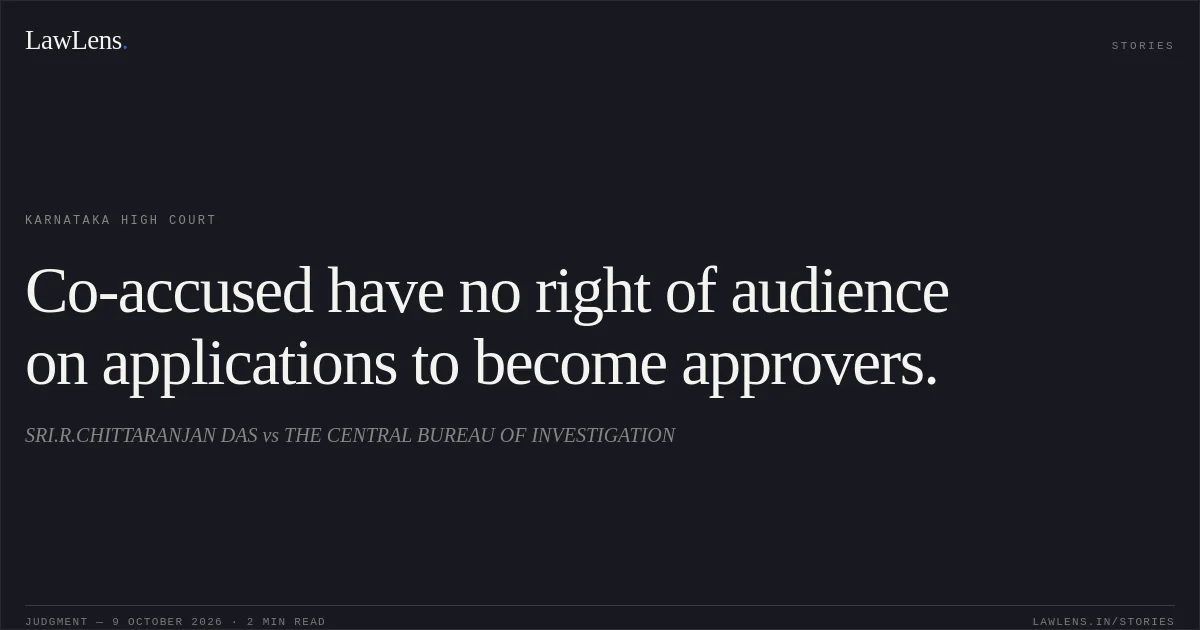
1. Whether a co-accused has a right to be heard on another accused’s application to be tendered pardon under Sections 306 or 307 CrPC
Source reference: paras. 12–152. Whether the trial court’s orders granting pardon to respondents 2–4 disclosed legal infirmity or perversity warranting interference
Source reference: paras. 5, 18Law Applied
Sections 306 and 307 CrPC govern the tender of pardon to an accused who makes a full and true disclosure; the process concerns the court, the accused seeking pardon and the prosecution, and does not provide a co-accused with a right of audience on the application
Source reference: paras. 12–15Relying on Lt. Commander Pascal Fernandes v. State of Maharashtra, AIR 1968 SC 594, and CBI v. Ashok Kumar Aggarwal, (2013) 15 SCC 222, the Court noted that granting pardon is a judicial act and that the court should obtain the prosecution’s position and consider the relevant circumstances, including the proposed approver’s culpability and the interests of justice
Source reference: paras. 7, 10, 19–21A co-accused may challenge an approver’s credibility through cross-examination, including by resort to Section 146 of the Evidence Act
Source reference: paras. 16–17Reasoning
The Court treated the pardon application as a matter within the statutory process involving the accused seeking pardon, the prosecution and the trial court; Sections 306 and 307 CrPC did not confer a right of audience on the petitioner
Source reference: paras. 12–15It distinguished the petitioner’s concern that an approver might give evidence against him from any entitlement to oppose the pardon application: the petitioner could test the approver’s credibility at trial by cross-examination
Source reference: paras. 16–17Although the petitioner relied on Ashok Kumar Aggarwal to allege mechanical decision-making, the Court found no legal infirmity or perversity in the impugned orders warranting interference
Source reference: paras. 18–21Holding
The Court dismissed the writ petition and reserved the petitioner’s right to cross-examine the accused who had been permitted to turn approvers
Acts & Sections Cited
8 provisions across 4 statutes referred to in this judgment. Each provision opens on LawLens.
Code of Criminal Procedure, 19733
Indian Penal Code, 18603
Prevention of Corruption Act, 19881
Hindu Succession Act, 19561
Original Court PDF
SRI.R.CHITTARANJAN DASvsTHE CENTRAL BUREAU OF INVESTIGATION
Click to open original judgment
Original judgment, available to read, download and summarize on LawLens.in