Facts
Crime No. 34/2021 was registered at Police Station Niwari for offences under Sections 376 and 506 IPC based on an FIR dated 29 October 2021 concerning an alleged incident of 11 October 2021.
Source reference: para. 2After filing of the charge-sheet, the applicant was released on bail and participated in the trial for several years.
Source reference: para. 2During the trial, he allegedly suffered a brain haemorrhage and underwent treatment and hospitalisation in Delhi. He consequently remained absent on certain dates, resulting in the issuance of warrants and thereafter a permanent warrant.
Source reference: para. 3The applicant sought cancellation/recall of the warrant under Section 70(2) CrPC, corresponding to Section 72(2) BNSS, but the trial Court rejected his application on 25 May 2026.
Source reference: paras. 1, 3The trial Court noted that the applicant had last appeared on 9 September 2025, whereas the medical documents reflected treatment only from 20 November 2025 and hospitalisation from 31 December 2025 to 4 January 2026; therefore, the documents did not explain the entire period of absence.
Source reference: para. 7The applicant challenged that order under Section 528 BNSS read with Section 482 CrPC.
Source reference: para. 1Issues
Whether the High Court should interfere with the trial Court’s refusal to recall the warrant issued against the applicant under Section 70(2) CrPC/Section 72(2) BNSS?
Source reference: paras. 1, 6–8Whether, despite the applicant’s failure to explain every date of absence, the warrant could be recalled where he had remained on bail, had substantially participated in the trial, and could be subjected to conditions securing his future attendance?
Source reference: paras. 8–13Law Applied
The Court exercised its inherent jurisdiction under Section 528 BNSS read with Section 482 CrPC to secure the ends of justice and prevent abuse of process.
Source reference: para. 1It considered Section 70(2) CrPC, corresponding to Section 72(2) BNSS, governing cancellation or recall of a warrant.
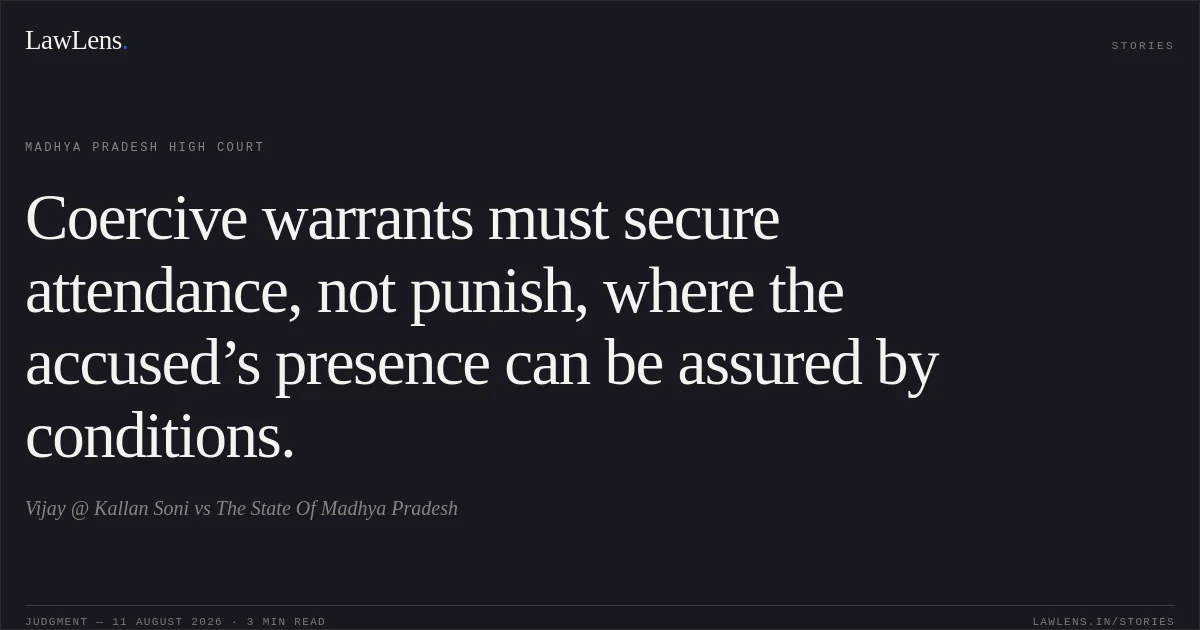
Source reference: paras. 1, 7The governing principle is that a warrant is issued to secure the appearance of an accused and not to punish him for a default in appearance.
Source reference: para. 8In Inder Mohan Goswami v. State of Uttaranchal, (2007) 12 SCC 1, the Supreme Court held that coercive processes should be issued and continued only for securing attendance and not as punitive measures.
Source reference: para. 9In Satender Kumar Antil v. CBI, (2022) 10 SCC 51, the Supreme Court reiterated that criminal courts should adopt a liberal and pragmatic approach where the accused does not appear to be evading the process of law and attendance can be secured through less restrictive conditions.
Source reference: para. 9Reasoning
The High Court accepted that the trial Court’s observation regarding the incomplete explanation of the applicant’s absence was not wholly unfounded.
Source reference: para. 8However, the applicant had faced trial since 2021, remained on bail, substantially participated in the proceedings, and had not misused his liberty or attempted to evade the process of law.
Source reference: para. 8Since the trial had reached the stage of final arguments, the Court considered that his prior conduct and the advanced stage of the proceedings weighed in favour of recalling the warrant.
Source reference: no citationApplying the principle that warrants are coercive measures intended only to secure attendance, the Court held that the applicant’s attendance could be adequately secured through conditions rather than continued coercive proceedings.
Source reference: paras. 8–11The Court therefore substituted the trial Court’s discretion in order to secure the ends of justice, while preserving the trial Court’s power to proceed according to law in the event of any future default.
Source reference: para. 12Holding
The petition was allowed and the trial Court’s order dated 25 May 2026 was set aside.
The permanent warrant issued against the applicant was recalled, subject to his appearing before the trial Court within fifteen days from receipt of the certified copy of the order and furnishing fresh bail bonds to the satisfaction of the trial Court.
Source reference: para. 13He was directed to remain present on all subsequent dates and not seek unnecessary adjournments.
Source reference: para. 13The trial Court was permitted to proceed in accordance with law if the applicant committed any future default.
Source reference: para. 13Acts & Sections Cited
6 provisions across 3 statutes referred to in this judgment. Each provision opens on LawLens.
Bharatiya Nagarik Suraksha Sanhita, 20232
Code of Criminal Procedure, 19732
Indian Penal Code, 18602
Original Court PDF
Vijay @ Kallan SonivsThe State Of Madhya Pradesh
Click to open original judgment
Original judgment, available to read, download and summarize on LawLens.in