Facts
The claimant sustained serious head injuries in a collision between his motorcycle and a tipper lorry on 1 March 2017.
Source reference: p. 3–6He sought compensation under Section 166 of the Motor Vehicles Act, 1988.
Source reference: p. 3–6The Tribunal awarded ₹8,71,462, including compensation for loss of earning capacity based on 20% disability and monthly income of ₹13,350.
Source reference: p. 3–6The insurer appealed the quantum; the claimant had not filed a cross-appeal or cross-objection but sought enhancement in response to the appeal.
Source reference: p. 3–6The High Court considered the medical evidence of cognitive disability and seizure-related disability, the assessment of income, and the other compensation heads.
Source reference: p. 7–13Issues
1. Whether the compensation awarded by the Tribunal required modification, including correction of the income and disability assessments and the amounts awarded under other heads.
Source reference: p. 7; para. 142. Whether the claimant could receive enhanced compensation despite not filing a cross-appeal or cross-objection.
Source reference: p. 10–11; paras. 21–23Law Applied
Under Section 166 of the Motor Vehicles Act, compensation must be just and reasonable; an appeal against a Tribunal award lies under Section 173(1).
Source reference: p. 2–3Order XLI Rules 22 and 33 of the Code of Civil Procedure permit a court, in appropriate circumstances, to grant a respondent relief even without a cross-appeal or cross-objection where the Tribunal’s award is not just and reasonable; the Court relied on Ranjana Prakash v. Divisional Manager, (2011) 14 SCC 639.
Source reference: p. 10–11For loss of earning capacity, the Court applied the multiplier method, used the KSLSA notional-income chart in the absence of income proof, and assessed disability by reference to the medical evidence.
Source reference: p. 11–12Reasoning
The doctor’s evidence supported 21.7% cognitive disability, which the insurer did not dispute, but the evidence showed only one seizure episode in January 2018 and no subsequent documented seizure before the doctor’s evidence.
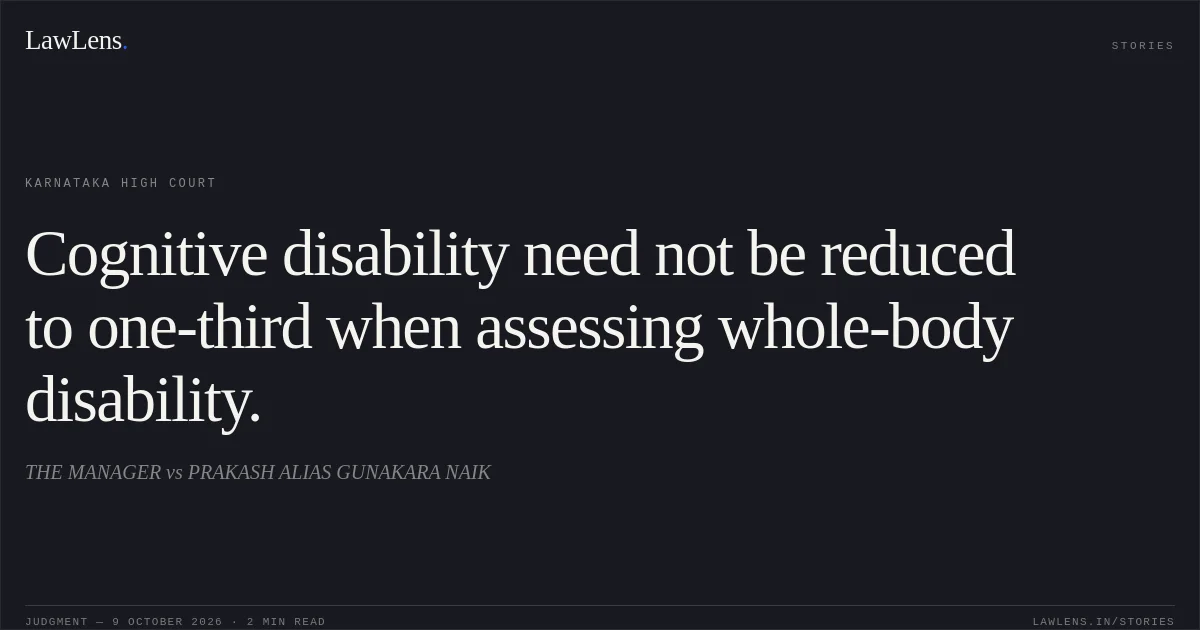
Source reference: p. 8–10; paras. 18–20The Court therefore rejected the separate 25% seizure-related disability and used 21.7% cognitive disability, declining to reduce it to one-third because it was cognitive rather than a disability confined to a particular limb.
Source reference: p. 8–10; paras. 18–20As the claimant had produced no proof of income, the Court substituted the KSLSA-chart figure of ₹11,000 per month for the Tribunal’s ₹13,350.
Source reference: p. 11–12; para. 25It retained the 40% addition for future prospects, the age-based multiplier of 15, and recalculated loss of earning capacity at ₹6,01,524.
Source reference: p. 11–12; para. 25It reduced laid-up-period income to ₹33,000, enhanced loss of amenities to ₹50,000, and left the remaining heads unchanged.
Source reference: p. 11–13; paras. 25–27The Court held that enhancement could be considered under the CPC principles it relied upon, notwithstanding the claimant’s failure to cross-appeal.
Source reference: p. 10–13; paras. 21–27Holding
The appeal was allowed in part.
The Tribunal’s award was modified, reducing the total compensation from ₹8,71,462 to ₹8,23,096, with the Tribunal’s other findings left undisturbed.
Source reference: p. 13–14; para. 28The insurer was directed to deposit the compensation with accrued interest within eight weeks; disbursement and deposit were to follow the Tribunal’s order.
Source reference: p. 13–14; para. 28The Court made no order as to costs.
Source reference: p. 13–14; para. 28Acts & Sections Cited
2 provisions across 1 statute referred to in this judgment. Each provision opens on LawLens.
Motor Vehicles Act, 19882
Original Court PDF
THE MANAGERvsPRAKASH ALIAS GUNAKARA NAIK
Click to open original judgment
Original judgment, available to read, download and summarize on LawLens.in