Facts
The petitioner is the MD & CEO of LIC Housing Finance Ltd. (LIC HFL), based in Mumbai
Source reference: p.1, 3The complainant alleged that in 2017, agents of LIC HFL (accused nos. 2-6) induced her to take a housing loan, misappropriated 14 signed cheques, and diverted loan funds
Source reference: para. 4The petitioner joined the company as Director only on 01.02.2021
Source reference: para. 8A loan was sanctioned in 2016, but the borrowers defaulted, leading LIC HFL to issue a SARFAESI demand notice in 2022
Source reference: para. 7Following this notice, the complainant filed a criminal complaint in 2023. The Judicial Magistrate, 1st Class, took cognizance under Sections 406 and 34 of the IPC via order dated 27.02.2023
Source reference: para. 2Issues
1. Whether the criminal proceedings are maintainable given the significant delay in filing and the bar of limitation under Section 468 Cr.PC
Source reference: para. 162. Whether the MD & CEO can be held vicariously liable for the company's acts without specific allegations or the company being named as an accused
Source reference: para. 11, 203. Whether the Magistrate complied with the mandatory inquiry requirements under Section 202 Cr.PC for accused residing outside the jurisdiction
Source reference: para. 18Law Applied
Section 406 of the IPC regarding criminal breach of trust
Source reference: para. 14Section 468 of the Cr.PC, which imposes a three-year limitation period for offences punishable with up to three years
Source reference: para. 16Sarah Mathew v. Institute of Cardio Vascular Diseases, establishing that limitation is computed from the date of filing
Source reference: para. 16Pepsi Foods Ltd. v. Judicial Magistrate, summoning an accused requires a speaking order reflecting the application of mind
Source reference: para. 17Vijay Dhanuka v. Najima Mamtaj mandates an inquiry under Section 202 Cr.PC when an accused resides outside the court's territorial jurisdiction
Source reference: para. 18R. Kalyani v. Janak C. Mehta establishes that corporate officers cannot be held vicariously liable unless the company is an accused and specific roles are pleaded
Source reference: para. 20Reasoning
The Court observed that the alleged misappropriation occurred in 2017, but the complaint was filed in 2023, exceeding the three-year limitation period under Section 468 Cr.PC
Source reference: para. 16Factually, the petitioner was not even in office at the time of the alleged incident, having joined in 2021
Source reference: para. 8The Court found the dispute to be a "civil dispute converted into criminal cases" following loan default and SARFAESI proceedings
Source reference: para. 15Legally, the summoning order was "non-speaking" and failed to justify the petitioner's individual liability
Source reference: para. 17Furthermore, as the petitioner resided in Mumbai, the Magistrate's failure to conduct a mandatory inquiry under Section 202 Cr.PC invalidated the process
Source reference: para. 18-19The Court also highlighted that the corporate entity (LIC HFL) was not made a party, which is a prerequisite for proceeding against its officers for corporate acts
Source reference: para. 20Holding
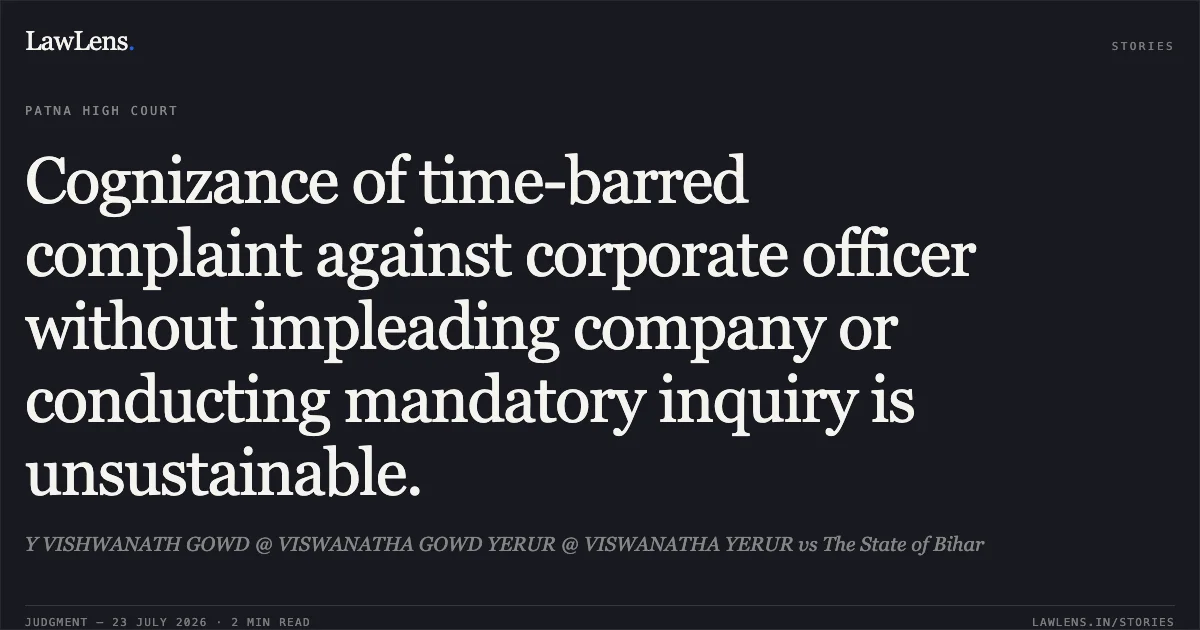
The Court held that the Magistrate lacked competence because the complaint was prima facie time-barred and the order lacked the necessary legal reasoning and mandatory inquiry
The Court allowed the petition and quashed the cognizance order dated 27.02.2023 against all accused persons. The accused are discharged from the burden of Complaint Case No. 174 of 2023
Source reference: para. 22Acts & Sections Cited
9 provisions across 2 statutes referred to in this judgment. Each provision opens on LawLens.
Indian Penal Code, 18604
Code of Criminal Procedure, 19735
Original Court PDF
Y VISHWANATH GOWD @ VISWANATHA GOWD YERUR @ VISWANATHA YERURvsThe State of Bihar
Click to open original judgment
Original judgment, available to read, download and summarize on LawLens.in