Facts
Respondent No. 2 filed a private complaint alleging that, during the by-election at Polling Station, Andhupura, on 13 November 2024, the appellants formed an unlawful assembly, committed electoral malpractice, physically assaulted him, and hurled caste-based abuses at him in public view.
Source reference: para. 4An inquiry conducted by the Sub-Divisional Officer of Police, Vijaypur, concluded that the alleged incident had not occurred and that the allegations were false.
Source reference: para. 4Nevertheless, after recording the statements of the complainant and his witnesses, the Special Judge (Atrocities), Sheopur, took cognizance of offences under Section 115(2) of the Bharatiya Nyaya Sanhita, 2023, read with Section 3(2)(va) of the Scheduled Castes and the Scheduled Tribes (Prevention of Atrocities) Act, 1989, and issued bailable warrants against the appellants by order dated 9 December 2025.
Source reference: paras. 3–4The appellants challenged that order under Section 14-A(1) of the 1989 Act, principally contending that they had not been afforded an opportunity of hearing before cognizance was taken, as mandated by the first proviso to Section 223(1) of the Bharatiya Nagarik Suraksha Sanhita, 2023 (“BNSS”).
Source reference: paras. 5, 8Issues
Whether the Special Court could take cognizance of the private complaint without first granting the appellants an opportunity of hearing under the first proviso to Section 223(1) of the BNSS?
Source reference: paras. 8–10Whether cognizance taken and bailable warrants issued without compliance with the statutory hearing requirement were liable to be quashed and the matter remanded for fresh consideration?
Source reference: paras. 11–14Law Applied
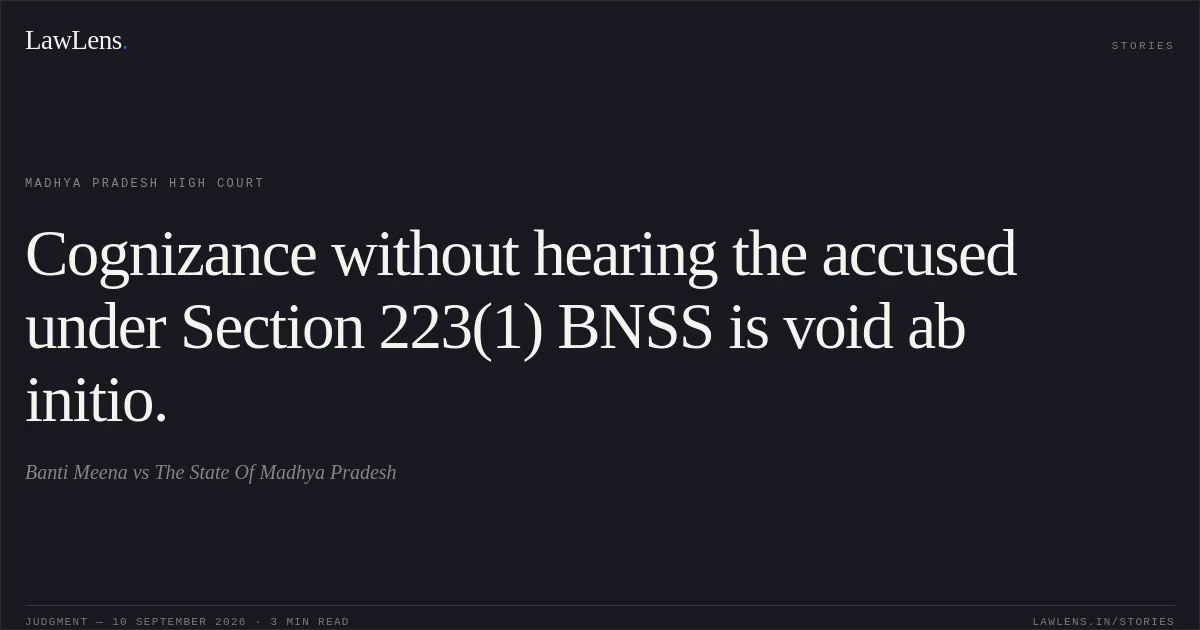
The Court applied the first proviso to Section 223(1) of the BNSS, which prohibits a Magistrate from taking cognizance of an offence on complaint without giving the accused an opportunity of being heard.
Source reference: para. 9The Court held that this proviso incorporates the principle of audi alteram partem at the pre-cognizance stage, confers a substantive right connected with the accused’s right to a fair trial under Article 21 of the Constitution, and is mandatory because of the use of the word “shall”.
Source reference: para. 10; para. 11Relying on Parvinder Singh v. Directorate of Enforcement, 2026 LiveLaw (SC) 522, the Court held that cognizance taken without compliance with the proviso is void ab initio.
Source reference: para. 11The Court also proceeded under Section 14-A(1) of the Scheduled Castes and the Scheduled Tribes (Prevention of Atrocities) Act, 1989, which provides the appellate remedy against orders of a Special Court under the Act.
Source reference: para. 3Reasoning
The impugned order showed that the Special Court recorded the complainant’s and witnesses’ statements and proceeded directly to take cognizance and issue bailable warrants, without issuing prior notice to or hearing the appellants.
Source reference: para. 12Since Section 223(1) of the BNSS expressly requires an opportunity of hearing before cognizance is taken, and the Supreme Court in Parvinder Singh had characterized the requirement as mandatory and substantive, the omission constituted a patent procedural illegality.
Source reference: paras. 10–13The Court therefore held that the merits of the allegations, including the SDOP’s conclusion that the complaint was false, could not be adjudicated at this stage; the defect lay in the failure to follow the mandatory pre-cognizance procedure.
Source reference: paras. 4, 13, 16Holding
The appeal was allowed.
The order dated 9 December 2025 taking cognizance and issuing bailable warrants against the appellants was quashed and set aside.
Source reference: para. 14(1)The matter was remanded to the Special Judge (Atrocities), Sheopur, with directions to issue formal notice to the appellants, afford them a fair and proper opportunity of hearing in compliance with the first proviso to Section 223(1) of the BNSS, and thereafter pass a fresh, reasoned order on cognizance independently and in accordance with law.
Source reference: para. 14(2)The Court clarified that it had expressed no opinion on the merits of the allegations.
Source reference: para. 16Acts & Sections Cited
4 provisions across 3 statutes referred to in this judgment. Each provision opens on LawLens.
Scheduled Castes and the Scheduled Tribes (Prevention of Atrocities) Act, 19891
Bharatiya Nyaya Sanhita, 20231
Bharatiya Nagarik Suraksha Sanhita, 20232
Original Court PDF
Banti MeenavsThe State Of Madhya Pradesh
Click to open original judgment
Original judgment, available to read, download and summarize on LawLens.in