Facts
The petitioner applied for the post of Accountant/Cost Accountant, T & S Grade ‘A’, in Eastern Coalfields Limited (ECL), and was included in the provisional selection list published on 13 November 2021, subject to medical fitness.
Source reference: para. 5; para. 22On 16 December 2021, ECL informed him that he had been declared unfit for employment solely due to colour blindness.
Source reference: para. 3He challenged the decision, contending that the Medical Attendance Rules of Coal India Limited (MAR) prescribed colour-blindness testing for Group A employees directly connected with mining, but not for Group B employees, and that his accounting duties were office-based.
Source reference: paras. 8–14The respondents argued, among other things, that the post required effective colour discrimination, that the Mines Act and Mines Rules applied, and that the selection panel had expired.
Source reference: paras. 16–18Issues
1. Whether the petitioner’s post, described as “T & S Gr. ‘A’,” placed him in Group A under the MAR’s functional classification for medical standards.
Source reference: paras. 23, 25, 282. Whether colour blindness, by itself, disqualified the petitioner from appointment as an Accountant/Cost Accountant under the applicable rules.
Source reference: paras. 23–243. Whether the nature of the post established a functional requirement for effective colour discrimination sufficient to justify the petitioner’s rejection.
Source reference: paras. 23, 29, 36Law Applied
Chapter VIII, clause 1 of the MAR distinguishes Group A employees—those directly connected with mining and specified allied functions—from Group B employees, who fall outside Group A; the Court treated colour-blindness testing as part of the physical standard prescribed for Group A, not as a universal disqualification.
Source reference: paras. 20–21, 25–27The Court also considered the Mines Rules, 1955, including Form P-I, as permitting colour-blindness testing in special cases where the job requires good colour discrimination, making the requirement dependent on the function performed.
Source reference: para. 34Applying Nandkumar Narayanrao Ghodmare v. State of Maharashtra, (1995) 6 SCC 720, and the cited Calcutta High Court decisions in Pradip Kumar Maji v. Coal India Limited and Ashes Kumar Roy v. Coal India Limited, the Court held that colour blindness is not an automatic bar absent a demonstrated nexus with the duties of the post.
Source reference: paras. 30–33It further applied the principles of fairness and non-arbitrariness under Articles 14 and 16, and the rule that recruitment criteria should not be altered to a candidate’s detriment after the process has commenced.
Source reference: paras. 38, 43Reasoning
The Court construed the MAR’s Group A and Group B categories by reference to the employee’s functions, holding that “T & S Gr. ‘A’” was a service or grade designation and did not automatically make the post Group A for medical purposes.
Source reference: paras. 25, 28The Accountant/Cost Accountant role was office-based, and the respondents produced no job description, recruitment condition, or contemporaneous material showing that colour discrimination was essential to its duties.
Source reference: para. 29The Court found that neither the Mines Act’s broad definition of a mine nor the later clarification of 3 August 2022 established an automatic disqualification; the latter could not retrospectively impose a new requirement.
Source reference: paras. 34–37Although inclusion in a selection list does not create an indefeasible right to appointment, that principle did not validate rejection on a ground contrary to the applicable rules.
Source reference: paras. 40–41The rejection therefore lacked a demonstrated functional basis and was arbitrary.
Source reference: paras. 42–45Holding
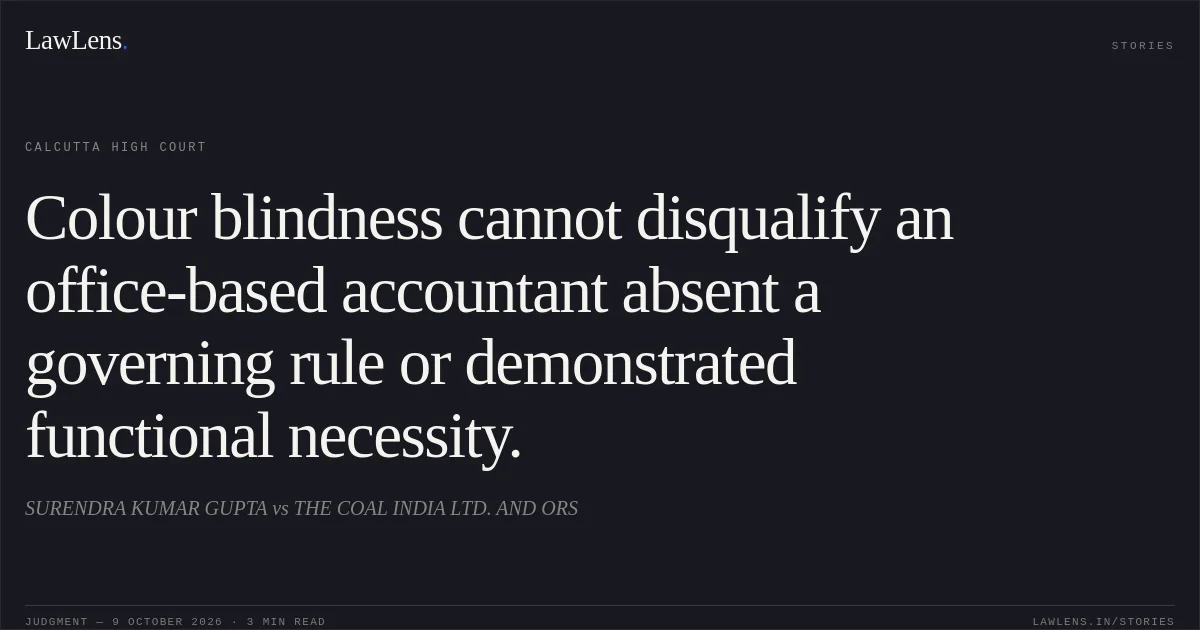
The Court held that the petitioner could not be treated as a Group A employee merely because the post was designated “T & S Gr. ‘A’,” and that colour blindness, by itself, was not a disqualification for the accounting post under the applicable MAR.
It set aside the 16 December 2021 unfitness decision and directed the respondents to give effect to the petitioner’s provisional selection, treating colour blindness alone as no bar to appointment, and to take the necessary steps to issue an appointment letter within four weeks of communication of the order.
Source reference: para. 49The writ petition was allowed.
Source reference: paras. 48–50Original Court PDF
SURENDRA KUMAR GUPTAvsTHE COAL INDIA LTD. AND ORS
Click to open original judgment
Original judgment, available to read, download and summarize on LawLens.in