Facts
The Petitioner, a public servant, was subjected to a CBI search on 24.11.1995 in connection with an RC against his wife.
Source reference: p.1, 6Documents seized suggested the Petitioner was running a private business, "M/s Jitendra Builders," in violation of service rules.
Source reference: p.6Based on intelligence and these documents, a Preliminary Enquiry (PE) was registered on 23.12.1996.
Source reference: p.2, 7Investigation was permitted under Section 155(2) Cr.P.C. on 29.07.1997 because the alleged offence under Section 168 IPC is non-cognizable.
Source reference: p.2The CBI filed a chargesheet on 28.07.1998 for Section 168 IPC, along with an application to condone a purported 1.5-month delay.
Source reference: p.2The Trial Court condoned the delay multiple times, leading to several rounds of litigation, including a remand by the Supreme Court.
Source reference: p.3, 6The Petitioner challenged the latest order dated 12.04.2004, which condoned the delay and took cognizance under Sections 168 and 419 IPC.
Source reference: p.6Issues
Whether the period of limitation for filing the chargesheet commenced from the date of the search/seizure of documents or the date of registration of the RC.
Source reference: p.4, 8Whether the delay in filing the chargesheet was adequately explained to warrant condonation under Section 473 Cr.P.C.
Source reference: p.9, 12Whether the prosecution could invoke Section 419 IPC at a later stage solely to circumvent the barred limitation period for Section 168 IPC.
Source reference: p.11Law Applied
The court primarily applied Section 468 Cr.P.C., which mandates a one-year limitation for offences punishable by imprisonment up to one year, such as Section 168 IPC.
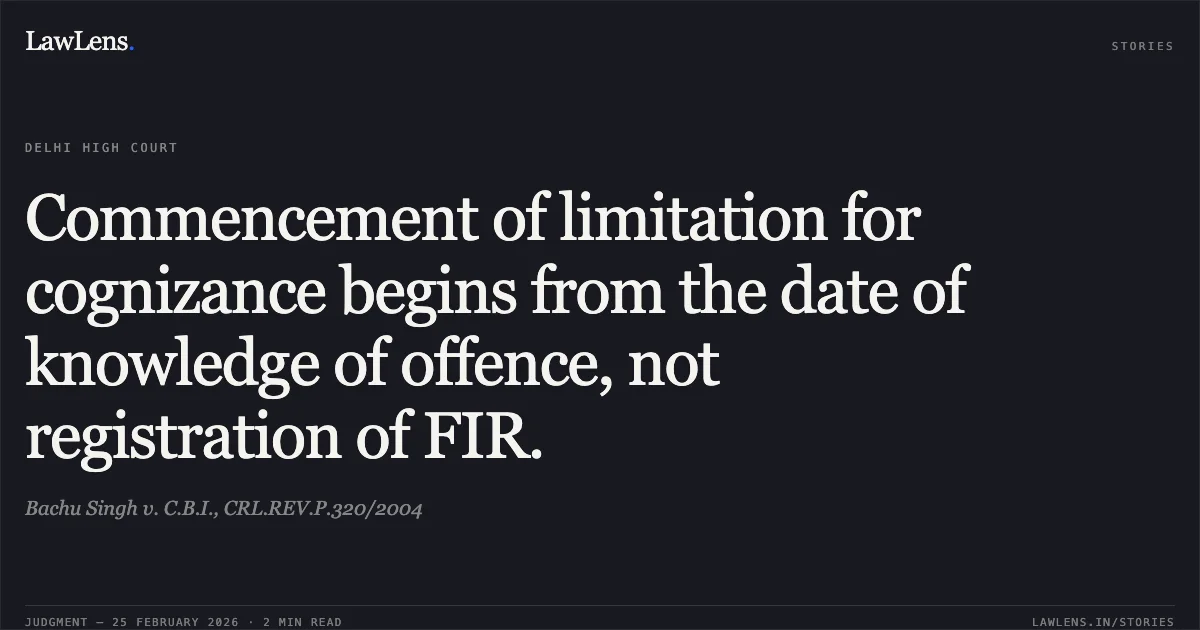
Source reference: p.7-8It relied on Section 469 Cr.P.C. to determine the commencement of limitation, specifically noting that the period begins on the day the offence/offender comes to the knowledge of the police officer.
Source reference: p.8The court also examined Section 155(2) Cr.P.C. regarding the investigation of non-cognizable cases and the principles for condonation of delay under Section 473 Cr.P.C.
Source reference: p.2, 4Reasoning
The Court found that the CBI had knowledge of the alleged offence as early as 24.11.1995 (search date) or at the latest by 01.02.1996 (bank document collection), making the 28.07.1998 filing delayed by over two years rather than the 1.5 months claimed.
Source reference: p.8-9, 12The court rejected the CBI’s argument that the delay was due to waiting for a CFSL Report, stating that such reports are corroborative and do not prevent the filing of a chargesheet when the documents themselves disclosed the offence.
Source reference: p.10Regarding the addition of Section 419 IPC (cheating by personation), the court observed that no supplementary chargesheet was filed and there was no evidence that "Jitender Singh" was a non-existent person or a fake name used by the Petitioner.
Source reference: p.10-11The court concluded that the application for Section 419 IPC was a strategic move by the CBI to bypass the limitation bar of Section 168 IPC.
Source reference: p.11Holding
The Court answered that the limitation period commenced in late 1995/early 1996 and had expired long before the chargesheet was filed in 1998.
It held that the CBI failed to provide a cogent explanation for the delay of over two years.
Source reference: p.12Consequently, the Court set aside the Trial Court's order dated 12.04.2004, quashed the chargesheet as being barred by time, and allowed the Revision Petition.
Source reference: p.12Acts & Sections Cited
12 provisions across 3 statutes referred to in this judgment. Each provision opens on LawLens.
Indian Penal Code, 18603
Prevention of Corruption Act, 19881
Code of Criminal Procedure, 19738
Original Court PDF
Bachu Singh v. C.B.I., CRL.REV.P.320/2004
Click to open original judgment
Original judgment, available to read, download and summarize on LawLens.in