Facts
Respondent No. 2, Pankaj Sharma, filed a complaint under Section 138 of the Negotiable Instruments Act, 1881 (“NI Act”) against Manjula Kapoor, alleging that Cine Prime Entertainment owed him ₹5,00,000 for services rendered and that Kapoor, its director and authorised signatory, had issued a company cheque towards that liability.
Source reference: pp. 2–3; para. 2The cheque was dishonoured with the remark “payment stopped by drawer”; the statutory demand notice was served only on Kapoor and not on the Company.
Source reference: pp. 2–3, 6–7; paras. 2–3, 8The Magistrate took cognizance and summoned Kapoor. When the matter reached the stage of recording her statement under Section 313 of the Code of Criminal Procedure, 1973 (“CrPC”), Kapoor sought quashing on the ground that the Company, on whose bank account the cheque was drawn, had not been arraigned as an accused, relying on Aneeta Hada v. Godfather Travels & Tours (P) Ltd.
Source reference: pp. 3–4; para. 3The High Court accepted the applicability of Aneeta Hada but directed the Trial Court to implead the Company suo motu under Section 319 CrPC and conduct a de novo trial. Kapoor appealed to the Supreme Court.
Source reference: pp. 4–6; paras. 3–4Issues
1. Whether prosecution of a director or authorised signatory under Sections 138 and 141 of the NI Act is maintainable when the company on whose account the cheque was drawn has not been arraigned as an accused.
Source reference: pp. 9–12; paras. 10–112. Whether the Court can invoke Section 319 CrPC to implead the company as an accused after the statutory limitation period under Section 142 of the NI Act has expired, thereby curing the complaint’s failure to implead the company at its inception.
Source reference: pp. 12–15; paras. 12–153. Whether the complaint and consequential proceedings were liable to be quashed for want of valid cognizance.
Source reference: pp. 14–16; paras. 14–17Law Applied
Section 138 of the NI Act applies to the person who draws a cheque on an account maintained by that person and which is dishonoured in the circumstances specified by the provision.
Source reference: pp. 7–10; paras. 9–11Where the cheque is drawn on a company’s bank account, the company is the principal offender for purposes of Section 138.
Source reference: pp. 7–10; paras. 9–11Section 141 creates vicarious liability for persons in charge of and responsible for the company’s business, but, under the three-Judge Bench decision in Aneeta Hada v. Godfather Travels & Tours (P) Ltd., (2012) 5 SCC 661, arraignment of the company is a mandatory condition precedent for prosecuting such persons under Section 141.
Source reference: pp. 10–12; para. 11Section 142 of the NI Act prescribes the conditions and limitation for taking cognizance of a Section 138 offence, subject to condonation where sufficient cause is shown.
Source reference: pp. 12–14; para. 12Section 319 CrPC cannot be used to initiate prosecution against the company beyond the limitation period or to cure a fundamental defect where no valid cognizance could originally have been taken; the Court relied on N. Harihara Krishnan v. J. Thomas, (2018) 13 SCC 663.
Source reference: p. 15; para. 15Reasoning
The cheque was drawn on the Company’s account and was allegedly issued to discharge the Company’s liability; therefore, the Company—not merely its authorised signatory—was the person that committed the Section 138 offence.
Source reference: pp. 6–7, 9–11; paras. 8–11Under Aneeta Hada, the Company’s prosecution was indispensable before vicarious liability could attach to Kapoor under Section 141.
Source reference: pp. 6–7, 11–14; paras. 8, 11, 14Since the complaint neither impleaded the Company nor served the statutory demand notice upon it, the complaint suffered from a fundamental defect and the Magistrate could not validly take cognizance against Kapoor alone.
Source reference: pp. 6–7, 11–14; paras. 8, 11, 14The High Court’s direction to invoke Section 319 CrPC could not revive or validate a complaint in respect of which cognizance was legally impermissible from the outset.
Source reference: p. 15; para. 15Such use of Section 319 would also circumvent the limitation framework under Section 142 of the NI Act.
Source reference: p. 15; para. 15The proper course, if otherwise within limitation or supported by sufficient cause for delay, was filing a fresh complaint after impleading the Company.
Source reference: p. 15; para. 15Holding
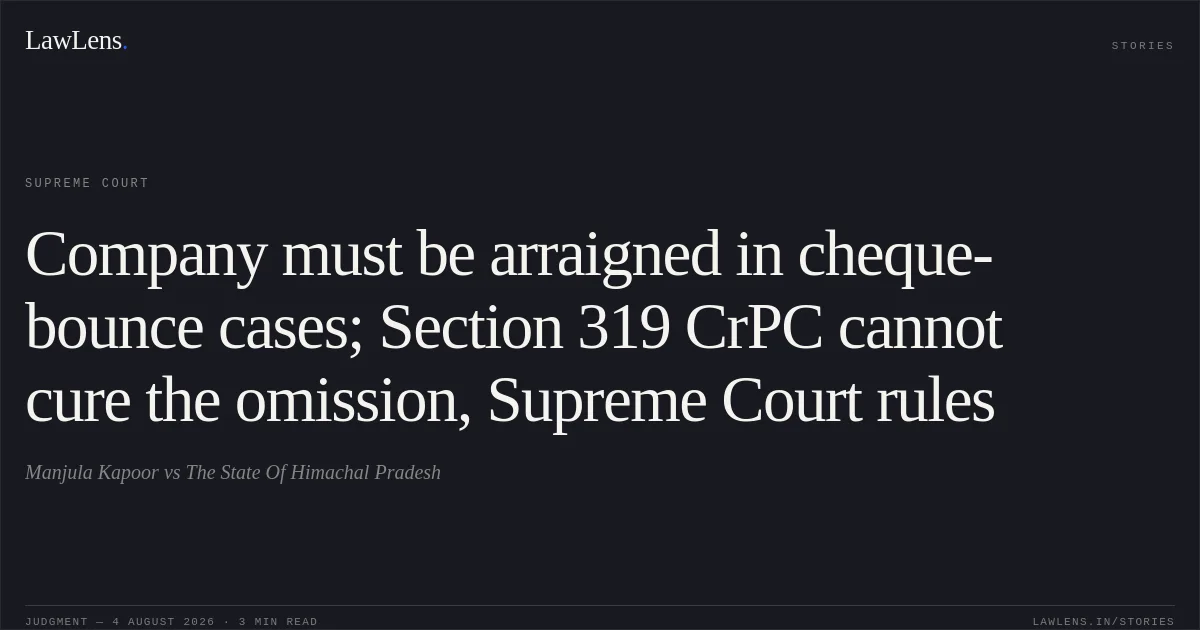
The Supreme Court held that arraigning the Company was mandatory for maintaining prosecution against its director or authorised signatory under Sections 138 and 141 of the NI Act.
The High Court exceeded its jurisdiction by directing the Trial Court to implead the Company suo motu under Section 319 CrPC.
Source reference: p. 16; para. 16The appeal was allowed, the High Court’s order was set aside, and the complaint under Section 138 of the NI Act along with all consequential proceedings was quashed.
Source reference: p. 16; para. 17Original Court PDF
Manjula KapoorvsThe State Of Himachal Pradesh
Click to open original judgment
Original judgment, available to read, download and summarize on LawLens.in