01Facts
The petitioner’s father, a regular Pumpman employed by the Raipur Development Authority, died in harness on 8 October 1999, when the petitioner was 11 years old.
¶ 2The petitioner asserted that his mother applied for compassionate appointment and that he later made representations in 2017, 2018 and 2019; he alleged that the authorities informed him of rejection only in 2020.
¶ 2The respondents disputed proof of the alleged 2019 representation and objected that the writ petition, filed more than 26 years after the employee’s death, was barred by delay and laches.
¶ 3, 5–602Issues
i.Whether the petitioner’s claim for compassionate appointment could be considered despite the writ petition having been filed more than 26 years after his father’s death.
¶ 5, 10, 16ii.Whether the petitioner established a sufficient explanation or exceptional circumstance to warrant the High Court’s exercise of its discretionary jurisdiction under Article 226.
¶ 5–6, 1603Law Applied
Article 226 prescribes no limitation period for filing a writ petition, but the Court’s discretionary jurisdiction ordinarily requires a litigant to approach it within a reasonable time; unexplained delay and laches may justify refusing relief.
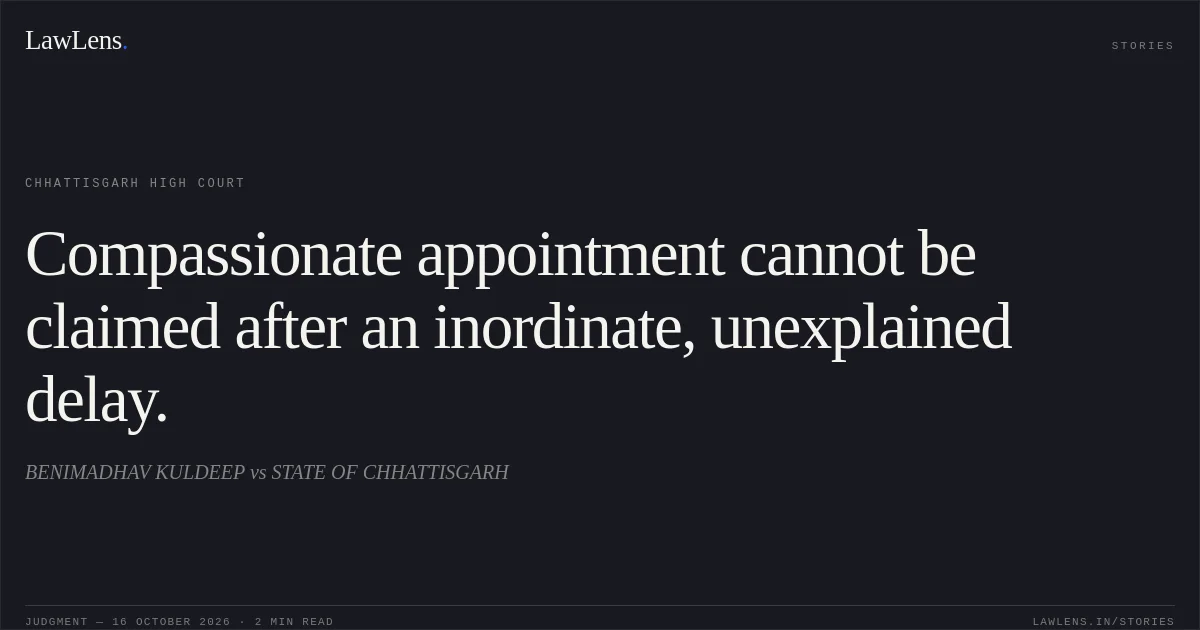
¶ 8–10Compassionate appointment is intended to provide immediate assistance to a family facing financial hardship following an employee’s death; it is not a vested right or a windfall to the deceased employee’s kin, and cannot ordinarily be claimed after an inordinate lapse of time.
¶ 7, 11, 14The Court relied on Sushma Gosain v. Union of India, (1989) 4 SCC 468, on the need for compassionate employment to address the family’s immediate distress.
¶ 14The Court relied on the Division Bench decision in Ankit Kumar Navik v. State of Chhattisgarh and Others, which it described as rejecting compassionate appointment after a long delay.
¶ 1504Reasoning
The Court found that the petition was brought more than 26 years after the employee’s death and that the petitioner had not satisfactorily explained that delay.
¶ 5–6The assertion that rejection was communicated only in 2020 did not, in the Court’s view, explain the subsequent delay in approaching it; nor was there an acknowledgment or receipt establishing that the claimed representation had been submitted.
¶ 5–6Given the purpose of compassionate appointment—relief from the immediate financial crisis—and the prolonged delay, the Court considered that the circumstances justifying such relief no longer survived.
¶ 7, 11–13It also found no exceptional circumstance warranting exercise of its discretionary writ jurisdiction.
¶ 1605Holding
The Court held that the petitioner had not established sufficient grounds to overcome the unexplained delay and laches, and declined to exercise its jurisdiction under Article 226.
¶ 16The writ petition was dismissed in limine.
¶ 17Original Court PDF
BENIMADHAV KULDEEPvsSTATE OF CHHATTISGARH
Click to open original judgment
Original judgment, available to read, download and summarize on LawLens.in