01Facts
The petitioners’ lands were acquired for the Raipur–Dhamtari National Highway (NH-30).
In the lead petition, the competent authority awarded compensation for 1,168 square metres of land; the petitioner challenged the valuation and sought enhancement through arbitration under Section 3G(5) of the National Highways Act, 1956.
The arbitrator terminated the proceedings on 10 January 2019 on the ground that evidence had not been led, without deciding the compensation claim on its merits.
¶ 3, 8The petitioners challenged the arbitrator’s orders in writ proceedings.
The respondents objected that the petitioners should instead pursue the remedy under the Arbitration and Conciliation Act, 1996, including an application under Section 34.
¶ 602Issues
i.1. Whether the writ petitions challenging the arbitrator’s orders concerning compensation under Section 3G(5) of the National Highways Act were maintainable when remedies under the Arbitration and Conciliation Act, 1996, were available.
¶ 6, 9–10ii.2. Whether the Court should exercise writ jurisdiction to interfere with the arbitrator’s orders in the circumstances presented.
¶ 9–1003Law Applied
Section 5 of the Arbitration and Conciliation Act, 1996, restricts judicial intervention in matters governed by Part I to intervention permitted under that Part.
¶ 9In Bhaven Construction v. Executive Engineer, Sardar Sarovar Narmada Nigam Ltd., (2022) 1 SCC 75, the Supreme Court held that constitutional review under Articles 226 and 227 remains available but should be exercised only exceptionally, such as where a party is left without a statutory remedy or there is clear bad faith.
¶ 9Deep Industries Ltd. v. Oil and Natural Gas Corporation Ltd., (2019) SCC OnLine SC 1602, likewise requires extreme circumspection in exercising Article 227 jurisdiction over arbitral proceedings.
¶ 9The availability of an effective statutory remedy ordinarily weighs against entertaining a writ petition.
¶ 9, citing Nivedita Sharma v. Cellular Operators Association of India, (2011) 14 SCC 337Provisions in the judgment · 3 · Linked ones open on LawLens
Arbitration and Conciliation Act, 1996 Section 5Section 34Section 37
04Reasoning
The Court treated the petitions as challenges to orders made in the statutory arbitration process and applied the principle that judicial intervention should ordinarily follow the remedies provided by the 1996 Act.
It concluded that the petitioners ought to have pursued those remedies before the competent statutory forum.
¶ 10The Court did not determine whether the compensation was inadequate or whether the arbitrator was correct to terminate the proceedings for failure to lead evidence; it dismissed the petitions on maintainability grounds.
¶ 8, 1005Holding
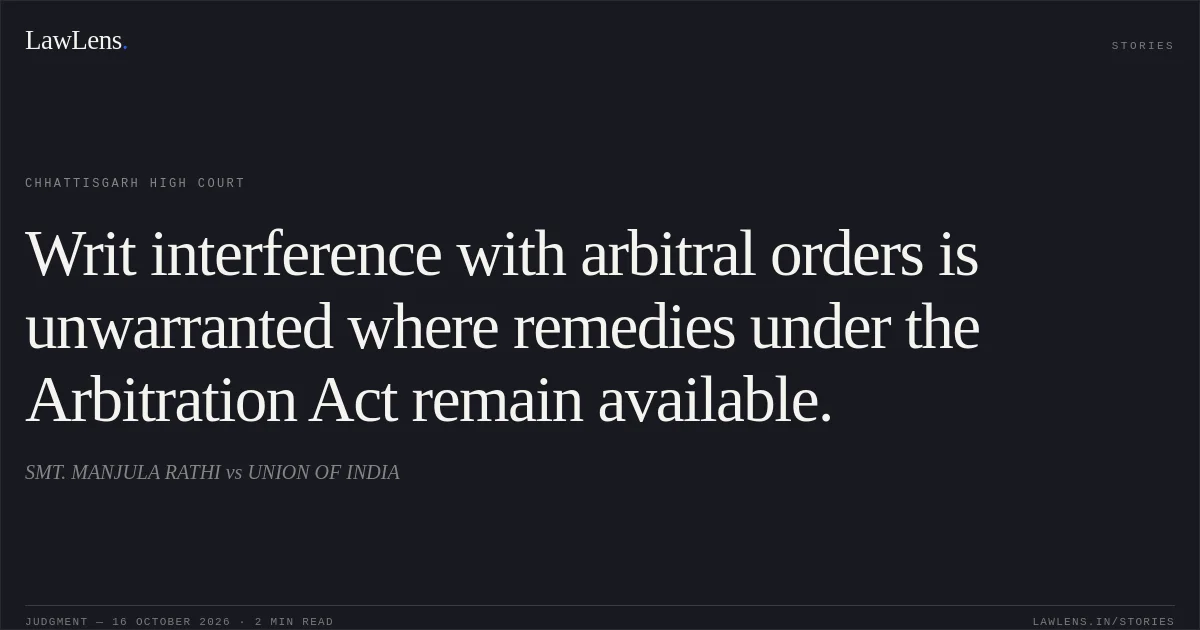
The High Court held that the writ petitions were not maintainable and dismissed all three petitions.
¶ 10, 12It reserved liberty to the petitioners to challenge the arbitrator’s orders or awards before the competent statutory forum in accordance with the Arbitration and Conciliation Act, 1996, if so advised.
¶ 11Original Court PDF
SMT. MANJULA RATHIvsUNION OF INDIA
Click to open original judgment
Original judgment, available to read, download and summarize on LawLens.in