01Facts
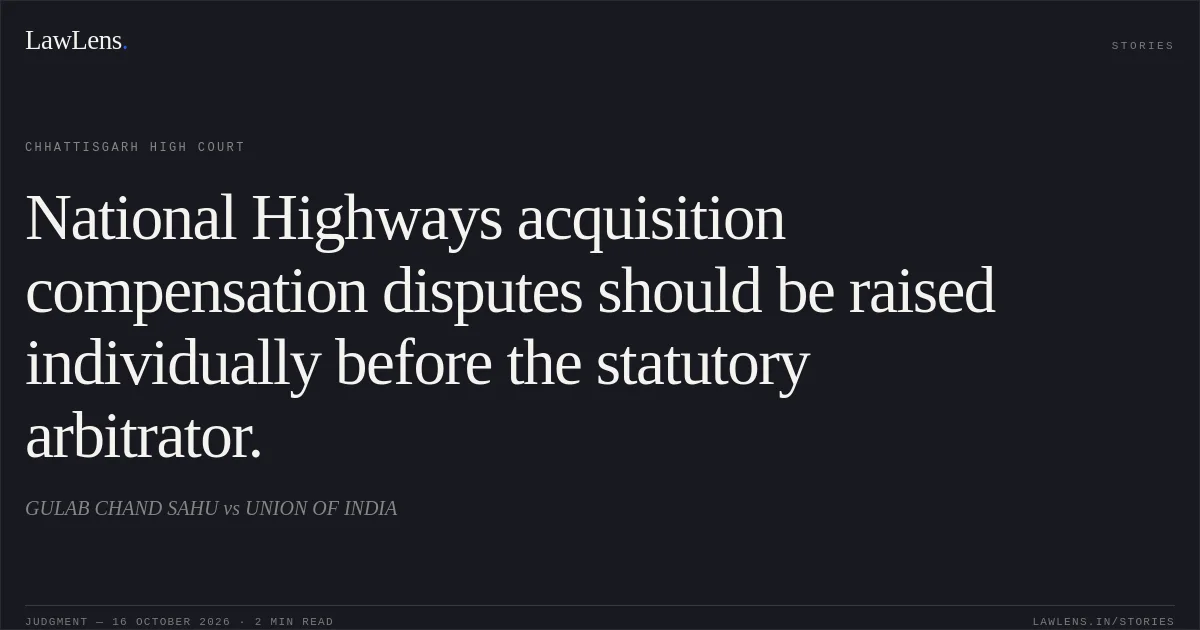
The connected writ petitions concerned land acquired for National Highway projects under the National Highways Act, 1956.
¶ 3–4The petitioners challenged the compensation awarded, alleging that the authorities applied an improper multiplier and used inconsistent rates for similar or adjoining properties, resulting in unequal compensation.
¶ 3–4The respondents relied on the statutory remedy of arbitration under Section 3G(5) of the Act and cited earlier decisions directing landowners to pursue that remedy.
¶ 502Issues
i.Whether landowners dissatisfied with compensation determined under the National Highways Act should pursue the remedy under Section 3G(5) before the Arbitrator.
¶ 5–7ii.Whether the compensation disputes raised by the petitioners should be determined collectively in the writ petitions or individually by the Arbitrator.
¶ 703Law Applied
Section 3G(5) of the National Highways Act, 1956 provides that where either party does not accept the compensation determined by the competent authority, the amount may, on application by either party, be determined by an Arbitrator appointed by the Central Government.
¶ 6The Court also referred to the Division Bench decision in Puriram Kashyap and Others v. State of Chhattisgarh and Others, affirmed in W.A. No. 423/2020, and the principles discussed in Ashutosh Agarwal and Another v. Union of India and Others, W.A. No. 7/2019. Those authorities recognize that the alternative remedy is ordinarily a rule of convenience, not a bar to the High Court’s jurisdiction under Article 226; however, compensation disputes may be referred to arbitration, with the Arbitrator considering the relevant precedent and applicable guidelines.
¶ 5Provisions in the judgment · 1
National Highways Act, 1956 Section 3G
04Reasoning
The Court noted that the petitioners’ complaints concerned the multiplier and the valuation of properties situated in different places, requiring individual consideration of their respective disputes.
¶ 7Since Section 3G(5) expressly provides an arbitration mechanism for a party dissatisfied with the competent authority’s compensation determination, the Court directed the petitioners to raise their claims individually before the Arbitrator rather than adjudicating the compensation merits in the writ proceedings.
¶ 8The Arbitrator was expected to consider the cited Division Bench judgment and other applicable guidelines and parameters, and to give a reasoned decision.
¶ 805Holding
The Court disposed of all the writ petitions, directing each petitioner to approach the Arbitrator under Section 3G(5) individually, preferably within two weeks of receiving the order.
¶ 8–10The Arbitrator was requested to decide each application preferably within 60 days of receipt, and counsel for the respondents were to assist the petitioners’ counsel regarding appointment of the Arbitrator.
¶ 8–10Original Court PDF
GULAB CHAND SAHUvsUNION OF INDIA
Click to open original judgment
Original judgment, available to read, download and summarize on LawLens.in