01Facts
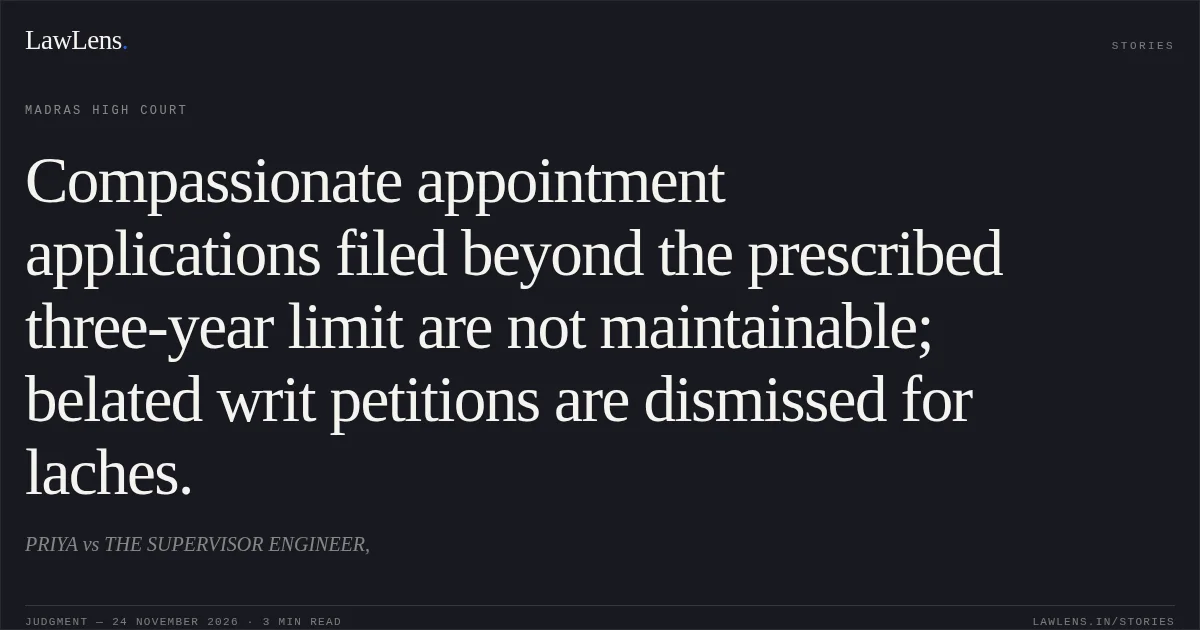
The appellant's father, Jayaraj, died on 19.03.2011 while employed with TANGEDCO.
p. 2The appellant applied for compassionate appointment, and the request was rejected by order dated 27.06.2012.
p. 2The appellant challenged the rejection in W.P.(MD) No. 11925 of 2021, explaining the delay in filing by stating that he was a minor at the relevant time.
p. 2The learned Single Judge dismissed the writ petition on 07.03.2022.
p. 2The appellant then filed this writ appeal under Clause 15 of the Letters Patent.
pp. 1–2The father had worked only as a casual labourer, but he had obtained an order dated 26.12.2002 conferring permanent status.
p. 3The Division Bench dismissed TNEB's appeal against that order in W.A. No. 1302 of 2003 and batch on 24.10.2008.
p. 3The court relied on a recent Division Bench decision in W.A.(MD) No. 1913 of 2021 (TANGEDCO v. M. Muthumani, dated 31.08.2026), which upheld compassionate employment for the dependant of a contract employee deemed permanent under a binding settlement.
pp. 3–4 · ¶ 302Issues
i.1. Whether the ground on which the appellant's claim for compassionate appointment was rejected, namely that the father was only a casual labourer, is sustainable in law.
¶ 3 / p.303Law Applied
The court relied on the father's order dated 26.12.2002 conferring permanency, which had been upheld by the Division Bench in W.A. No. 1302 of 2003 and batch, so that his casual status could not sustain the rejection.
p. 3The court applied the binding settlement under Section 12(3) (as referred to in the quoted passage) and the Division Bench ruling in TANGEDCO v. M. Muthumani (W.A.(MD) No. 1913 of 2021), which holds that where a contract employee has been granted permanent status and the position is governed by a binding settlement, a dependant's claim for compassionate employment should be granted, and similarly situated persons should receive similar relief.
pp. 3–4 · ¶ 3The court relied on its inherent appellate power to remit the matter for fresh consideration and to fix a time limit for decision. The judgment does not expressly cite any statutory provision or compassionate-appointment rule.
p. 4 · ¶ 404Reasoning
The court held that the sole ground of rejection, the father's casual labour status, was undermined by the 2002 permanency order, which had been upheld by the Division Bench in 2008.
p. 3The facts were treated as similar to those in Muthumani, where the Division Bench had declined to interfere with a single-judge order granting compassionate employment on the same footing of deemed permanency and parity.
pp. 3–4 · ¶ 3Applying that reasoning, the court found the rejection unsustainable and did not decide the claim on its merits.
p. 4 · ¶ 4The appellant's delay in approaching the court, attributed to minority, is not separately analysed in the judgment.
Because the matter had been pending for a considerable time, the court chose to remit it to the respondents, with a direction to decide within eight weeks.
p. 4 · ¶ 4The appellant's further representation was to be treated as a continuation of the original application, not as a fresh claim.
pp. 4–5 · ¶ 405Holding
The ground of rejection is not sustainable, since the father's permanency order and the binding Division Bench precedent, followed in Muthumani, render the casual-labour objection untenable.
p. 4 · ¶ 3–4The writ appeal is allowed. The order of the learned Single Judge dated 07.03.2022 and the rejection order dated 27.06.2012 are set aside, and the matter is remitted to the respondents.
p. 4 · ¶ 4The respondents must decide the appellant's claim within eight weeks of receiving a copy of the order, and the appellant may file a comprehensive application with supporting materials, which is to be treated as a continuation of the original application. No costs.
pp. 4–5 · ¶ 4 · p. 5Original Court PDF
J. Ajith Aravind,vsThe Chief Engineer (Personnel),
Click to open original judgment
Original judgment, available to read, download and summarize on LawLens.in