01Facts
The petitioners were employed by Tamil University, Thanjavur. In WP(MD) Nos. 3062 of 2024 and batch, decided on 03.04.2024, they challenged a Government letter dated 07.02.2024 and sought a consequential direction to regularize their services in light of an earlier order in WP(MD) No. 11103 of 2021 dated 26.09.2022.
¶ 1–2 · p. 8The Court held that no positive direction to regularize could be issued. Instead, it granted limited relief allowing the petitioners to continue in employment until regular vacancies were filled through a regular recruitment process, and directed the respondents to maintain status quo until then.
¶ 3–4 · p. 9The order records that the 2024 writ order contains the phrase "WP(MD)No.3062 of 2014," which appears to be a typographical error for 2024.
¶ 1 · p. 8Subsequently, by proceeding dated 17.09.2026 in Na.Ka.Aa3/2328/2018, the Registrar allegedly altered the petitioners' service condition to temporary daily-wage employees for 90 days.
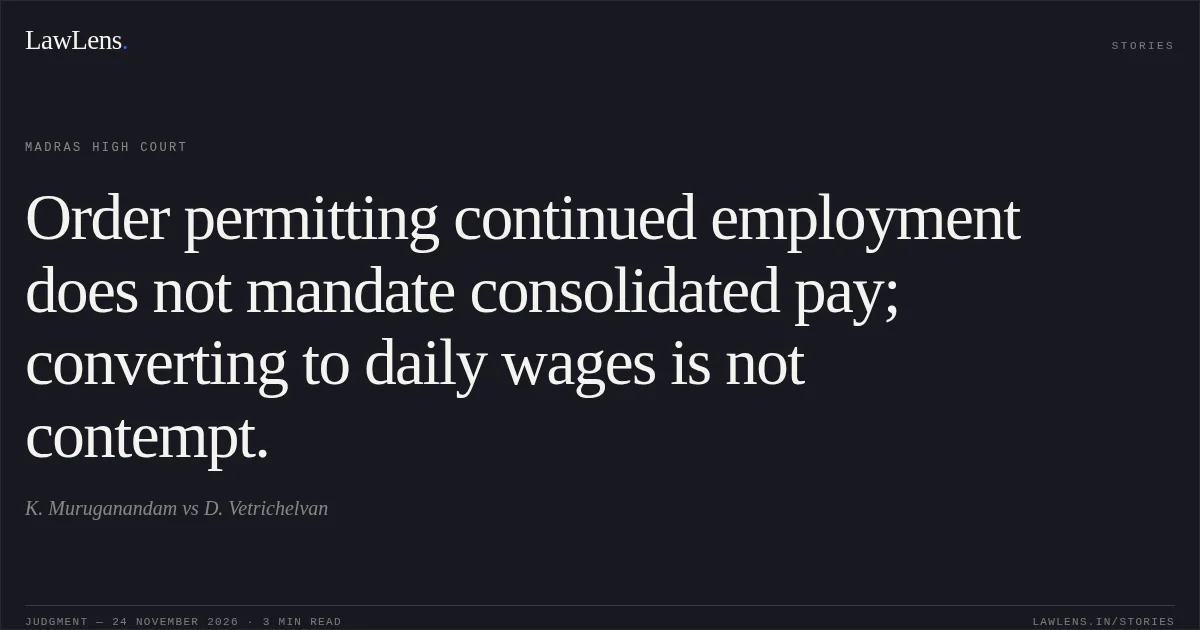
prayer · pp. 1–7The petitioners contended that, instead of continuing them on consolidated pay, the University converted them to daily wagers, which they said violated the 03.04.2024 order and warranted contempt proceedings under Section 11 of the Contempt of Courts Act, 1971 and Article 215 of the Constitution.
¶ 5 · p. 9 · prayer · pp. 1–702Issues
i.1. Whether the Registrar's conversion of the petitioners to temporary daily-wage employees for 90 days constitutes wilful disobedience of the Common Order dated 03.04.2024, where that order did not expressly address whether the petitioners' interim employment should be on consolidated pay or daily-wage terms.
¶ 5–7 · pp. 9–10ii.2. Whether the contempt court can examine the petitioners' status and mode of payment in contempt proceedings, or whether that question must be decided in a separate remedy.
¶ 6–9 · p. 1003Law Applied
The Court relied on the Contempt of Courts Act, 1971 (Section 11) and Article 215 of the Constitution, under which the High Court punishes wilful disobedience of its orders.
prayer · pp. 1–7The Court treated the operative part of the 03.04.2024 order as the measure of compliance: the order permitted continuation of employment until regular recruitment and directed status quo, but did not decide the nature or basis of remuneration.
¶ 3–4, 6–7 · pp. 9–10The Court construed the earlier order by its actual reasoning and scope, holding that it addressed regularization, not the pay structure of interim employees.
¶ 6 · p. 10No precedent on contempt standards is cited in the order.
The principle applied is that disobedience requires a clear and specific direction that has been breached; absent such a direction, wilful disobedience cannot be established.
¶ 7 · p. 10Provisions in the judgment · 1 · Linked ones open on LawLens
Contempt of Courts Act, 1971 Section 11
04Reasoning
The Court examined the 03.04.2024 order and found that the writ court had not decided whether the petitioners' status should be consolidated or daily-wage. It was concerned only with regularization and held that the University could fill vacancies through regular recruitment.
¶ 6 · p. 10The only operative relief was continuation of employment until that process was complete. Since the order contained no direction on pay structure, the alteration of the petitioners' remuneration basis could not be said to flout it. The Court therefore found no disobedience, much less wilful disobedience, by the Registrar.
¶ 7 · p. 10The Court also held that the question whether the petitioners should be paid on consolidated pay or treated as daily-wage employees is a separate matter outside the scope of contempt, and left it to be pursued in an appropriate proceeding.
¶ 9 · p. 1005Holding
The Court held that no disobedience, let alone wilful disobedience, was made out, because the 03.04.2024 order did not regulate whether interim employees should receive consolidated pay or daily wages.
¶ 7 · p. 10All twelve contempt petitions were dismissed. The petitioners were granted liberty to pursue their remedy in the manner known to law on whether they should be paid on consolidated pay or treated as daily-wage employees. The order is a dismissal on the ground of no contempt; it does not decide the merits of the petitioners' pay-structure claim.
¶ 8–9 · p. 10Original Court PDF
K. MuruganandamvsD. Vetrichelvan
Click to open original judgment
Original judgment, available to read, download and summarize on LawLens.in