Facts
The respondent’s husband, V. Kumar, a Head Constable, died in harness on 05.05.2005.
Source reference: para. 2The respondent applied for compassionate appointment on 24.07.2005. After a delay of 15 years, the authorities issued her an appointment order on 31.12.2020, which she did not join due to an alleged accident.
Source reference: para. 2In 2021, sixteen years after the employee's death, she sought appointment for her second son. This application was rejected by the authorities on 12.05.2023 on the grounds that alternative applications are only considered if the original applicant dies pending consideration.
Source reference: para. 2The Writ Court previously ruled in favor of the respondent, directing the appellants to appoint the son.
Source reference: para. 3The Government appealed this order, noting that another son of the deceased is already in Government service.
Source reference: para. 4Issues
1. Whether the respondent’s family is entitled to compassionate appointment after a lapse of 16 years and despite the fact that another family member is in Government service.
Source reference: para. 4 & 62. Whether the Writ Court was justified in directing appointment based on an "alternative application" submitted by the son after the mother declined the initial offer.
Source reference: para. 3 & 8Law Applied
The Court applied the principles governing compassionate appointment, emphasizing that it is a concession and not a constitutional right, and is inherently an exception to Articles 14 and 16 of the Constitution.
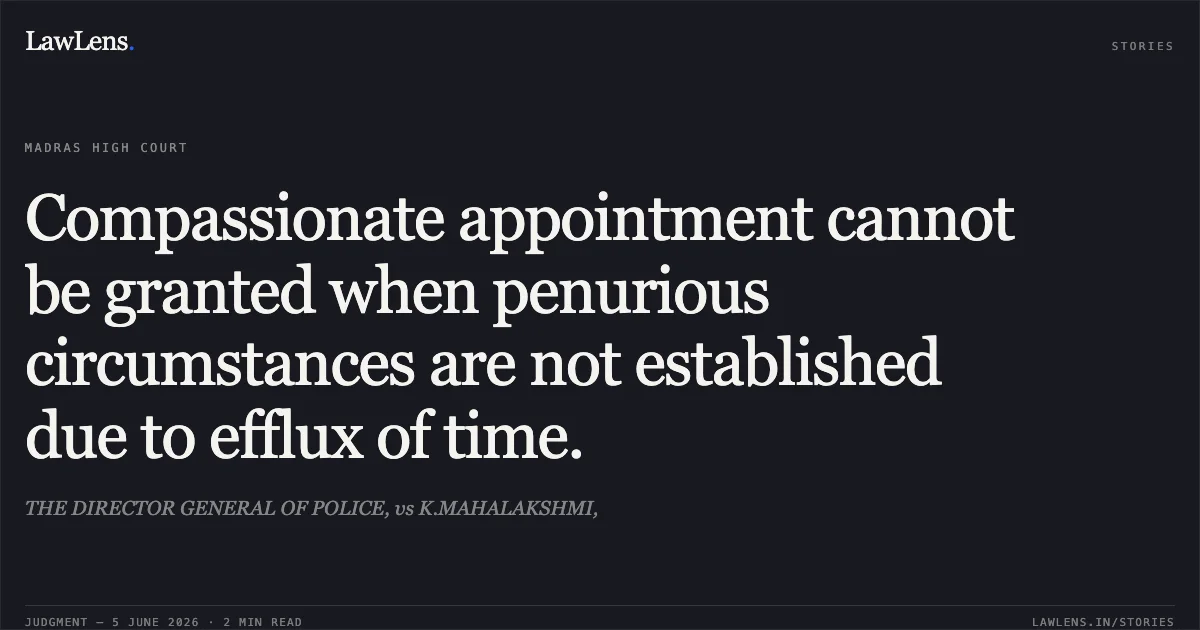
Source reference: para. 6The Court relied on the doctrine that the primary objective of the scheme is to mitigate immediate financial distress (penurious circumstances) arising from the sudden death of an employee. Long pendency or efflux of time negates the presumption of indigence.
Source reference: para. 6Judicial review must not be exercised based on "misconceived sympathy" which would infringe upon the rights of meritorious candidates in public employment.
Source reference: para. 7Reasoning
The Court reasoned that compassionate appointment is intended to provide immediate relief, not to serve as a perpetual right to a post. In this case, the 15-year delay in issuing the original appointment, followed by the respondent's refusal to join, demonstrated that the immediate "penurious circumstances" no longer existed.
Source reference: para. 2 & 6The Court took significant note of the fact that another son of the deceased is already employed in Government service, which effectively removes the family from the category of "indigent".
Source reference: para. 8It held that the Writ Court erred by granting relief through sympathy rather than legal merit, as the scheme must be implemented scrupulously according to its specific terms, which do not generally allow for "alternative applications" simply because a candidate chooses not to join.
Source reference: para. 6-8Holding
The High Court answered the issues in the negative, holding that the family is not entitled to compassionate appointment due to the passage of time (21 years since the death) and the existing employment of another son.
The Court set aside the Writ Court’s order dated 30.01.2024 and allowed the Writ Appeal. No costs were awarded, and the connected miscellaneous petition was closed.
Source reference: para. 9Acts & Sections Cited
1 provisions across 1 statute referred to in this judgment. Linked provisions open on LawLens.
Letters Patent1
Original Court PDF
THE DIRECTOR GENERAL OF POLICE,vsK.MAHALAKSHMI,
Click to open original judgment
Original judgment, available to read, download and summarize on LawLens.in