Facts
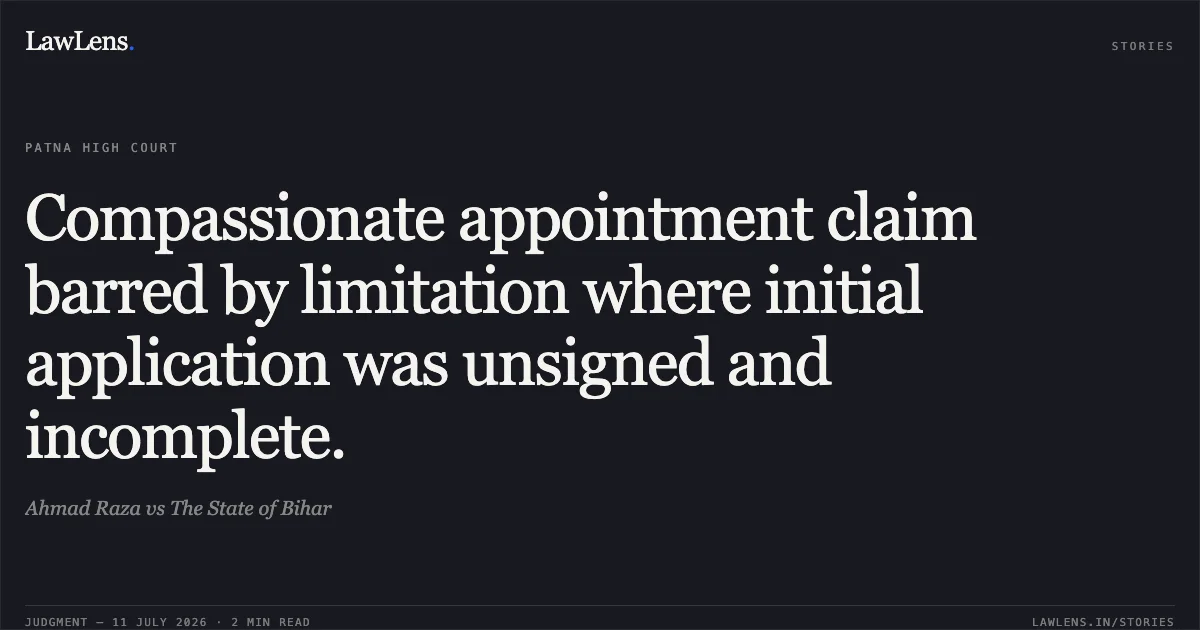
The petitioner sought compassionate appointment following the death of his stepmother, an employee at the Primary Health Centre, Pandarak, who died on 14.04.2008.
Source reference: para. 8The petitioner’s initial application was rejected in 2016 for being time-barred under the state’s five-year limitation policy.
Source reference: para. 3In a prior litigation (CWJC No. 10010 of 2017), the High Court directed the respondents to factually determine if the application was filed within time.
Source reference: para. 4Upon reconsideration, the Civil Surgeon found that while a document was submitted on 28.03.2012, it lacked the petitioner’s signature and essential information; a complete, signed application was only submitted on 17.07.2013.
Source reference: para. 5Consequently, the claim was rejected again via Memo No. 5813 dated 11.07.2019, which the petitioner challenged in the present writ.
Source reference: para. 2, 5Issues
1. Whether the petitioner's application for compassionate appointment was filed within the prescribed five-year limitation period.
Source reference: para. 4-52. Whether the rejection of the application as time-barred was legally sustainable despite the petitioner’s claim of timely submission.
Source reference: para. 6, 12Law Applied
Personnel and Administrative Reforms Department (Government of Bihar) Letter No. 2822 dated 27.04.1995, which mandates that applications for compassionate appointment must be filed within five years of the employee's death.
Source reference: para. 3, 12Compassionate appointment is an exception to the general rules of public employment under Articles 14 and 16 of the Constitution of India, intended solely to provide immediate financial relief to bereaved families.
Source reference: para. 10State of Jammu Kashmir Ors. Vs. Sajad Ahmed Mir (2006), establishing that compassionate appointment cannot be granted after unreasonable delay as the urgency of the financial crisis dissipates over time.
Source reference: para. 13Reasoning
The court examined the administrative record to resolve the "disputed question of fact" regarding the submission date. It found that the purported application of 28.03.2012 was defective as it lacked the applicant’s signature and necessary particulars.
Source reference: para. 5, 12The court determined that a valid, actionable application was only brought into existence on 17.07.2013 when the petitioner appeared in person to sign and complete the documentation—well beyond the five-year limit from the date of death (14.04.2008).
Source reference: para. 5, 8The court rejected the petitioner's plea for compensation based on BSNL Ors. Vs. Vidya Prasad, noting there were no laches on the part of the State.
Source reference: para. 14Furthermore, the court observed that seventeen years had passed since the employee's death, rendering the demand for "immediate succor" moot.
Source reference: para. 8, 10Holding
The Court answered the first issue in the negative, holding that the valid application was filed beyond the five-year limitation.
Regarding the second issue, the Court held that the rejection by the Civil Surgeon-cum-Chief Medical Officer, Patna, was justified and free from legal error. The writ petition was dismissed on the grounds of lack of merit and the expiration of the primary purpose of compassionate appointment.
Source reference: para. 12, 14, 15Original Court PDF
Ahmad RazavsThe State of Bihar
Click to open original judgment
Original judgment, available to read, download and summarize on LawLens.in