Facts
The deceased employee, Afsar Ali Sardar, was a Postman who died in harness on 29.01.1999
Source reference: p. 3, 5His widow (Applicant No. 1) applied for a compassionate appointment for her son (Applicant No. 2) in 1999
Source reference: p. 3Following multiple rounds of litigation and a Review Application (R.A. 20/2021), the respondents rejected the claim on 24.05.2022
Source reference: p. 3The Applicants challenged this in O.A. 1266/2022, which was dismissed, but later set aside by the Calcutta High Court in WPCT 123/2022
Source reference: p. 3The High Court directed the respondents to consider the application afresh based on the rules prevalent at the time of death (1999)
Source reference: p. 3, 5In purported compliance, the Chief Post Master General issued a speaking order on 06/09.03.2023, again rejecting the claim on the grounds that the family was not indigent and mentioning a 5% vacancy cap
Source reference: p. 6, 9The Tribunal initially dismissed the current O.A. on 28.08.2024, but the High Court, in WPCT 314/2024, remanded the matter back to the Tribunal to determine if the 1999 policy was strictly applied
Source reference: p. 2, 7Issues
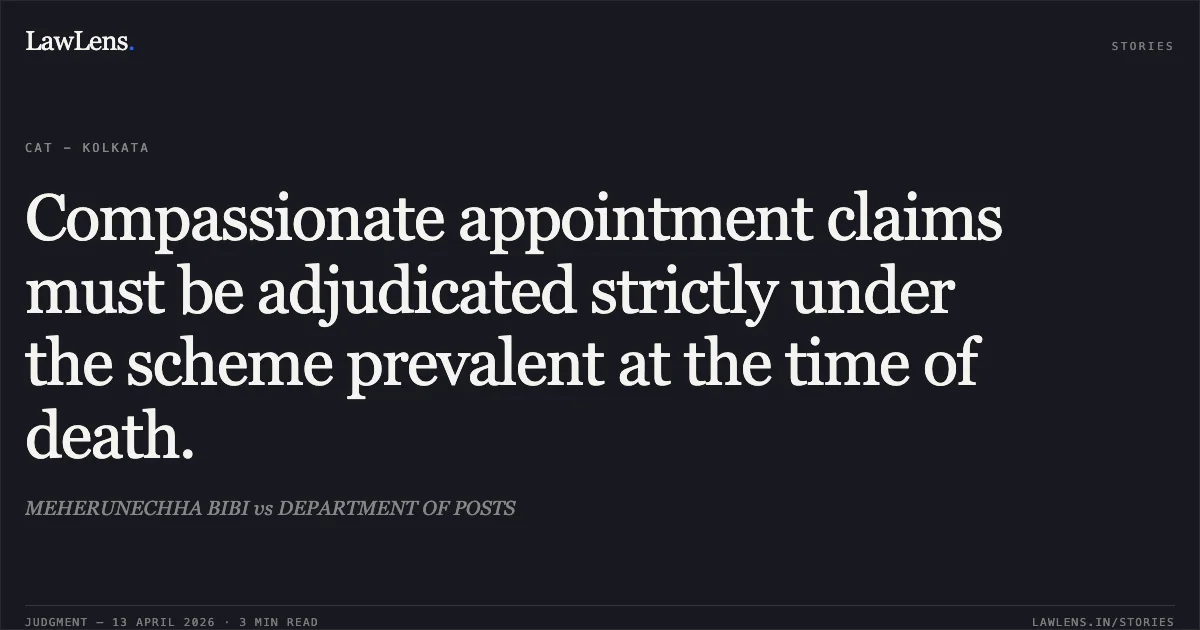
1. Whether the respondents complied with the High Court's directive to consider the application for compassionate appointment strictly under the scheme prevalent at the time of the employee's death in 1999
Source reference: p. 82. Whether the inclusion of subsequent restrictive criteria, such as a 5% vacancy cap and modern point-allocation systems, invalidated the rejection order dated 06/09.03.2023
Source reference: p. 9-10Law Applied
The court primarily applied the principles regarding compassionate appointment established in Secretary to Govt. Dept. of Education (Primary) & Ors. v. Bheemesh alias Bheemappa (2021), which held that the applicability of a modified scheme depends on fixed criteria, such as the date of death, rather than the date of consideration
Source reference: p. 4-5It further relied on the Department of Personnel and Training (DoP&T) OM No. 14014/6/94-Estt(D) dated 09.10.1998, which was the scheme in force at the time of the employee's death
Source reference: p. 8This 1998 scheme exempted compassionate appointments from certain recruitment procedures and did not stipulate the 5% vacancy cap introduced in later policies
Source reference: p. 9-10Reasoning
The Tribunal noted that while the respondents claimed to have followed the 1999 rules, their speaking order and affidavit in reply relied on a "point allocation system" from 2022 and a 5% vacancy cap
Source reference: p. 9The Tribunal found that the 1998 OM, applicable at the time of death, explicitly exempted compassionate appointments from standard recruitment procedures and ban orders, implying that no such 5% cap existed at that time
Source reference: p. 9-10By applying the "indigence" formula and vacancy limitations of 2022 to a 1999 death, the respondents failed to follow the High Court's mandate to apply the old policy in its "true spirit"
Source reference: p. 10The Tribunal concluded that the respondents’ reliance on subsequent restrictive guidelines negated their claim of having considered the case under the 1999 scheme
Source reference: p. 10Holding
The Tribunal allowed the O.A., quashing and setting aside the impugned speaking order dated 06/09.03.2023
The respondents were directed to clearly identify the specific compassionate appointment scheme in force on 29.01.1999 and reconsider the applicant’s case strictly in accordance with that scheme
Source reference: p. 10The respondents must complete this exercise and take follow-up action within 120 days of receiving the order
Source reference: p. 10No costs were awarded
Source reference: p. 10Acts & Sections Cited
2 provisions across 1 statute referred to in this judgment. Each provision opens on LawLens.
Administrative Tribunals Act, 19852
Original Court PDF
MEHERUNECHHA BIBIvsDEPARTMENT OF POSTS
Click to open original judgment
Original judgment, available to read, download and summarize on LawLens.in