01Facts
The respondent’s father, R. Gunasekaran, an Assistant Section Officer in the Rural Development and Panchayat Raj Department, died in service on 03.11.1995.
p. 2The respondent was then 12 years old and a minor.
p. 2His mother applied for compassionate appointment for him on 11.05.1996, but the application was not considered.
p. 2After attaining majority, the respondent submitted a fresh application on 19.05.2006.
p. 2The State rejected it on the ground that the application was made beyond the three-year period prescribed under the compassionate appointment scheme.
p. 2The respondent’s writ petition was allowed by the Writ Court on the reasoning that his mother had made an application within time.
pp. 1–3The State challenged that order in the present intra-court appeal under Clause 15 of the Letters Patent.
pp. 1–302Issues
i.Whether an application made by the respondent’s mother on behalf of the minor respondent could satisfy the requirement of submitting an application for compassionate appointment within the prescribed period?
pp. 2–4ii.Whether the respondent could claim compassionate appointment after attaining majority and after the expiry of the three-year period stipulated under the scheme?
pp. 2–4iii.Whether the respondent’s claim could be granted after approximately 31 years from the date of the employee’s death, having regard to the limited and exceptional nature of compassionate appointment?
pp. 8–1003Law Applied
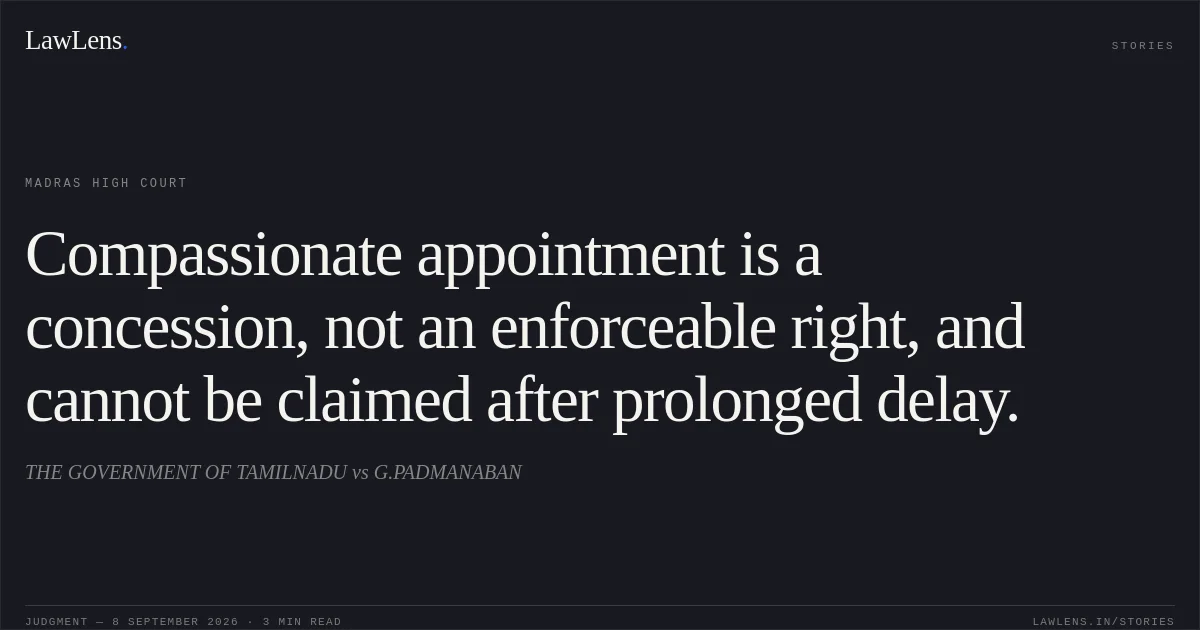
The Court applied the principle that compassionate appointment is a concession and not a constitutional or vested right, and therefore the scheme must be strictly complied with.
p. 4An application must be made within the period prescribed by the applicable scheme, ordinarily within three years from the employee’s death, by an eligible legal heir or representative, and the family must demonstrate continuing indigent or penurious circumstances caused by the employee’s death.
pp. 3–4Compassionate appointment is intended only to mitigate the immediate financial crisis arising from the sudden death of the breadwinner, and not to provide employment to a family member as a matter of inheritance.
pp. 4–8The Court further invoked the constitutional principles of equality of opportunity in public employment under Articles 14 and 16, the requirement of maintaining administrative efficiency under Article 335, and the need to protect the interests of candidates seeking public employment through the regular constitutional process.
pp. 5–7It held that the passage of substantial time may itself demonstrate that the immediate penurious circumstances, if any, no longer survive.
pp. 8–1004Reasoning
The Court held that the Writ Court had treated the mother’s application as sufficient merely because it was made within time, without properly applying the conditions of the compassionate appointment scheme.
pp. 2–4The respondent’s subsequent application was made only in 2006, well beyond the prescribed three-year period, and compassionate appointment could not be claimed as an accrued entitlement upon attaining majority.
pp. 4–8The Court emphasised that the scheme addresses an immediate financial crisis and cannot be extended indefinitely merely because the claimant was a minor when the employee died.
pp. 4–8It also considered the constitutional consequences of granting public employment outside the ordinary recruitment process, observing that indiscriminate or delayed compassionate appointments may prejudice the equal opportunity rights of meritorious candidates and undermine reservation and administrative efficiency.
pp. 5–8Since nearly 31 years had elapsed from the employee’s death, the Court inferred that the circumstances existing in 1995 could not reasonably justify appointment at the time of adjudication.
pp. 8–1005Holding
The Court answered the issues against the respondent.
p. 10It held that the mother’s application did not confer an enforceable right to compassionate appointment and that the respondent’s delayed application could not be entertained under the applicable scheme.
p. 10The writ order dated 03.11.2022 in W.P. No. 22032 of 2015 was set aside, the writ appeal was allowed, and the connected miscellaneous petition was closed.
p. 10No order as to costs was made.
p. 10Original Court PDF
THE GOVERNMENT OF TAMILNADUvsG.PADMANABAN
Click to open original judgment
Original judgment, available to read, download and summarize on LawLens.in