Facts
The respondent’s father, an Income Tax Department employee, died in harness in 2000. Following a Selection Committee recommendation, she was appointed as MTS (Trainee) on compassionate grounds in 2016, although she did not then hold the prescribed matriculation qualification. Her appointment letter stated that she would be regularised upon acquiring that qualification.
Source reference: paras. 5(a)–(d)In 2017, the Department issued a termination notice, asserting that her appointment had not followed the applicable procedure. After an earlier representation was rejected, she filed OA No. 450 of 2018 before the Central Administrative Tribunal. The Tribunal permitted withdrawal of the OA on the basis of an agreement that she would acquire the qualification within five years, failing which the Department could terminate her service.
Source reference: paras. 5(e)–(g)The Union’s review application, alleging that its counsel lacked authority to make that concession, was dismissed. The Union challenged both Tribunal orders before the High Court. By the time of the High Court proceedings, the respondent had acquired the qualification within the stipulated period.
Source reference: paras. 5(h)–(j), 10Issues
Whether the Tribunal erred in dismissing the review application without addressing the Union’s claim that its counsel lacked authority to make the concession on which the original order was based.
Source reference: paras. 13–15Whether, given that the respondent lacked the prescribed qualification and her engagement had not received the competent Secretary’s approval, the High Court could direct consideration of ex post facto approval rather than order her regularisation or require a fresh application.
Source reference: paras. 18–22Law Applied
An advocate has no implied or ostensible authority, merely by virtue of engagement, to bind a client to a compromise or settlement; a concession or undertaking requires the client’s express instructions (*Himalayan Coop. Group Housing Society v. Balwant Singh*, (2015) 7 SCC 373; *Bar of Indian Lawyers v. D.K. Gandhi PS National Institute of Communicable Diseases*, (2024) 8 SCC 430).
Source reference: para. 13Where an order is alleged to rest on an invalid, unauthorised concession, the court must examine that allegation and may act to correct the wrong.
Source reference: para. 13Under paragraph 6(B)(b) of the compassionate-appointment scheme in DoPT O.M. dated 11 December 2009, a person lacking the minimum educational standard may, in exceptional circumstances, be engaged as a trainee, but in an attached or subordinate office the Secretary of the concerned administrative Ministry or Department is the competent authority.
Source reference: paras. 18–19An appointment made without the required prior approval is a nullity (*Union of India v. Raghuwar Pal Singh*, (2018) 15 SCC 463).
Source reference: para. 22Reasoning
The Tribunal’s review decision addressed whether the respondent had acquired the qualification, but did not consider the Union’s central contention that its counsel had lacked authority to make the concession underlying the 2018 order. The High Court therefore held that the Tribunal had not properly addressed the review application.
Source reference: paras. 14–15On the merits, the respondent had been appointed without the approval of the competent Secretary, so the appointment could not be treated as valid; however, she was not responsible for the procedural lapse, had acquired the required qualification within the period specified in her appointment letter, and there was no allegation of fraud or malpractice.
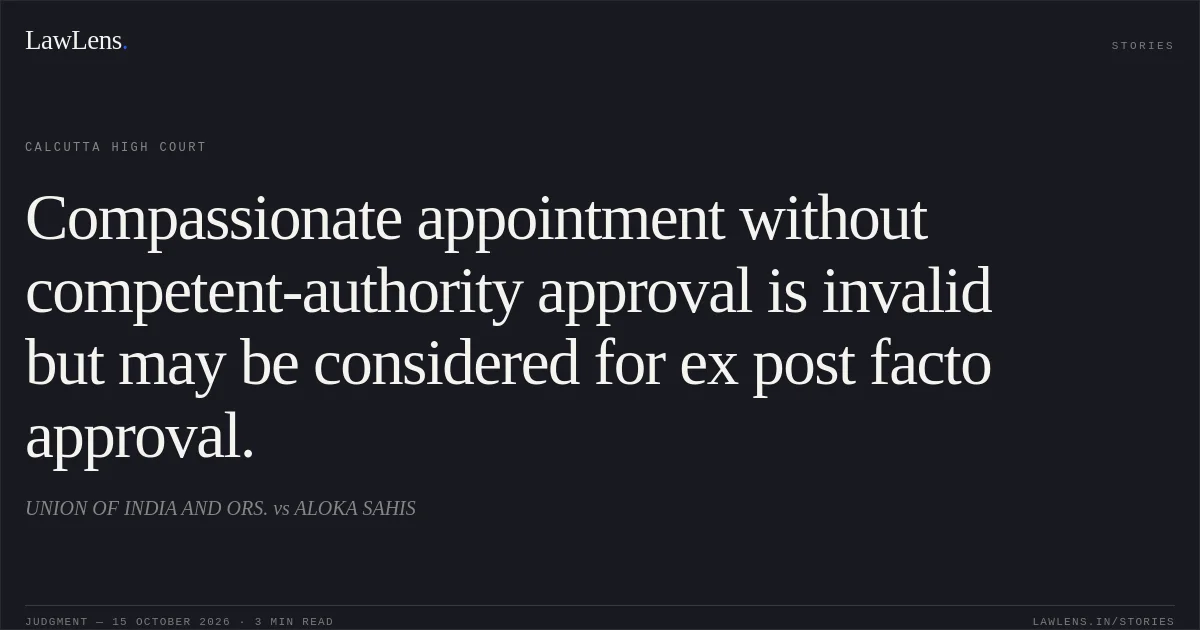
Source reference: paras. 15–20In light of the Department’s earlier indication that her case could be forwarded for consideration, and to avoid another round of litigation, the Court directed that her existing case file be sent to the competent authority for consideration of ex post facto approval. It expressly declined to direct regularisation.
Source reference: paras. 20–22Holding
The High Court set aside the impugned Tribunal orders and disposed of the writ petition without costs.
It directed the PCCIT to forward the respondent’s case file to the CBDT within two weeks, and the Secretary, Department of Revenue, Ministry of Finance, to decide within a further two weeks whether to grant ex post facto approval, taking account of the respondent’s acquisition of the required qualification.
Source reference: para. 23No order directing regularisation was made.
Source reference: para. 22Acts & Sections Cited
1 provisions across 1 statute referred to in this judgment. Each provision opens on LawLens.
Administrative Tribunals Act, 19851
Original Court PDF
UNION OF INDIA AND ORS.vsALOKA SAHIS
Click to open original judgment
Original judgment, available to read, download and summarize on LawLens.in