Facts
The Appellant/Plaintiff claimed ownership of property bearing Municipal No. 669, Ward No. 75, Kishan Ganj, Delhi, comprising built-up quarters, jhuggis, a temple, open spaces and other structures.
Source reference: paras. 3–12His title was traced through historical sale deeds, revenue records and a registered Will dated 8 November 1978.
Source reference: paras. 3–12In October 2012 and again in March 2013, he alleged that the Respondent electricity distribution licensee had erected electric poles and laid overhead wires, distribution boxes and transformers on the property without his consent or statutory permission.
Source reference: paras. 15–19He sought permanent and mandatory injunctions, removal of the installations, and damages of ₹50,000 per month.
Source reference: para. 19The Respondent contended that the works were undertaken to provide regular electricity connections to jhuggi residents, who had consented to the works, and that the property belonged to the Indian Railways.
Source reference: paras. 20–29It further pleaded that disputes concerning the works and compensation were governed by Section 67 of the Electricity Act, 2003 and the Works of Licensees Rules, 2006, thereby excluding the jurisdiction of the Civil Court.
Source reference: paras. 20–29The Trial Court dismissed the suit, holding that the Civil Court’s jurisdiction was barred and that the Plaintiff had failed to prove the quantum of damages.
Source reference: para. 34The First Appellate Court affirmed the dismissal, additionally observing that the works had already been completed and that the Plaintiff had not approached the competent statutory authority.
Source reference: paras. 35–36The Plaintiff thereafter preferred the present Regular Second Appeal under Section 100 CPC.
Source reference: paras. 37–41Issues
Whether the jurisdiction of the Civil Court was barred from granting relief in respect of the erection of electric poles, laying of wires and determination of compensation under Section 67 of the Electricity Act, 2003 and Rule 3 of the Works of Licensees Rules, 2006?
Source reference: paras. 44–59Whether the Respondent had complied with the statutory requirement of obtaining the consent of the owner or occupier, or written permission from the District Magistrate, Commissioner of Police or other competent authority?
Source reference: paras. 46–54Whether the Plaintiff was entitled to damages or compensation and had established the basis and quantum of the amount claimed?
Source reference: paras. 60–66Whether the appeal raised any substantial question of law warranting interference under Section 100 CPC?
Source reference: para. 68Law Applied
Section 67(3) of the Electricity Act, 2003 requires a licensee to cause as little damage, detriment and inconvenience as possible and to pay full compensation for damage or inconvenience caused by its works; under Section 67(4), disputes arising under that provision, including disputes regarding compensation, are to be determined by the Appropriate Commission.
Source reference: para. 45Rule 3 of the Works of Licensees Rules, 2006 requires the licensee to obtain the prior consent of the owner or occupier before carrying out works on or over land; where the owner or occupier objects, the licensee must obtain written permission from the District Magistrate, Commissioner of Police or other authorised officer, who may also direct removal or alteration of the works.
Source reference: para. 46Section 145 of the Electricity Act bars the Civil Court from entertaining matters assigned to statutory authorities under the Act and prohibits injunctions in respect of actions taken under statutory powers.
Source reference: paras. 57–59In a second appeal under Section 100 CPC, interference is permissible only where a substantial question of law arises.
Source reference: para. 68Reasoning
The Court accepted, for purposes of the appeal, that the Plaintiff was the owner of the property.
Source reference: para. 42It found that the Respondent had not obtained the Plaintiff’s consent and had also not obtained written permission from the District Magistrate, Commissioner of Police or any other competent authority after the Plaintiff objected to the works.
Source reference: paras. 47–54The Respondent’s reliance on the consent of jhuggi residents was insufficient because such consent could not substitute for the consent of the owner once the owner had raised an objection.
Source reference: paras. 48–50The alleged urgency arising from electricity theft or the need to regularise electricity supply did not dispense with the statutory requirements.
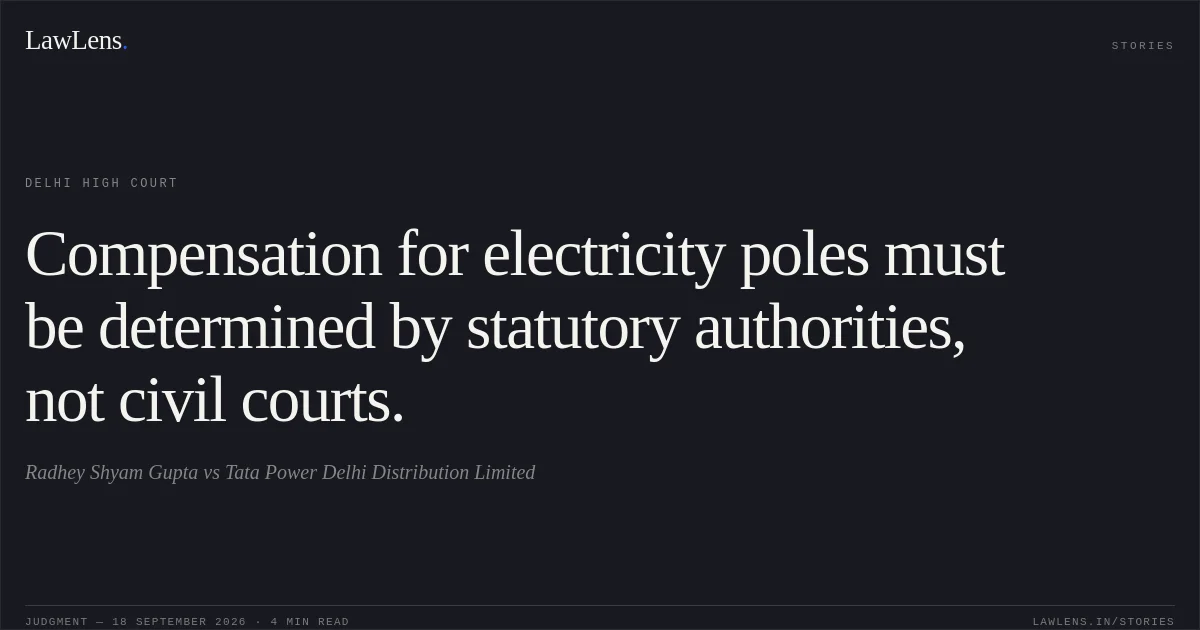
Source reference: para. 48Nevertheless, the Court held that disputes concerning compensation for the erection of poles and laying of wires fell within the statutory mechanism under Section 67 and Rule 3, and therefore could not be adjudicated by the Civil Court.
Source reference: paras. 55–59Independently, the Plaintiff failed to prove the claimed damages of ₹50,000 per month: he produced only circle-rate material and did not establish diminution in property value, the affected area, the nature of the land, or any rational basis for the claimed amount.
Source reference: paras. 60–66The Court consequently found no substantial question of law arising from the concurrent findings of the courts below.
Source reference: para. 68Holding
The High Court dismissed the Regular Second Appeal, holding that the Civil Court lacked jurisdiction to determine compensation arising from the erection of electric poles and laying of electricity wires under the statutory scheme of the Electricity Act, 2003 and the Works of Licensees Rules, 2006.
It further held that the Plaintiff had failed to prove the quantum of damages claimed.
Source reference: paras. 67–69No substantial question of law arose for consideration under Section 100 CPC, and the pending applications were also dismissed.
Source reference: paras. 67–69Acts & Sections Cited
7 provisions across 2 statutes referred to in this judgment. Each provision opens on LawLens.
Code of Civil Procedure, 19082
Electricity Act, 20035
Original Court PDF
Radhey Shyam GuptavsTata Power Delhi Distribution Limited
Click to open original judgment
Original judgment, available to read, download and summarize on LawLens.in