Facts
The petitioner, a retired Time Keeper of the respondent department, sought the benefit of higher pay scales—₹515–800, revised to ₹950–1530 and thereafter ₹3050–4590—from the relevant dates, along with consequential arrears and allowances.
Source reference: para. 2He relied principally on A.L. Thakur v. State of M.P., R.K. Lakhera v. State of M.P., Bipin Kumar Bansal v. State of M.P., and other allegedly similar decisions.
Source reference: para. 2The petitioner submitted that the Coordinate Bench had granted similar relief in Bipin Kumar Bansal and that an identical petition, Sandeep Vishwakarma v. State of M.P., had been disposed of with a direction to consider the petitioner’s claim.
Source reference: para. 3The State disputed the applicability of A.L. Thakur, contending that the decision was based on Laxmi Narayan Upadhyay v. State of M.P., which had subsequently been set aside in W.P. No. 945/2001, and relied on Parmanand Kushwah v. State of M.P.
Source reference: para. 4Issues
1. Whether the petitioner’s claim for the allegedly higher pay scale and consequential arrears should be considered in light of the decisions in A.L. Thakur, R.K. Lakhera, Bipin Kumar Bansal, and other similarly situated cases.
Source reference: paras. 2–52. Whether the competent authority should determine the petitioner’s entitlement after considering the State’s objections concerning W.P. No. 945/2001 and Parmanand Kushwah.
Source reference: paras. 4–7Law Applied
Article 226 of the Constitution empowers the High Court to issue appropriate writs, orders, or directions, including a direction to a competent authority to consider and decide a representation in accordance with law.
Source reference: para. 1Where the Court has not examined the merits of an entitlement claim, the administrative authority must independently determine the claim by considering applicable precedents, the factual parity of the claimant with similarly situated employees, and any contrary or subsequent judicial decisions.
Source reference: paras. 5–7The Court directed consideration of the principles arising from A.L. Thakur v. State of M.P., R.K. Lakhera v. State of M.P., Bipin Kumar Bansal v. State of M.P., W.P. No. 945/2001, and Parmanand Kushwah v. State of M.P.
Source reference: paras. 2–5Reasoning
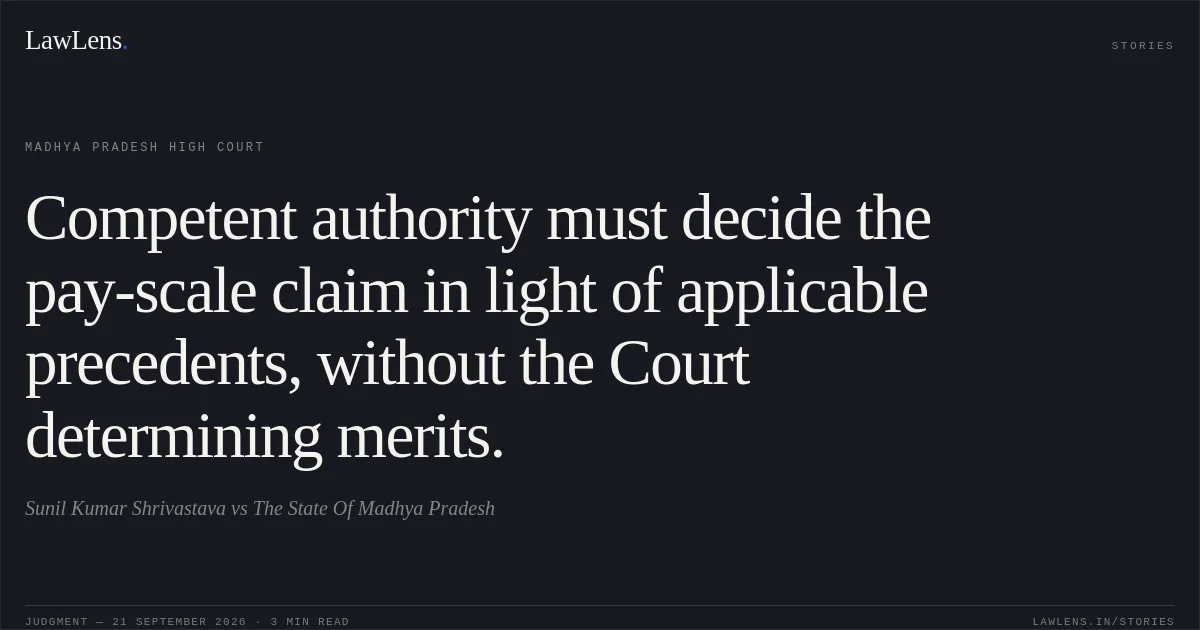
The Court did not adjudicate whether the petitioner was substantively entitled to the claimed pay scales.
Source reference: paras. 3–5Instead, considering the petitioner’s reliance on decisions granting or directing consideration of similar claims and the State’s objection that A.L. Thakur was affected by the decision in W.P. No. 945/2001, the Court adopted a limited remand/representation mechanism.
Source reference: paras. 3–5The petitioner was permitted to submit the order, petition, annexures, and a fresh representation to the competent authority.
Source reference: paras. 5–7The authority was directed to examine the claim with reference to Bipin Kumar Bansal, A.L. Thakur, W.P. No. 945/2001, Parmanand Kushwah, and the position of similarly situated employees.
Source reference: paras. 5–7The Court expressly preserved the authority’s duty to decide the matter strictly in accordance with law and clarified that it had not expressed any view on the merits.
Source reference: paras. 5–7Holding
The writ petition was disposed of without granting the claimed pay-scale benefits directly.
The petitioner was directed to submit a fresh representation, along with the relevant court order, petition, and annexures, to respondent No. 2/competent authority within two weeks.
Source reference: para. 5The competent authority must decide the representation within 90 days thereafter, after considering the cited precedents and the petitioner’s parity with similarly situated persons.
Source reference: para. 6If the petitioner is found to be similarly situated, the corresponding benefit for the applicable period must be extended to him.
Source reference: para. 6The Court expressly left the merits open and closed any pending applications.
Source reference: paras. 6–9Original Court PDF
Sunil Kumar ShrivastavavsThe State Of Madhya Pradesh
Click to open original judgment
Original judgment, available to read, download and summarize on LawLens.in