Facts
In W.P.(C) 13882/2026, Rajesh Kumar had initially instituted a suit for possession and recovery before the Commercial Court, which was rejected after the respondent invoked Section 8 of the Arbitration and Conciliation Act, 1996.
Source reference: p. 3, para. 3The arbitral proceedings were subsequently terminated on 14 April 2026 because the petitioner could not pay the requisite arbitral and institutional fees.
Source reference: p. 3, para. 3In W.P.(C) 13884/2026, M/s Sri Export Co. was the respondent in separate DIAC arbitration proceedings. Its counter-claim was dropped by the arbitrator on 29 May 2026 because the petitioner was unable to pay its share of the arbitration fees and expenses.
Source reference: p. 3, para. 4The petitioners contended that they were effectively remediless because the arbitration clauses prevented them from pursuing their claims before civil or commercial courts, while their financial incapacity prevented them from prosecuting their claims or counter-claims in arbitration.
Source reference: p. 3, para. 5Issues
Whether a party unable to pay its share of the arbitral deposit on account of financial incapacity is entitled to waiver or deferment of arbitral and DIAC fees, notwithstanding Section 38(2) of the Arbitration and Conciliation Act, 1996 and the applicable DIAC Rules.
Source reference: pp. 3–6, paras. 6–13Whether the Court could direct the Union of India, the Government of the National Capital Territory of Delhi, or DIAC to formulate rules or policies providing financial or structural assistance to indigent claimants and counter-claimants in arbitration proceedings.
Source reference: p. 6, para. 14Whether relief could be granted against the impugned orders without a challenge to the constitutional validity of Section 38 of the Arbitration and Conciliation Act, 1996.
Source reference: p. 6, para. 15Law Applied
The Court applied Section 38(1) and (2) of the Arbitration and Conciliation Act, 1996, under which arbitral deposits may be fixed as advances towards arbitration costs, payable equally by the parties; if one party fails to pay, the other may pay its share, but if neither party pays, the arbitral tribunal may suspend or terminate the proceedings concerning the claim or counter-claim.
Source reference: pp. 4–5, paras. 9–11The Court also relied on Rule 33.5 of the DIAC (Arbitration Proceedings) Rules, 2023, concerning payment of arbitral and institutional fees.
Source reference: p. 3, para. 6In Harshbir Singh Pannu v. Jaswinder Singh, 2025 SCC OnLine SC 2742, the Supreme Court recognised that Section 38(2) empowers an arbitral tribunal to terminate proceedings where the requisite deposit is not paid.
Source reference: p. 5, para. 12The Court further held that formulation of a policy or framework for financial assistance to indigent parties was a legislative or policy matter beyond the scope of the relief sought under Article 226.
Source reference: p. 6, para. 14Reasoning
The Court interpreted Section 38 as expressly permitting suspension or termination of arbitral proceedings where the requisite deposit remains unpaid by both parties.
Source reference: pp. 4–5, paras. 9–11Since the statutory scheme does not create an exception for parties who are financially incapable of paying arbitral fees, the Court declined to read into Section 38 a power to waive or defer such payments on grounds of indigency.
Source reference: p. 6, para. 13The termination of the first petitioner’s arbitration and the dropping of the second petitioner’s counter-claim were therefore consistent with the statutory framework.
Source reference: p. 6, para. 13The Court also held that directing the respondents to formulate a financial-support policy would amount to judicial legislation or policy-making, which could not be ordered in the exercise of Article 226 jurisdiction.
Source reference: p. 6, para. 14Finally, because the petitioners had not challenged the constitutional validity of Section 38, the Court found no basis to grant relief against orders passed in accordance with that provision.
Source reference: p. 6, para. 15Holding
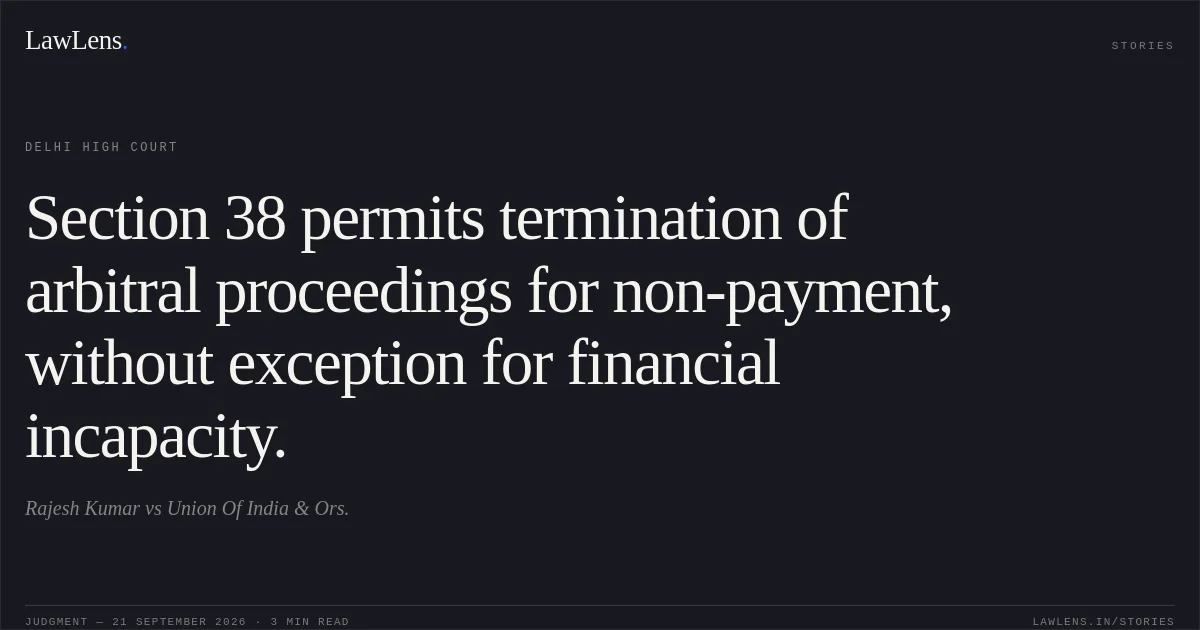
The Court held that financial incapacity does not entitle a party to waiver or deferment of its share of arbitral or institutional fees under Section 38 of the Arbitration and Conciliation Act, 1996.
It further held that the Court could not direct the respondents to frame a policy or rules providing financial assistance to indigent parties in arbitration, particularly in the absence of a constitutional challenge to Section 38.
Source reference: pp. 6–7, paras. 13–16Both writ petitions were accordingly dismissed, and all pending applications were disposed of.
Source reference: p. 7, paras. 16–17Acts & Sections Cited
4 provisions across 1 statute referred to in this judgment. Each provision opens on LawLens.
Arbitration and Conciliation Act, 19964
Original Court PDF
Rajesh KumarvsUnion Of India & Ors.
Click to open original judgment
Original judgment, available to read, download and summarize on LawLens.in