Facts
The opposite party no. 1 instituted Title Suit No. 241 of 2023 before the Civil Judge, Senior Division, Additional Court, Hooghly Sadar, seeking declarations, accounts and permanent injunction against the petitioners and other defendants.
Source reference: para. 2The petitioners applied under Order XI Rule 14 of the Code of Civil Procedure, 1908 (“CPC”) for production of documents allegedly in the opposite party’s possession.
Source reference: para. 3The opposite party filed an application under Order XXXIX Rule 7 CPC seeking inspection of the business’s cash books, bank accounts and income-and-expenditure records, preparation of a balance sheet, and submission of profit-and-loss accounts.
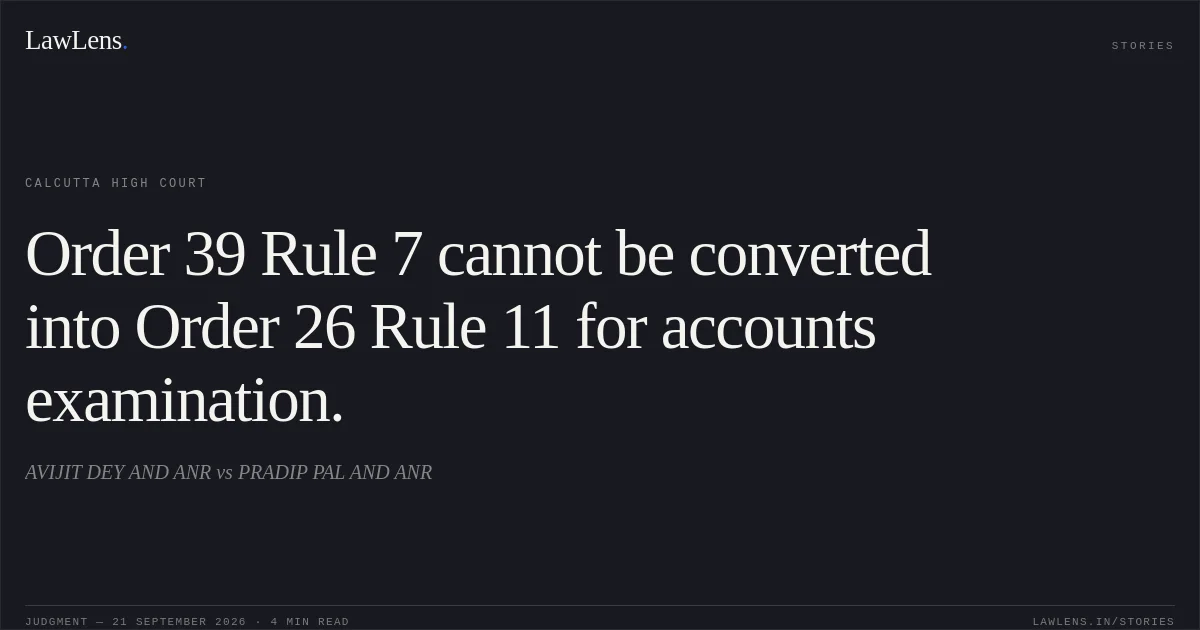
Source reference: paras. 3–4By order dated 1 February 2025, the Trial Court rejected the petitioners’ request without granting relief and allowed the opposite party’s application by treating it as one under Order XXVI Rule 11 CPC.
Source reference: paras. 5, 18–19It appointed an Accounts Commissioner to inspect the business records, prepare a balance sheet and report whether the business was a partnership or proprietorship concern.
Source reference: paras. 5, 18–19The petitioners challenged that order in revision, contending that the inspection amounted to a fishing inquiry and that the Trial Court had improperly delegated a judicial function to the Commissioner.
Source reference: paras. 6–11Issues
1. Whether the Trial Court was justified in allowing an application under Order XXXIX Rule 7 CPC, or converting it into an application under Order XXVI Rule 11 CPC, to direct a broad inspection and examination of the business’s financial records without a properly established prima facie basis.
Source reference: paras. 10–11, 23–262. Whether the Trial Court could direct the Accounts Commissioner to determine whether the business was a partnership or proprietorship concern, thereby delegating an essential judicial function.
Source reference: para. 233. Whether the Trial Court’s disposal of the petitioners’ application under Order XI Rule 14 CPC was based on the pleadings and materials on record.
Source reference: paras. 20–22Law Applied
Order XI Rule 14 CPC provides the procedural mechanism for compelling production of documents in a party’s possession or power; Order XXXIX Rule 7 CPC concerns the detention, preservation, inspection or examination of property relevant to the suit and cannot ordinarily be used for a roving or fishing inquiry; and Order XXVI Rule 11 CPC concerns the appointment of a Commissioner for examination of accounts.
Source reference: no citationThe Court relied on The Institution of Engineers (India) & Another v. Bishnu Pada Bag & Another, 1977 SCC OnLine Cal 266, and The Owners and Parties Interested in the Vessel M.V. “Baltic Confidence” v. The State Trading Corporation of India Ltd. & Another, 1999 SCC OnLine Cal 339, for the principle that an order of inspection requires a prima facie basis and cannot be employed to fish for evidence.
Source reference: para. 11The Court further held that a Commissioner cannot be authorised to decide an essential issue in the suit, such as the legal nature of the business; that determination remains for the Court.
Source reference: para. 23Although the opposite party relied on Section 6 of the Indian Partnership Act, 1932, arguing that the real relationship between the parties, and not the nomenclature of the business, determines whether a partnership exists, the High Court did not finally decide that substantive issue.
Source reference: para. 12Reasoning
The High Court found that the Trial Court’s reasoning was not founded on the pleadings.
Source reference: para. 18The Trial Court proceeded on the basis that the opposite party had stated that his documents were kept at the business premises and that he was denied entry; however, the opposite party’s written objection expressly denied that he lacked documents showing his proprietorship or the petitioners’ status as employees.
Source reference: paras. 18–22The Trial Court therefore relied substantially on counsel’s submissions rather than the material on record.
Source reference: paras. 20–22Further, the direction to inspect daily cash books, bank accounts and several years’ financial records and to prepare a balance sheet constituted an intrusive financial inquiry unsupported by an adequate prima facie case.
Source reference: paras. 23–24If documents were required from the petitioners, the opposite party could invoke the specific discovery, production or inspection mechanisms under the CPC; the Trial Court was not justified in bypassing those procedures by converting an Order XXXIX Rule 7 application into one under Order XXVI Rule 11.
Source reference: paras. 25–26Finally, directing the Commissioner to determine whether the business was a partnership or proprietorship effectively delegated the adjudication of a substantive issue that was for the Trial Court to decide.
Source reference: para. 23Holding
The High Court answered the issues in the negative.
It held that the Trial Court had acted impermissibly by relying on matters not supported by the pleadings, ordering a broad financial inspection without sufficient justification, converting the application under Order XXXIX Rule 7 CPC into one under Order XXVI Rule 11 CPC, and delegating to the Commissioner the determination of the nature of the business.
Source reference: paras. 23–26The order dated 1 February 2025 was set aside, and the matter was remanded to the Trial Court for fresh consideration after hearing the parties in accordance with law.
Source reference: para. 27The Trial Court was directed to decide the matter independently and without being influenced by the High Court’s observations on the merits.
Source reference: para. 28The revision was disposed of without costs.
Source reference: para. 29Acts & Sections Cited
1 provisions across 1 statute referred to in this judgment. Each provision opens on LawLens.
Indian Partnership Act, 19321
Original Court PDF
AVIJIT DEY AND ANRvsPRADIP PAL AND ANR
Click to open original judgment
Original judgment, available to read, download and summarize on LawLens.in