Facts
The appellant (original complainant) filed a criminal complaint under Section 138 of the Negotiable Instruments Act, 1881, regarding a dishonoured cheque.
Source reference: p.1By judgment dated 26.04.2018, the Additional Chief Judicial Magistrate, Deesa, acquitted the accused.
Source reference: p.1The appellant approached the High Court via Section 378 of the Code of Criminal Procedure (CrPC).
Source reference: p.2During the pendency of the appeal, a legal question arose regarding the proper appellate forum in light of recent Supreme Court jurisprudence concerning the rights of "victims" in dishonour of cheque cases.
Source reference: p.2Issues
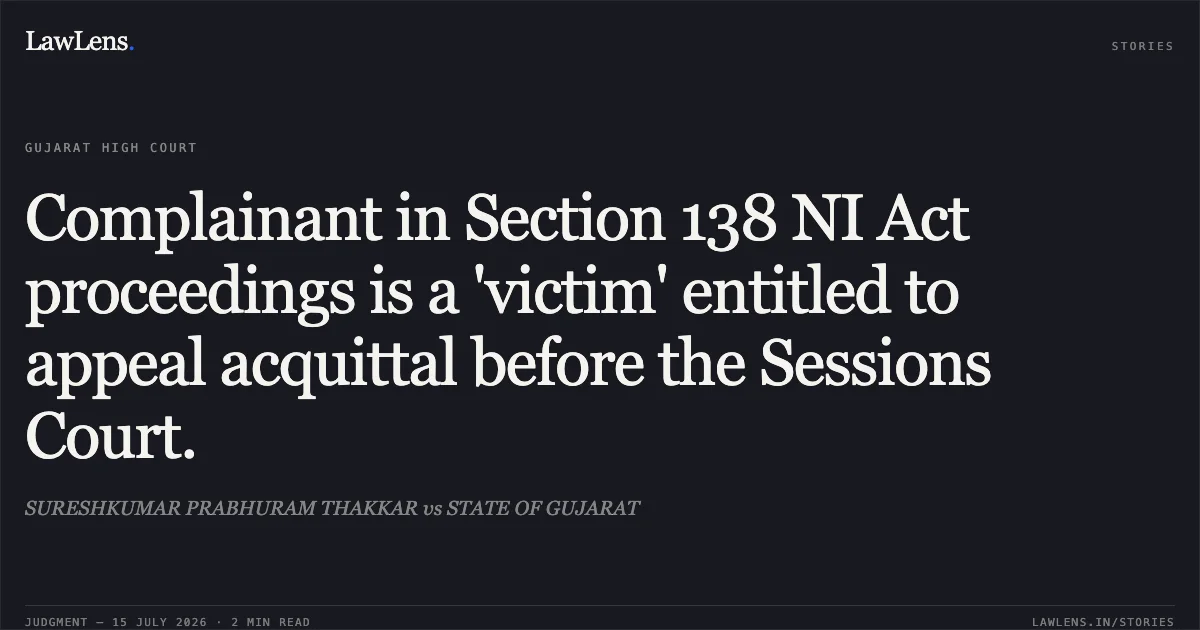
1. Whether a complainant in a case under Section 138 of the Negotiable Instruments Act is considered a "victim" and possesses a right to file an appeal against acquittal before the Sessions Court under the proviso to Section 372 of the CrPC / Section 413 of the BNSS.
Source reference: para 3-42. Whether the present appeal filed before the High Court should be transferred to the concerned Sessions Court for adjudication.
Source reference: para 8Law Applied
Proviso to Section 372 of the CrPC (now Section 413 of the BNSS), which grants a victim the right to appeal against an order of acquittal to the court to which an appeal ordinarily lies against a conviction.
Source reference: p.2Precedent established by the Supreme Court in Celestium Financial v. A. Gnanasekaran Etc. (2025 (3) GLH 747), which held that a complainant in a Section 138 NI Act proceeding is a "victim" as defined under Section 2(wa) of the CrPC.
Source reference: para 7.8, 7.12Reference for a larger bench in Special Leave to Appeal (Crl.) No. 12350/2024, while noting that existing authoritative pronouncements currently support the victim's right to appeal to the Sessions Court.
Source reference: para 6Reasoning
The Court observed that because a complainant in a Section 138 case suffers the impact of cheque dishonour, they fall squarely within the definition of a "victim".
Source reference: para 7.8Drawing from Celestium Financial, the Court reasoned that a victim’s right to appeal is a substantive, absolute right that should not be unnecessarily circumscribed by the requirement of seeking "special leave" under Section 378(4) of the CrPC, as is required for complainants in private complaints who are not victims.
Source reference: para 7.12The Court found that since the Sessions Court is the immediate superior hierarchy to the Magistrate, the appeal against acquittal should be heard there as an appeal by a victim rather than at the High Court level under Section 378.
Source reference: para 4-5Holding
The High Court held that the complainant has a specific right to prefer an appeal to the Sessions Court as a victim.
The High Court disposed of the appeal by directing the Registry to transfer the entire record and proceedings to the concerned Sessions Court.
Source reference: para 8The Sessions Court was directed to treat the matter as an appeal under the proviso to Section 372 of the CrPC / Section 413 of the BNSS and to make an endeavor to dispose of it expeditiously given the time already lapsed.
Source reference: para 8-9Acts & Sections Cited
9 provisions across 3 statutes referred to in this judgment. Each provision opens on LawLens.
Code of Criminal Procedure, 19735
Bharatiya Nagarik Suraksha Sanhita, 20232
Negotiable Instruments Act, 18812
Original Court PDF
SURESHKUMAR PRABHURAM THAKKARvsSTATE OF GUJARAT
Click to open original judgment
Original judgment, available to read, download and summarize on LawLens.in