Facts
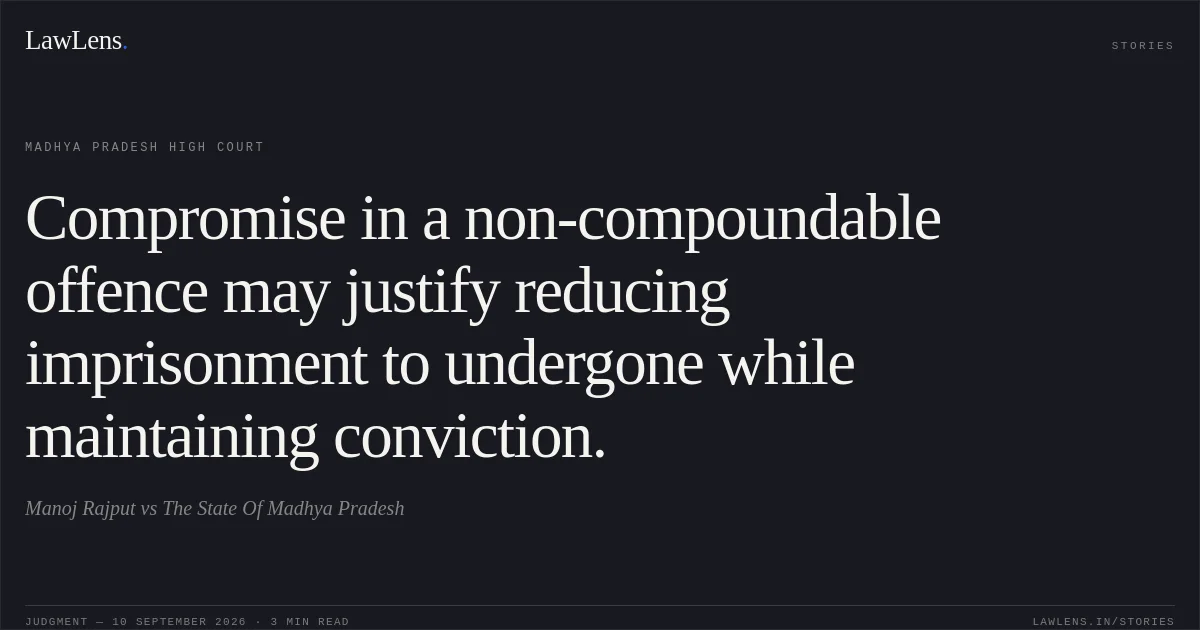
The appellant was convicted by the Additional Sessions Court, Bareli, District Raisen, in S.T. No. 183/2022 for an offence punishable under Sections 329/34 of the Indian Penal Code and sentenced to five years’ rigorous imprisonment with a fine of ₹2,000 and default stipulations.
Source reference: para. 2The prosecution alleged that, during a marriage ceremony, the complainant, Soberan Singh, was allegedly restrained and assaulted by the appellant and a delinquent juvenile after a dispute concerning consumption of alcohol and a demand for ₹200.
Source reference: para. 3The juvenile allegedly assaulted the complainant with an axe, while the appellant allegedly assaulted him with hands and fists; the complainant sustained injuries, including a fracture to the wrist/ulna.
Source reference: para. 3During the pendency of the appeal, the injured complainant and the appellant entered into a compromise, which was verified by the Registrar (J-II).
Source reference: para. 5Issues
Whether the compromise between the parties could be considered for reducing the sentence even though the offence under Sections 329/34 IPC was non-compoundable?
Source reference: paras. 5–9Whether, in the circumstances of the case, the appellant’s sentence of five years’ rigorous imprisonment should be reduced to the period already undergone?
Source reference: paras. 10–12Law Applied
The Court considered the offence under Sections 329/34 IPC and the compromise provisions under Section 359(2), (5) and (8) of the Bharatiya Nagarik Suraksha Sanhita, 2023.
Source reference: paras. 2, 5It applied the principle that a non-compoundable offence cannot be formally compounded contrary to the statutory scheme; however, a compromise may be treated as a relevant mitigating circumstance while determining the quantum of sentence.
Source reference: para. 7This principle was drawn from Murali v. State (represented by Inspector of Police), (2021) 1 SCC 726, which relied on Ishwar Singh v. State of M.P., (2008) 15 SCC 667, and recognised that compromise, familial relationship, lapse of time, and the accused’s circumstances may justify reducing imprisonment to the period already undergone even in a non-compoundable offence.
Source reference: para. 7The Court also relied on Surendra Nath Mohanty v. State of Orissa, (1999) 5 SCC 238, and Ram Pujan v. State of Uttar Pradesh, (1973) 2 SCC 456, for the proposition that compromise may be considered in sentencing although it does not result in legal compounding of the offence.
Source reference: paras. 8–9Reasoning
The Court maintained the conviction because the compromise could not legally compound the non-compoundable offence.
Source reference: paras. 7, 12However, it treated the compromise as a mitigating circumstance relevant to sentencing.
Source reference: para. 12The Court noted that the parties had settled the dispute, were members of the same family, and that the appellant’s specific role was limited to assaulting the complainant with hands and fists; the more serious axe assault and the fracture to the wrist were attributed to the delinquent juvenile.
Source reference: para. 12The Court further considered that no fracture was reported on the complainant’s head and that the appellant had already remained in custody for approximately one month and twenty days after conviction.
Source reference: paras. 10, 12Applying the principles in Murali, Surendra Nath Mohanty and Ram Pujan, the Court concluded that continued incarceration was unnecessary despite the offence remaining non-compoundable.
Source reference: paras. 7–9, 12Holding
The appeal was partly allowed.
The appellant’s conviction under Sections 329/34 IPC was affirmed, but his sentence of five years’ rigorous imprisonment was reduced to the period already undergone; the fine of ₹2,000 imposed by the trial Court was maintained.
Source reference: para. 12The Court directed that the appellant be released forthwith if he was not required in any other case, and ordered return of the trial Court record.
Source reference: paras. 13–14Acts & Sections Cited
2 provisions across 1 statute referred to in this judgment. Each provision opens on LawLens.
Bharatiya Nagarik Suraksha Sanhita, 20232
Original Court PDF
Manoj RajputvsThe State Of Madhya Pradesh
Click to open original judgment
Original judgment, available to read, download and summarize on LawLens.in