Facts
The respondent, a Government servant with about 38 years of service, was compulsorily retired at age 58 under Article 226(2) of the Jammu and Kashmir Civil Services Regulations, 1956 (JKCSR), by Government Order dated 21 November 2016.
Source reference: para. 1, 3–4, 9–11The State stated that the Screening/Review Committee considered his service record, a pending vigilance case alleging demand and acceptance of a bribe, and his reputation.
Source reference: para. 1, 3–4, 9–11The respondent challenged the order, relying on his service record and disputing the allegations; the learned Single Judge quashed the order and directed reinstatement with consequential benefits.
Source reference: para. 5, 13–16The State appealed.
Source reference: para. 1Issues
1. Whether the learned Single Judge exceeded the limited scope of judicial review by reassessing the material supporting the respondent’s compulsory retirement?
Source reference: para. 2, 6–82. Whether the Committee’s consideration of the respondent’s service record, vigilance case and reputation provided a lawful basis for forming the opinion that his continued service was not in the public interest?
Source reference: para. 20, 25–28Law Applied
Article 226(2) of the JKCSR authorises premature retirement in public interest after the prescribed service or age threshold.
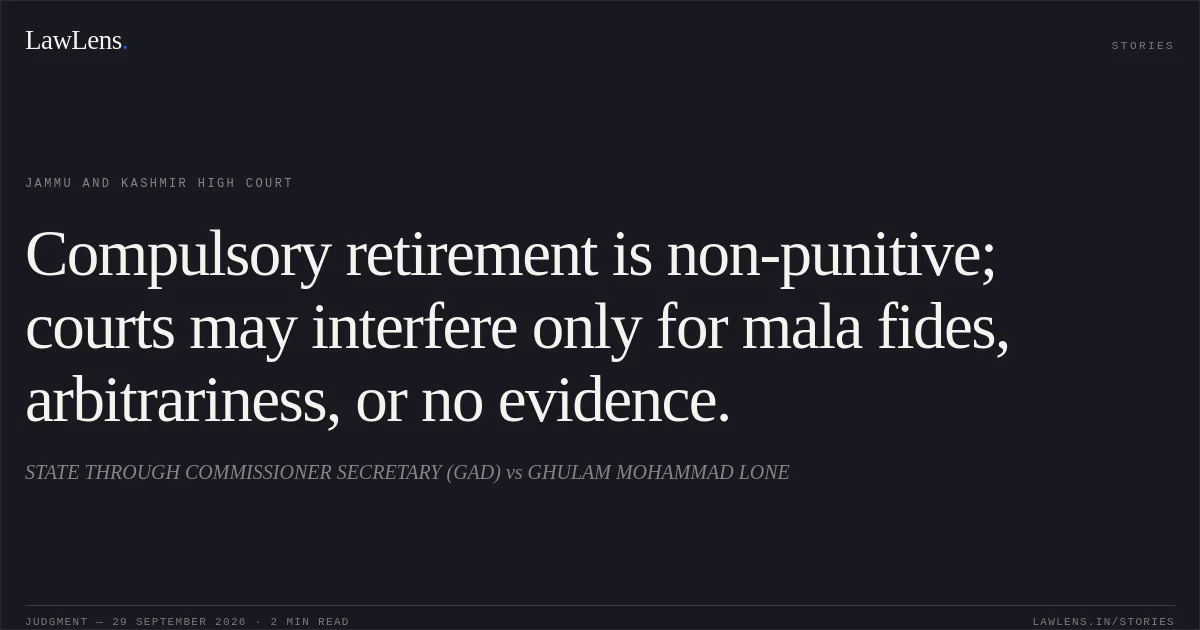
Source reference: para. 3, 18Under Baikuntha Nath Das v. Chief District Medical Officer, Baripada, (1992) SCC OnLine SC 336, compulsory retirement is not punishment; the authority must consider the entire service record, with greater weight to later years, and judicial interference is warranted where the decision is mala fide, based on no evidence, arbitrary or perverse.
Source reference: para. 19The Division Bench’s decision in State of Jammu and Kashmir v. Ahsan-ul-Haq Khan, LPASW No. 171/2018, decided 30 December 2025, reiterates that the authority’s subjective satisfaction must rest on cogent, relevant material and is reviewable for mala fides, arbitrariness, absence of evidence, reliance on extraneous considerations, or failure to consider relevant material.
Source reference: para. 18Reasoning
The Court treated the order as an administrative measure, not a punishment, and held that the pending criminal case need not have resulted in conviction to be relevant to the public-interest assessment.
Source reference: para. 20, 26–27The respondent’s service record, vigilance involvement and reputation had been considered by a duly constituted Committee; the APRs for 2011–12 to 2014–15 were generally satisfactory/average, rather than establishing a right to continued retention.
Source reference: para. 28–29Applying the limited-review standard, the Court concluded that it could not substitute its assessment for the competent authority’s where the decision was based on relevant material and no reviewable defect was established.
Source reference: para. 22, 27–30Holding
The Court allowed the appeal, set aside the Single Judge’s judgment dated 5 October 2018, and upheld Government Order No. 1264-GAD of 2016 dated 21 November 2016, compulsorily retiring the respondent.
Original Court PDF
STATE THROUGH COMMISSIONER SECRETARY (GAD)vsGHULAM MOHAMMAD LONE
Click to open original judgment
Original judgment, available to read, download and summarize on LawLens.in