01Facts
The petitioner instituted a contempt petition alleging wilful disobedience of the judgment dated 27 April 2026 in W.P.(C) 2439/2020, particularly paragraph 65(g), which concerned payment of back wages subject to specified conditions.
p. 1 · ¶ 1–2The respondent relied on paragraph 65(d) of the original judgment and asserted that he had acted pursuant to the liberty granted therein to initiate disciplinary proceedings.
p. 2 · ¶ 3–5The respondent issued an intimation dated 21 May 2026 regarding initiation of disciplinary proceedings and subsequently issued a memorandum of charges dated 8 June 2026 under Rule 25(3) of the applicable Conduct, Discipline and Appeal Rules.
p. 2 · ¶ 4 · p. 3 · ¶ 6The petitioner had not filed a reply to the charge sheet despite a further letter dated 30 June 2026.
p. 3 · ¶ 7–9The petitioner nevertheless contended that his claim for back wages under paragraph 65(g) had not been considered.
p. 5 · ¶ 1002Issues
i.Whether the respondent wilfully disobeyed the directions contained in paragraph 65(g) of the judgment dated 27 April 2026 in W.P.(C) 2439/2020.
p. 1 · ¶ 1–2ii.Whether the respondent’s initiation of disciplinary proceedings and issuance of the charge sheet satisfied the conditional directions contained in the original judgment, thereby negating contempt.
p. 5 · ¶ 10–1203Law Applied
Contempt jurisdiction is attracted only where there is clear and wilful disobedience of a binding judicial direction.
A conditional direction must be construed in accordance with the condition attached to it.
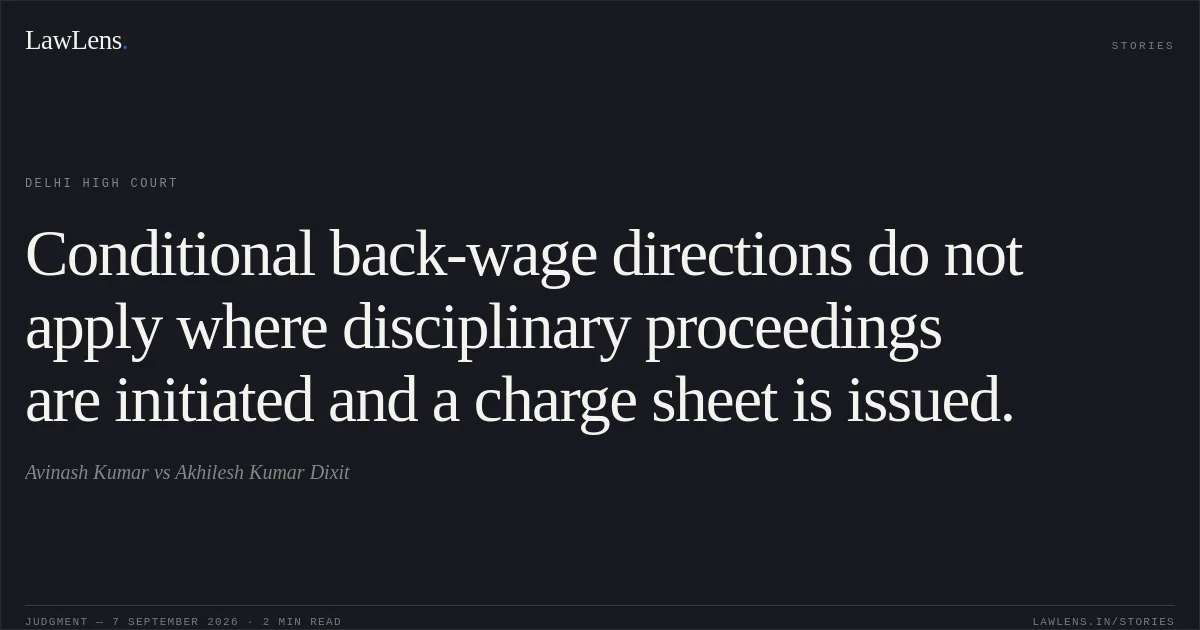
The Court treated paragraph 65(g) of the original judgment as conditional, applicable only if the respondent neither issued a charge sheet nor took a decision to initiate disciplinary proceedings against the petitioner.
p. 5 · ¶ 11The Court also recognised the respondent’s authority to initiate disciplinary proceedings under the liberty granted in the original judgment and under the applicable Conduct, Discipline and Appeal Rules, including Rule 25(3).
p. 2 · ¶ 4–5 · p. 3 · ¶ 604Reasoning
The Court held that paragraph 65(g) could not be read in isolation as creating an immediate and unconditional obligation to pay back wages. Its operation depended on the respondent not issuing a charge sheet and not deciding to initiate disciplinary proceedings.
p. 5 · ¶ 11The respondent had communicated the decision to initiate disciplinary proceedings on 21 May 2026 and had issued a charge sheet on 8 June 2026 under Rule 25(3).
p. 2 · ¶ 4 · p. 3 · ¶ 6These actions fulfilled the condition contemplated by the original judgment and demonstrated that the respondent had proceeded in accordance with the liberty granted by the Court.
Consequently, the alleged non-consideration or non-payment of back wages under paragraph 65(g) did not establish wilful disobedience.
p. 5 · ¶ 10–1205Holding
The Court answered the contempt question in favour of the respondent.
p. 5 · ¶ 11–13Since disciplinary proceedings had been initiated and a charge sheet had already been issued, the conditional direction concerning back wages under paragraph 65(g) was not attracted.
p. 5 · ¶ 11–13The Court found no wilful disobedience and dismissed the contempt petition for lack of merit.
p. 5 · ¶ 11–13Original Court PDF
Avinash KumarvsAkhilesh Kumar Dixit
Click to open original judgment
Original judgment, available to read, download and summarize on LawLens.in