Facts
The Appellant, Global Energy Private Limited (GEPL), a power trading company, filed an appeal against a 2016 order of the MERC.
Source reference: p.2, paras. 1-2During the pendency of the appeal, GEPL was admitted into Corporate Insolvency Resolution Process (CIRP) on 02.12.2019.
Source reference: p.4, para. 12Due to successive failures of Interim Resolution Professionals (IRPs) to represent the company and a general lack of prosecution, the Appellate Tribunal for Electricity (APTEL) dismissed the appeal on 12.02.2024.
Source reference: p.3, para. 8A resolution plan was subsequently approved by the NCLT on 03.07.2024 (corrected on 27.08.2024).
Source reference: p.4, para. 13The Successful Resolution Applicant (SRA), through a nominee of the Monitoring Committee, filed an application for restoration (IA 1759/2025) along with an application to condone a delay of 421 days (IA 1760/2025).
Source reference: p.3, paras. 9-10Issues
1. Whether the Applicant demonstrated "sufficient cause" under Section 5 of the Limitation Act to condone the inordinate delay in filing the restoration application.
Source reference: p.4, para. 112. Whether the moratorium under the IBC or the internal mismanagement by the Resolution Professional (RP) constitutes a valid legal excuse for non-prosecution post-approval of the resolution plan.
Source reference: p.8-9, paras. 27-31Law Applied
The court primarily applied Section 5 of the Limitation Act, 1963, and Order XLI Rule 19 of the CPC, which require the applicant to show "sufficient cause" for delay, interpreted with the "liberal approach" principles from Esha Bhattacharjee v. Managing Committee of Raghunathpur Nafar Academy.
Source reference: p.4, para. 13; p.12, para. 39Article 122 of the Limitation Act, which prescribes a 30-day limit for restoration.
Source reference: p.6, para. 19Preservation of assets by a Resolution Professional (RP) under the IBC as discussed in New Delhi Municipal Council v. Minosha India Ltd.
Source reference: p.9, para. 31Principle that vague claims of ill-health without medical evidence do not satisfy the burden of proof for condonation (L.K. Kaul v. Pradeep Kumar Khanna).
Source reference: p.11, para. 35Reasoning
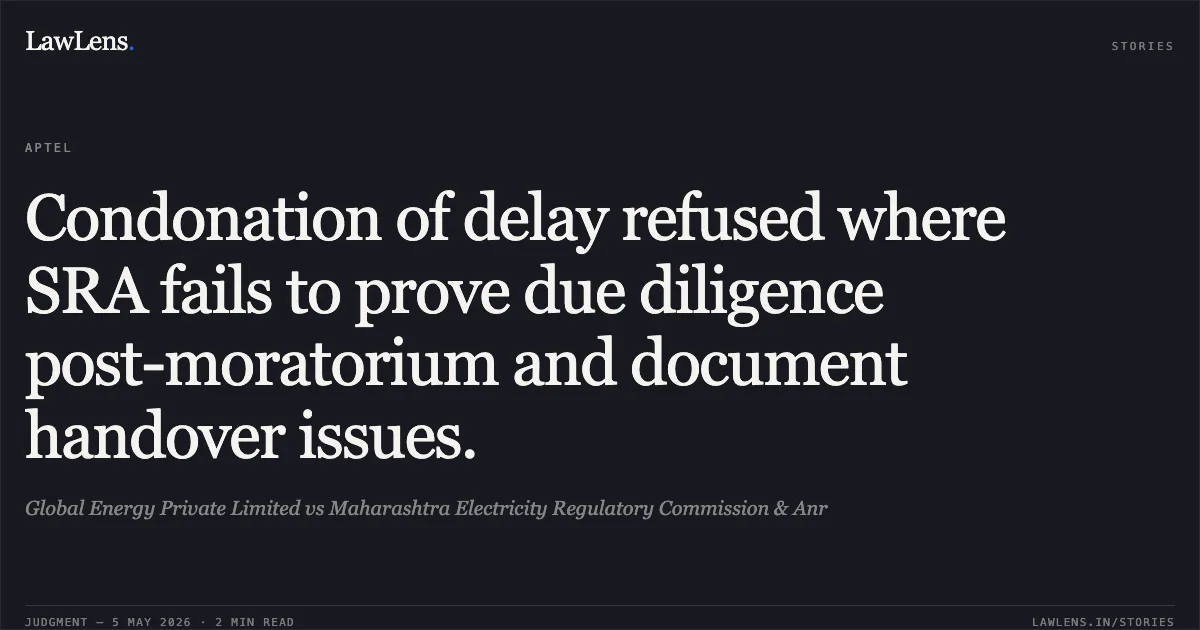
The Tribunal found the delay of 421 days to be inordinate and insufficiently explained. While acknowledging the CIRP period, the court noted that even after the NCLT’s final corrected order on 27.08.2024, the SRA failed to act within the 30-day limitation.
Source reference: p.8, para. 27The Tribunal rejected the plea of "lack of knowledge" because the SRA failed to disclose the specific date they discovered the dismissal and did not explain why they hadn't conducted "independent research" immediately upon taking control.
Source reference: p.10, para. 34Regarding the alleged non-cooperation of the RP, the Tribunal held that if the RP was failing his duties, the SRA’s proper remedy was to approach the NCLT, which they failed to do.
Source reference: p.10, para. 33The claim of the SRA’s ill-health was discarded as it was unsupported by medical records and did not explain why the Monitoring Committee (the actual applicant) could not have filed the application sooner.
Source reference: p.11-12, paras. 36-37Holding
The Tribunal dismissed IA No. 1760 of 2025, holding that the Applicant failed to establish "sufficient cause" and showed a lack of due diligence.
Consequently, the restoration application (IA No. 1759 of 2025) was dismissed as it did not survive the dismissal of the condonation plea. Appeal No. 88 of 2017 remains dismissed for non-prosecution.
Source reference: p.13, OrderActs & Sections Cited
5 provisions across 4 statutes referred to in this judgment. Each provision opens on LawLens.
Electricity Act, 20031
Insolvency and Bankruptcy Code, 2016.1
Code of Civil Procedure, 19081
Original Court PDF
Global Energy Private LimitedvsMaharashtra Electricity Regulatory Commission & Anr
Click to open original judgment
Original judgment, available to read, download and summarize on LawLens.in