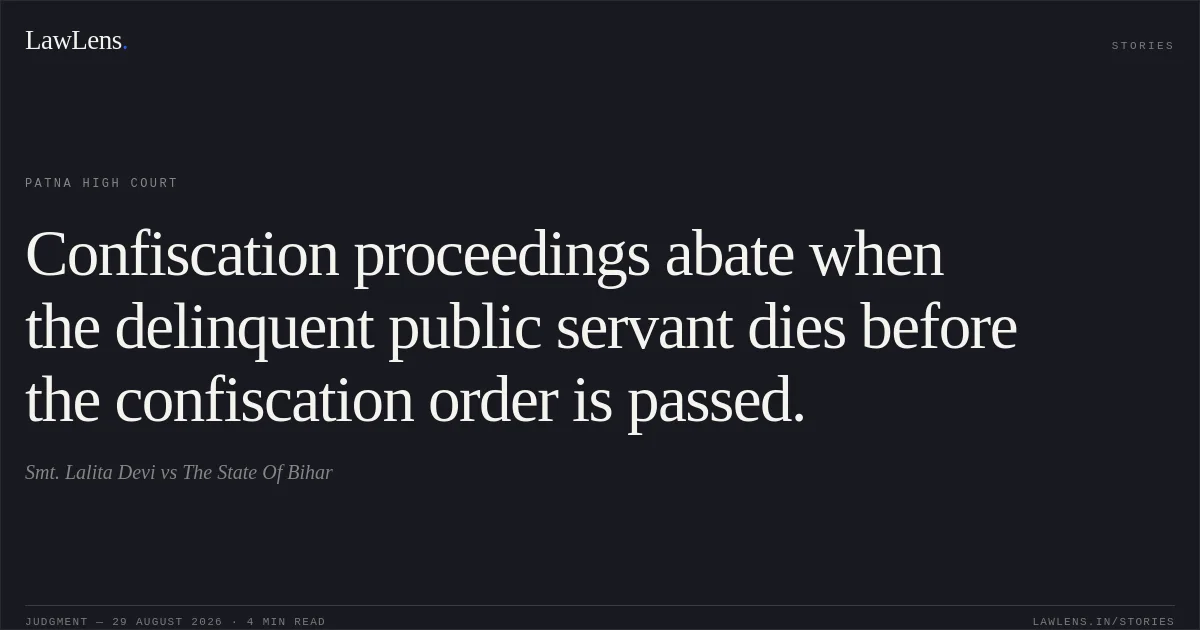
Facts
The appellant, Lalita Devi, challenged the confiscation order dated 30 September 2016 passed under the Bihar Special Courts Act, 2009, whereby movable and immovable properties standing in her name and that of her late husband, Dwarika Nath Rai, a former Superintending Engineer in the Public Health Engineering Department, were ordered to be confiscated.
Source reference: paras. 2–5; pp. 1–3The vigilance case alleged that Rai had acquired assets disproportionate to his known sources of income during the check period from February 1963 to May 1989. A chargesheet was filed against Rai and Lalita Devi for offences under the IPC and the Prevention of Corruption Act, including abetment of possession of disproportionate assets.
Source reference: para. 5; p. 2Lalita Devi’s criminal proceedings were quashed by the High Court on 20 November 2009 for want of material to proceed against her.
Source reference: paras. 24–25; pp. 14–15Confiscation proceedings were initiated on 17 April 2012. Rai died on 31 March 2016, the criminal trial against him abated on 10 June 2016, and the confiscation order was nevertheless passed on 30 September 2016.
Source reference: timeline; p. 3The State calculated total assets at Rs. 22,20,361 against alleged lawful income of Rs. 2,33,915.
Source reference: paras. 28–32; pp. 16–18Issues
Whether the confiscation proceedings and order were legally sustainable when the delinquent public servant died during their pendency and the criminal prosecution against him abated.
Source reference: paras. 37, 45–46, 54–57; pp. 21–22, 35–41, 45–47Whether the appellant’s discharge from the criminal case, after the High Court found no material to proceed against her, entitled her to the benefit applicable to an acquitted person in the confiscation proceedings.
Source reference: paras. 24–27, 47, 55–57; pp. 14–16, 40–47Whether the confiscation authority correctly determined the public servant’s known lawful sources of income and the value of the allegedly disproportionate assets.
Source reference: paras. 6–23, 36, 40–44, 49–51; pp. 3–14, 21, 25–32, 42–44Whether assets acquired or transferred beyond the check period, including post-check-period construction and an inventory prepared after the check period, could be included for confiscation.
Source reference: paras. 22–23, 35–36, 51; pp. 12–14, 20, 32–35, 44Law Applied
The Court applied Sections 13–16, 17 and 19 of the Bihar Special Courts Act, 2009: confiscation requires prima facie material and an affidavit-based application; the affected person must receive notice and a reasonable opportunity of hearing; only property acquired by means of the offence may be confiscated; transfers after notice may be rendered void; and confiscated property must be returned where the confiscation order is annulled or the affected person is acquitted.
Source reference: paras. 38, 48; pp. 22–24, 42Rules 13 and 15 of the Bihar Special Courts Rules, 2010 make the CrPC and Evidence Act applicable, insofar as consistent, to proceedings before the authorised officer.
Source reference: para. 39; p. 24“Known sources of income” means income from a lawful source which has been intimated in accordance with applicable law, rules or orders, as explained in Kedari Lal v. State of M.P.
Source reference: para. 40; pp. 25–26The Court relied on Vishwanath Chaturvedi v. Union of India for the principle that income-tax returns are not invariably conclusive, but must be scrutinised; M. Krishna Reddy v. State for allowing deductions supported by income-tax and wealth-tax records; and Nirankar Nath Pandey v. State of U.P. for the principle that the spouse’s independent lawful income must be considered in a disproportionate-assets calculation.
Source reference: paras. 41–43; pp. 26–28The Court further relied on U. Subhadramma v. State of Andhra Pradesh for the principle that proceedings founded on attachment or confiscation cannot continue to the detriment of the estate where the criminal prosecution abates on the accused’s death, and on Ex. Sqn. Ldr. R. Sood v. Union of India for the proposition that discharge, being based on absence of sufficient material to proceed to trial, places the accused in no worse position than an acquitted person.
Source reference: paras. 45–47; pp. 35–42Reasoning
The Court found that the authorised officer had failed to undertake a lawful and consistent assessment of the parties’ known sources of income.
Source reference: paras. 49–50; pp. 42–44The officer rejected the Circle Officer’s report estimating Rai’s agricultural income from 22.30 acres, principally because it was not conclusive and because the relevant income-tax returns were not produced, while simultaneously failing to properly consider Lalita Devi’s income-tax return, agricultural income, rental income and housing loan.
Source reference: paras. 49–50; pp. 42–44This selective approach was held to be arbitrary, particularly in light of the principle that the spouse’s independent lawful income must be included in assessing disproportionate assets.
Source reference: paras. 49–50; pp. 42–44The Court also held that the post-check-period inventory dated 22 April 1995 and construction of the second floor after the check period could not properly be used to inflate the assets attributable to the check period.
Source reference: paras. 51–52; p. 44Independently, Rai had died before the confiscation order was passed, and the order was based partly on written submissions filed after his death by the appellant. Since the criminal prosecution had abated and no fair opportunity could thereafter be afforded to Rai, continuation of the confiscation inquiry against his property offended principles of natural justice.
Source reference: paras. 54–56; pp. 45–47The appellant’s prior discharge, which had attained finality, was also treated as having the legal effect relevant to an acquittal for purposes of Section 19.
Source reference: paras. 47, 55; pp. 40–42, 46Holding
The High Court allowed the appeal and set aside the confiscation order dated 30 September 2016.
It held that the order was unsustainable both on merits—because lawful agricultural, rental and other income was ignored and assets outside the check period were included—and because the proceedings continued after the death of the delinquent public servant without a legally sustainable basis or adequate opportunity of hearing.
Source reference: paras. 57–59; pp. 47–48The appellant’s discharge was also treated as placing her in the position of an acquitted person for the purposes of the confiscation framework.
Source reference: paras. 57–59; pp. 47–48The confiscation order passed in Confiscation Case No. 02 of 2012 was accordingly quashed and set aside, and the record was directed to be transmitted to the trial court.
Source reference: paras. 58–60; p. 48Acts & Sections Cited
19 provisions across 5 statutes referred to in this judgment. Each provision opens on LawLens.
Indian Penal Code, 18608
Prevention of Corruption Act, 19881
BIHAR SPECIAL COURTS ACT, 20097
Bharatiya Sakshya Adhiniyam, 20231
Code of Criminal Procedure, 19732
Original Court PDF
Smt. Lalita DevivsThe State Of Bihar
Click to open original judgment
Original judgment, available to read, download and summarize on LawLens.in
![A police constable cannot be removed for unauthorized absence without a Rule 359-compliant inquiry.. Mohammad Sidiq Khan vs D/o Home Ut Of Jammu & Kashmir. CAT - ['Srinagar']. LawLens](/stories/thumbnails/a-police-constable-cannot-be-removed-for-unauthorized-absence-without-a-rule-359-compliant-7b43fc316bd94f22a62676153bbc9d54.webp)
![A Review DPC lacks authority to determine or alter inter se seniority.. SAURABH KUMAR vs REVENUE. CAT - ['Patna']. LawLens](/stories/thumbnails/a-review-dpc-lacks-authority-to-determine-or-alter-inter-se-seniority-4b21640f20af46fcabdfc8273d2ce959.webp)