01Facts
The fifth respondent held a quarry lease at S.F. No. 444/1, Sokkanur Village. Its original mining plan permitted quarrying to a depth of 27 metres; a hydrogeological report submitted for that plan stated that the water table began at 7.3 metres and water-yielding formations lay between 9 and 26 metres.
¶ 2, 14After the approved quantity had been quarried, the Joint Director approved a modified mining plan permitting quarrying to a depth of 62 metres. A later hydrogeological report submitted for the modified plan stated that aquifers were at 110–115 metres and that no major intersection with the water table was expected up to 100 metres.
¶ 2, 15The petitioner challenged the modified plan, raising concerns about a water channel and groundwater depletion. Those grounds had also been raised in earlier proceedings before the NGT and the High Court, which dismissed the challenges.
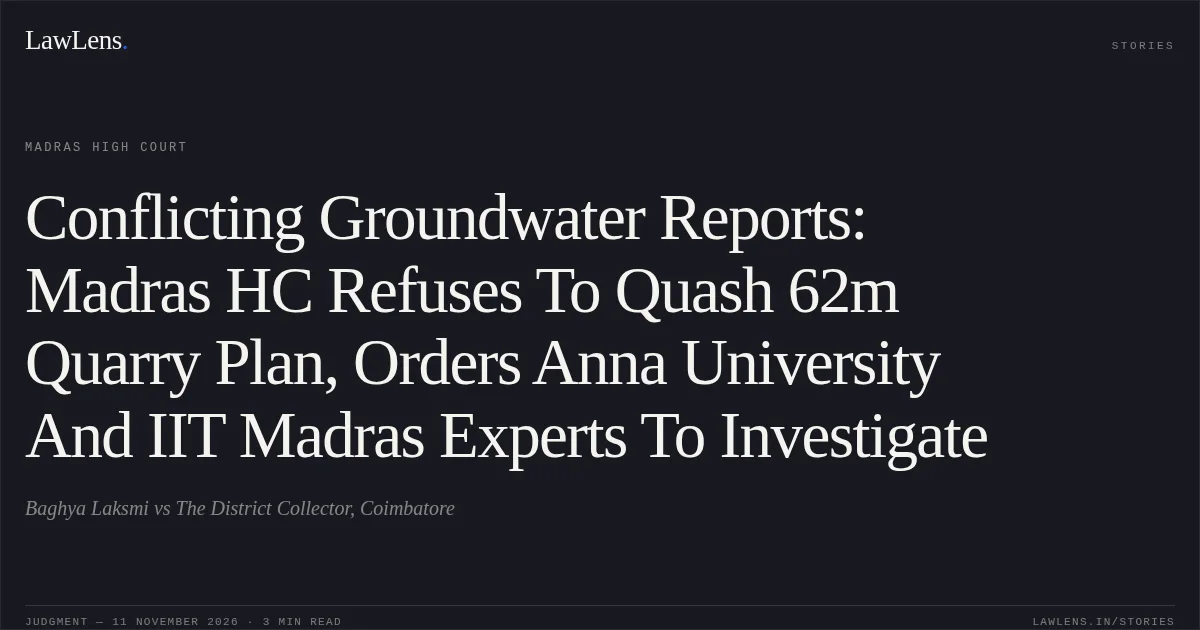
¶ 2, 13The Court refused the petitioner’s prayer but directed a further expert assessment of groundwater conditions and the potential effects of the increased mining depth.
¶ 2202Issues
i.1. Whether the petitioner could reopen grounds concerning the water channel and groundwater depletion that had been considered in the earlier litigation.
¶ 13ii.2. Whether approval of the modified mining plan could stand without the mining authority adequately considering possible groundwater interception or depletion, particularly given the materially different hydrogeological reports.
¶ 14–2003Law Applied
Rule 41 of the Tamil Nadu Minor Mineral Concession Rules, 1959 makes an approved mining plan a prerequisite to a lease and prescribes requirements for its preparation, approval, review and modification; Rule 42 is also relevant to further orders concerning a mining plan.
¶ 16 · ¶ 22(ii)(D)In Deepak Kumar v. State of Haryana, (2012) 4 SCC 629, the Supreme Court required due weight to be given to recommendations on the environmental effects of minor-mineral mining, including hydrogeological assessment for mining below the groundwater table.
¶ 17M.C. Mehta v. Union of India, (2004) 12 SCC 118, was relied on concerning groundwater depletion in the context of quarrying.
¶ 18The precautionary principle, recognised in Vellore Citizens Welfare Forum v. Union of India, (1996) 5 SCC 647, requires anticipatory protection against serious environmental harm.
¶ 19The Court also invoked the constitutional duty to protect and preserve the environment, referring to State of Telangana v. Mohd. Abdul Qasim (Died) Per Lrs., (2024) 6 SCC 461.
¶ 2104Reasoning
The Court held that the petitioner could not relitigate the previously considered grounds concerning the water channel and groundwater depletion.
¶ 13However, the contrasting hydrogeological reports raised a distinct concern relevant to the statutory approval of the modified plan: the earlier report placed water-yielding formations at 9–26 metres, while the later report placed aquifers at 110–115 metres.
¶ 14–15Because groundwater interception and depletion must be considered when modifying a mining plan—not only at the environmental-clearance stage—the authority was required to assess whether depletion had occurred during mining, whether mining caused it, and what effect increasing the permitted depth to 62 metres might have.
¶ 18–20The impugned approval did not show that this assessment had been undertaken; the Court therefore ordered an expert inquiry while declining to grant the petitioner’s requested relief.
¶ 20–2205Holding
The writ petition was disposed of, and the petitioner’s prayer to quash the modified mining-plan approval was refused.
¶ 22(i)The Joint Director was directed to engage one hydrogeological expert each from Anna University and IIT Madras to inspect the area and report on groundwater conditions, possible mining-attributable interception or depletion, and the potential effects of increasing the mining depth.
¶ 22(ii)If the assessment identified a concern or likely adverse effect, the fifth respondent was to be heard and further orders concerning the mining plan made under Rules 41 and 42.
¶ 22(ii)The exercise was to be completed within four months of receipt of the website-uploaded order; no costs were awarded.
¶ 22(ii)–(iii)Original Court PDF
Baghya LaksmivsThe District Collector, Coimbatore
Click to open original judgment
Original judgment, available to read, download and summarize on LawLens.in