Facts
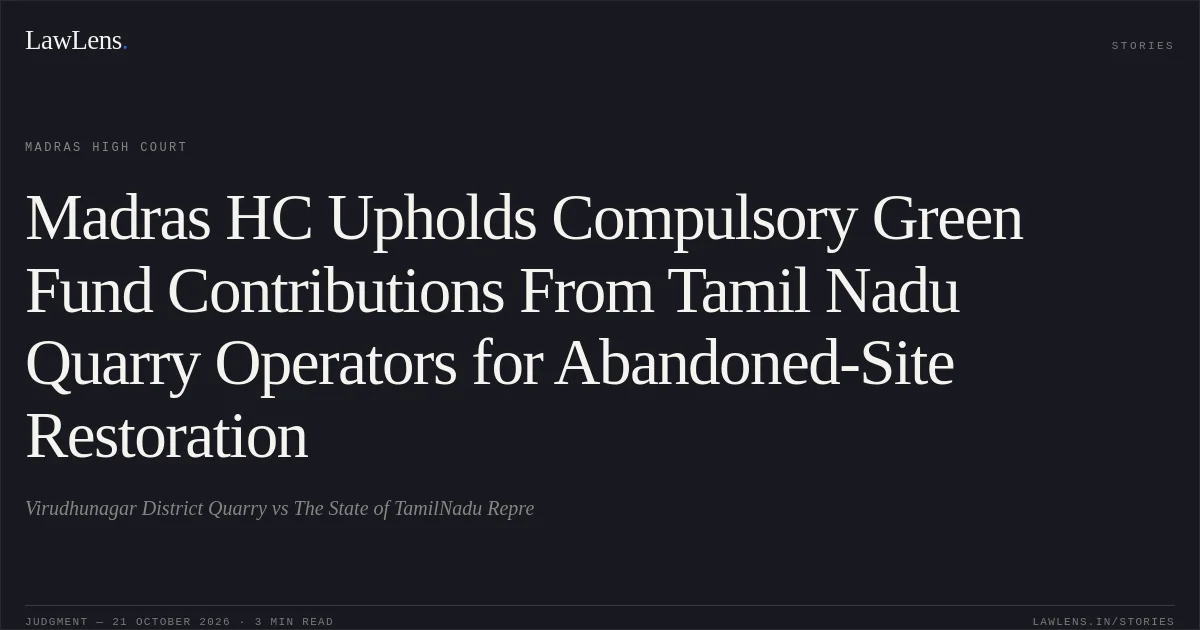
The petitioner, a registered association representing quarry owners, challenged G.O. (Ms.) No. 23, Industries (MMC.1) Department, dated 23 February 2022, which amended the Tamil Nadu Minor Mineral Concession Rules, 1959 by introducing Rules 35-A to 35-H and requiring contributions to a district Green Fund for reclamation, restoration and rehabilitation of abandoned mines or quarries.
Source reference: paras. 1, 26; pp. 2, 24–25The association argued, among other things, that the levy lacked legislative authority, was a tax in disguise, duplicated existing mining-related charges, and unreasonably restricted quarry operators’ trade.
Source reference: paras. 3–4; pp. 3–12The State defended the rules as a valid environmental regulatory contribution under the Mines and Minerals (Development and Regulation) Act, 1957 (“MMDR Act”).
Source reference: paras. 4, 16–20; pp. 8–12, 19–22Issues
Whether the petitioner association could maintain the writ petition challenging the Green Fund rules.
Source reference: paras. 6–10; pp. 13–16Whether the State had legislative authority under the MMDR Act to make the impugned rules and establish the Green Fund.
Source reference: paras. 16–20; pp. 19–22Whether the Green Fund contribution was an unauthorised tax or an unreasonable restriction on the right to carry on business under Article 19(1)(g).
Source reference: paras. 45–66; pp. 31–39Whether the Green Fund duplicated existing levies or obligations, including District Mineral Foundation contributions and amounts recoverable under Rules 22 and 28 of the 1959 Rules.
Source reference: paras. 67–85; pp. 39–47Whether the rules were inapplicable to quarrying on private patta lands or were affected by the later insertion of Section 9-D of the MMDR Act.
Source reference: paras. 24, 87–91; pp. 24, 48–49Law Applied
Under Section 15(1) and Section 15(1-A)(g)–(i) of the MMDR Act, the State may make rules regulating minor-mineral concessions, including rules concerning charges, protection of affected third parties, and rehabilitation of vegetation affected by quarrying; Sections 5–13 do not apply to minor-mineral concessions by virtue of Section 14.
Source reference: paras. 16–17, 24; pp. 19–21, 24The Court applied State of Tamil Nadu v. P. Krishnamurthy for the grounds on which subordinate legislation may be invalidated, including lack of competence, inconsistency with the parent statute or Constitution, and manifest arbitrariness.
Source reference: paras. 11–13; pp. 16–17It also relied on Deepak Kumar v. State of Haryana concerning the recommendation for a separate reclamation and rehabilitation corpus for minor-mineral mines and quarries.
Source reference: para. 19; p. 22In distinguishing a tax from a regulatory fee or contribution, the Court considered the levy’s regulatory purpose, broad relationship to the regulated industry, and earmarked use rather than requiring a direct, individual quid pro quo.
Source reference: paras. 50–66; pp. 33–39Environmental principles invoked included the polluter-pays principle, sustainable development, inter-generational equity and the public-trust doctrine, supported by Vellore Citizens’ Welfare Forum v. Union of India, Indian Council for Enviro-Legal Action v. Union of India and M.C. Mehta v. Kamal Nath.
Source reference: paras. 22, 44, 92–95; pp. 23, 31, 48–50Reasoning
The Court treated the petition as a public-interest challenge despite doubt about the association’s standing, given the broader environmental issues involved.
Source reference: para. 10; p. 16It held that Section 15 of the MMDR Act empowered the State to require contributions toward environmental rehabilitation associated with minor-mineral quarrying.
Source reference: paras. 16–20; pp. 19–22The Green Fund was not a general revenue measure: its proceeds were ring-fenced for specified reclamation, restoration and rehabilitation works within the district, and the Court found a broad regulatory connection between quarrying and those works.
Source reference: paras. 31–33, 50–60; pp. 27–28, 33–37The environmental purpose also justified the contribution as a reasonable restriction on quarrying activity.
Source reference: paras. 45–48; pp. 31–33The Court found no impermissible duplication because the DMF, Green Fund and Rules 22 and 28 served distinct purposes or operated at different stages; it further held that the Green Fund regulated mineral extraction regardless of land ownership and that Section 9-D did not apply to minor-mineral concessions in light of Section 14.
Source reference: paras. 24, 68–82, 87–91; pp. 24, 40–47, 48–49Holding
The Court upheld the Green Fund rules, rejecting the challenges based on lack of legislative competence, taxation, unreasonable restriction, duplication of levies, private-land ownership and Section 9-D of the MMDR Act.
The writ petition was dismissed, with no order as to costs; the connected miscellaneous petitions were closed.
Source reference: para. 96; p. 50Acts & Sections Cited
11 provisions across 1 statute referred to in this judgment. Each provision opens on LawLens.
Mines and Minerals (Development and Regulation) Act, 1957
Original Court PDF
Virudhunagar District QuarryvsThe State of TamilNadu Repre
Click to open original judgment
Original judgment, available to read, download and summarize on LawLens.in