01Facts
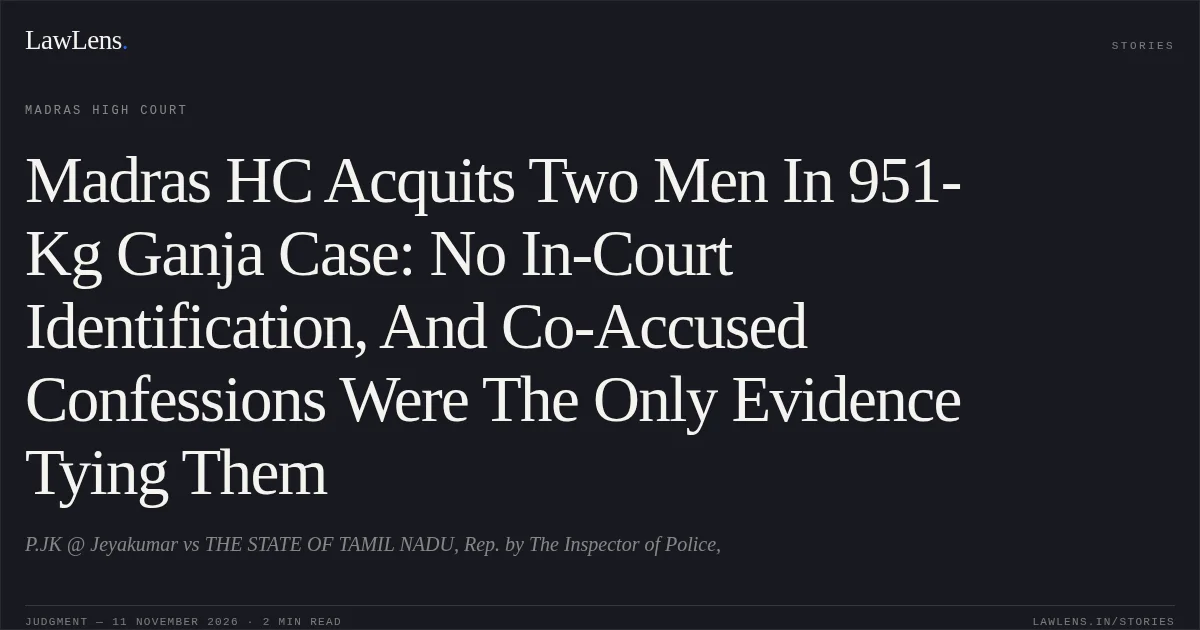
Police intercepted an Eicher lorry carrying 951 kg of ganja.
Two occupants, A-1 and A-2, were apprehended; A-3 Rajkumar and A-4 Jayakumar allegedly fled.
¶ 3–5, 12–14The trial court convicted all four under Section 8(c) read with Section 20(b)(ii)(C) of the NDPS Act and sentenced them to 20 years’ rigorous imprisonment and a fine.
¶ 3–5, 12–14A-3 and A-4 appealed; A-1 and A-2 did not.
¶ 3–5, 12–14The State did not appeal the acquittals under Sections 25 and 29(1) of the NDPS Act.
¶ 3–5, 12–14The prosecution relied on the co-accused’s statements, statements attributed to A-3 and A-4, and evidence that two persons fled from the lorry.
¶ 18, 25–26The appellants challenged the sufficiency and admissibility of that evidence.
¶ 18, 25–2602Issues
i.1. Whether the convictions and sentences imposed on A-3 and A-4 were sustainable on the evidence on record
¶ 16ii.2. Whether the co-accused’s statements and the evidence that two persons fled the scene sufficiently established the appellants’ identity and involvement in the offence
¶ 25–3103Law Applied
Under Tofan Singh v. State of Tamil Nadu, a statement recorded under Section 67 of the NDPS Act cannot be used as a confessional statement to convict an accused; officers empowered under Section 53 of that Act are “police officers” for the purposes of Section 25 of the Evidence Act.
¶ 27Under Haricharan Kurmi v. State of Bihar, a co-accused’s confession is not substantive evidence under Section 3 of the Evidence Act and cannot, by itself, sustain a conviction; it may only be considered alongside other substantive evidence.
¶ 28–30The Court also relied on Surinder Kumar Khanna v. Intelligence Officer, Directorate of Revenue Intelligence and Mohammed Fasrin v. State, concerning the need for corroborative evidence before relying on confessional material.
¶ 19, 26, 29The Court held that the statements of A-3 and A-4 to the investigating officer were inadmissible as confessions to a police officer and, alternatively, could not be used in view of Section 162 CrPC.
¶ 30Provisions in the judgment · 15 · Linked ones open on LawLens
Bharatiya Nagarik Suraksha Sanhita, 2023 Section 415
Narcotic Drugs and Psychotropic Substances Act, 1985 9 provisions
Section 8Section 20Section 29Section 25Section 57Section 42Section 50Section 67Section 53Code of Criminal Procedure, 1973 Section 167Section 207Section 313Section 161Section 162
04Reasoning
The Court found that the prosecution’s case against A-3 and A-4 rested principally on the statements of A-1 and A-2 and the statements attributed to the appellants during investigation.
¶ 26, 31The investigating-officer statements were inadmissible, while the co-accused’s confessions could not independently establish guilt.
¶ 31Although P.Ws. 1 and 2 said that two persons fled, neither identified the appellants in court; P.W. 3’s evidence on that point was hearsay, and no identification parade had been conducted.
¶ 31The Court therefore found no sufficient independent or corroborative evidence connecting either appellant to the contraband.
¶ 31–3205Holding
The Court held that the convictions and sentences of A-3 and A-4 were unsustainable and allowed both appeals.
¶ 32–33It set aside the convictions and sentences, directed that the appellants—then in custody—be released forthwith, ordered any fines paid to be refunded, and closed the connected miscellaneous petitions.
¶ 33Original Court PDF
P.JK @ JeyakumarvsTHE STATE OF TAMIL NADU, Rep. by The Inspector of Police,
Click to open original judgment
Original judgment, available to read, download and summarize on LawLens.in