01Facts
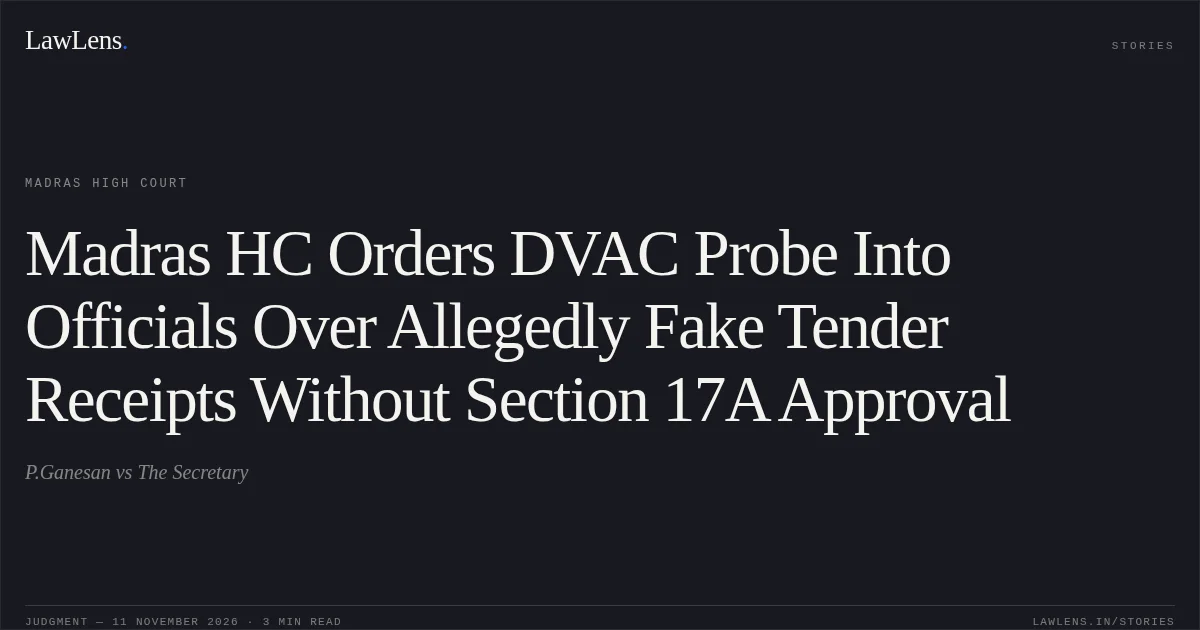
The appellant challenged the work order issued to the seventh respondent for construction of a mini stadium, alleging that the successful tenderer had submitted fabricated receipts and that officials had improperly scrutinised the tender.
pp. 5–6 · ¶ 3–4A prior status report to the Court stated that receipts submitted by the tenderer were fake and that the Vigilance and Anti-Corruption Department (DVAC) had sought approval under Section 17-A of the Prevention of Corruption Act, 1988, to conduct a preliminary enquiry against the concerned officials.
pp. 3–5 · ¶ 2The Single Judge dismissed the appellant’s writ petition, reasoning that tender evaluation was for the competent authorities and that the alleged procedural irregularity did not justify judicial interference absent demonstrated public-interest harm.
p. 6 · ¶ 4During the appeal, the Court received a report that approximately 40.90% of the work had been completed.
p. 7 · ¶ 6The Government had meanwhile declined the request for Section 17-A approval, relying on a departmental report that no tender-scrutiny irregularity had occurred.
pp. 7–8 · ¶ 7–802Issues
i.1. Whether the Government’s refusal to grant prior approval under Section 17-A, for a preliminary enquiry into the alleged acceptance of fabricated tender documents by public officials, was sustainable.
pp. 8–12 · ¶ 8–12ii.2. Whether the DVAC could proceed with an investigation or preliminary enquiry into the alleged conduct without prior approval under Section 17-A.
pp. 9–13 · ¶ 9–1303Law Applied
Section 17-A of the Prevention of Corruption Act, 1988, requires prior approval before an enquiry, inquiry or investigation into an offence alleged against a public servant where the alleged offence is relatable to a recommendation made or decision taken in discharge of official functions or duties.
pp. 9–11 · ¶ 9–10Relying on Tejaram v. State of Rajasthan, Criminal Appeal No. 4988 of 2026, decided on 16 October 2026, the Court stated that Section 17-A is not an omnibus protection: it applies where the alleged offence is connected to an official recommendation or decision, but not to a pure criminal act unconnected with official functions.
pp. 9–11 · ¶ 9Provisions in the judgment · 2
Prevention of Corruption (Amendment) Act, 2018 Section 17A
Prevention of Corruption Act, 1986 Section 17A
04Reasoning
The Court treated the alleged acceptance of fabricated documents as a criminal act distinct from the officials’ performance of their official tender-related functions, and therefore outside Section 17-A’s protective scope.
pp. 10–11 · ¶ 10It considered the earlier DVAC status report, which alleged that the contract had been awarded on the basis of fake documents, and held that the truth of that allegation required investigation.
pp. 3–5 · ¶ 2 · pp. 11–12 · ¶ 11The Court found that the Government had declined approval on the basis of the Commissioner’s report without independently enquiring into the facts, and concluded that its refusal could not prevent the DVAC from proceeding.
p. 8 · ¶ 8, 11–1205Holding
The Court quashed Government Letter (D) No. 426 dated 25 September 2026, which declined Section 17-A approval, and directed the DVAC Director to proceed with the investigation without that approval.
p. 12 · ¶ 12It impleaded the Director, Deputy Superintendent of Police and Inspector of Police of the DVAC as respondents 8 to 10, and directed the newly impleaded respondents to proceed with the investigation and file a report; respondents 2 and 3 were also directed to conduct a preliminary enquiry and report within four weeks.
pp. 12–13 · ¶ 12–13The interim injunction granted on 30 October 2026 was extended, and the matter was listed for 3 December 2026.
p. 13 · ¶ 13–14The judgment did not finally dispose of the appeal against the dismissal of the challenge to the work order.
Original Court PDF
P.GanesanvsThe Secretary
Click to open original judgment
Original judgment, available to read, download and summarize on LawLens.in