01Facts
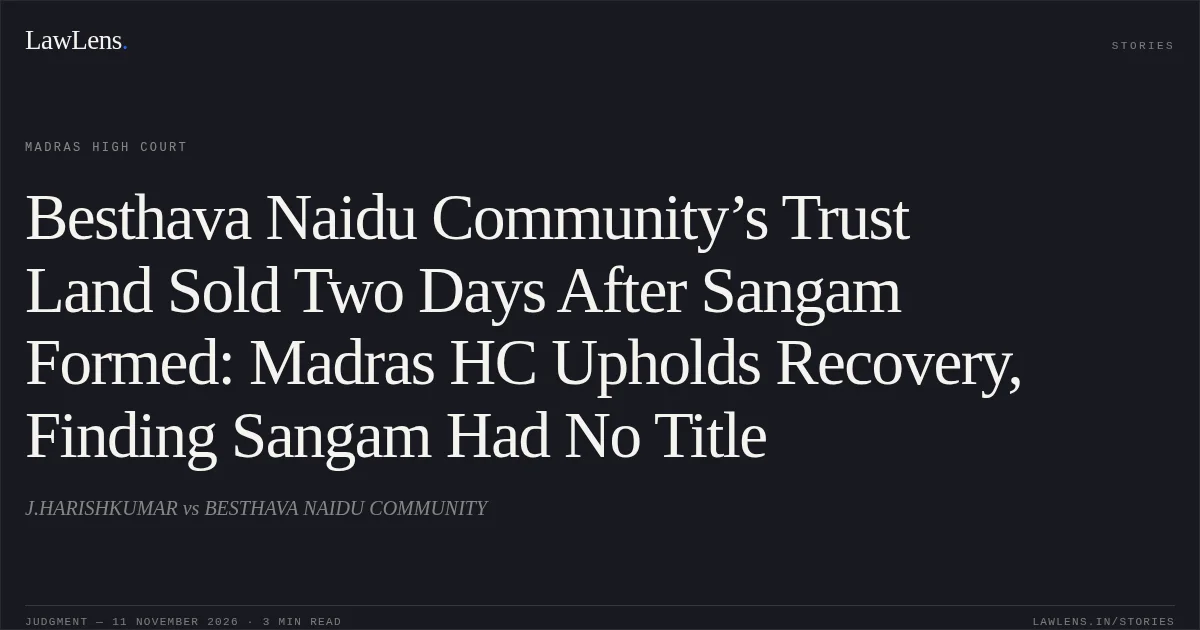
The plaintiffs, members of the Besthava Naidu Community, sued for a declaration that a 1976 sale of community property to the fourth defendant was invalid and for recovery of possession. They alleged that defendants 1–3, who managed the property as trustees, lacked authority to sell it.
¶ 3–16The defendants contended that a registered community Sangam had authorised the sale. The trial court decreed the suit, and the first appellate court affirmed. The fourth defendant’s legal representatives brought the second appeal, which was admitted on questions concerning jurisdiction and Section 92 CPC; additional questions included Order I Rule 8 CPC, non-joinder, and the validity of the sale
¶ 3–16, 19–2202Issues
i.1. Whether the suit for declaration and possession concerning public-trust property was governed by Section 92 CPC, and whether the District Munsif had jurisdiction to try it.
¶ 21, 38–43ii.2. Whether the suit was defective for non-compliance with Order I Rule 8 CPC.
¶ 44–51iii.3. Whether the suit failed because the Sangam that executed the sale was not joined, or because the amendment to the plaint’s representative description could be challenged in the second appeal.
¶ 52–67iv.4. Whether the Sangam had authority to convey the community property and whether the sale to the fourth defendant was binding on the community.
¶ 68–7603Law Applied
Section 92 CPC applies to specified proceedings concerning public trusts, including suits seeking the reliefs enumerated in that provision; not every suit concerning trust property falls within it, and a claim against a third-party purchaser to protect property rights may lie outside its scope.
¶ 39–43A trust benefiting an unascertained and fluctuating section of the public may be public.
¶ 35The court applied Order I Rule 8 CPC and held, relying on Kalyan Singh v. Chhoti, AIR 1990 SC 396, and Hari Ram v. Jyoti Prasad, AIR 2011 SC 952, that a community member may sue to protect community property; it also found that representative notice had in fact been published.
¶ 46–50Under Order I Rule 13 and Section 99 CPC, non-joinder objections must be raised at the proper stage and a decree is not to be reversed for non-joinder except where a necessary party is absent.
¶ 52–55The court further applied res judicata to the amendment issue previously determined in revision.
¶ 58–67A person or entity cannot convey a better title than it possesses (nemo dat quod non habet), and charitable or religious property must be protected against unauthorised alienation.
¶ 74–76Provisions in the judgment · 12 · Linked ones open on LawLens
Code of Civil Procedure, 1908 Section 92Section 99Section 100Section 105Section 115Section 1
Societies Registration Act, 1860 Section 6
Indian Trust Act, 1882 Section 1Section 5Section 6
Specific Relief Act, 1963 Section 32Section 34
04Reasoning
The court treated the property as belonging to a public trust for the Besthava Naidu Community, whose beneficiaries were unascertained and fluctuating.
¶ 35–36, 68–71It nevertheless held that the suit did not fall within Section 92 CPC: the plaintiffs sought to invalidate a conveyance and recover property from a third-party purchaser, rather than obtain one of the specified forms of relief concerning trust administration.
¶ 39–43The Order I Rule 8 objection failed because publication had been made and, independently, community members could sue to protect community property.
¶ 46–50The non-joinder objection had not been raised earlier, and the court considered the Sangam unnecessary to effectively decide whether defendants 1–3 could convey the property; the prior order allowing the plaint amendment also could not be reopened after its confirmation in revision.
¶ 52–67On the merits, historical records and the defendants’ own evidence supported the finding that the property belonged to the community and had not been transferred to the Sangam. As the Sangam therefore lacked title, it could not convey the property; the court also found no demonstrated necessity or justification for the sale.
¶ 68–7605Holding
The High Court answered the substantial questions against the appellants, holding that the suit was maintainable outside Section 92 CPC, that the procedural objections did not defeat it, and that the Sangam could not validly convey property that had not vested in it.
¶ 77The second appeal was dismissed; the decrees of the trial and first appellate courts were confirmed, with costs throughout. The connected miscellaneous petition was closed.
¶ 78Original Court PDF
J.HARISHKUMARvsBESTHAVA NAIDU COMMUNITY
Click to open original judgment
Original judgment, available to read, download and summarize on LawLens.in