01Facts
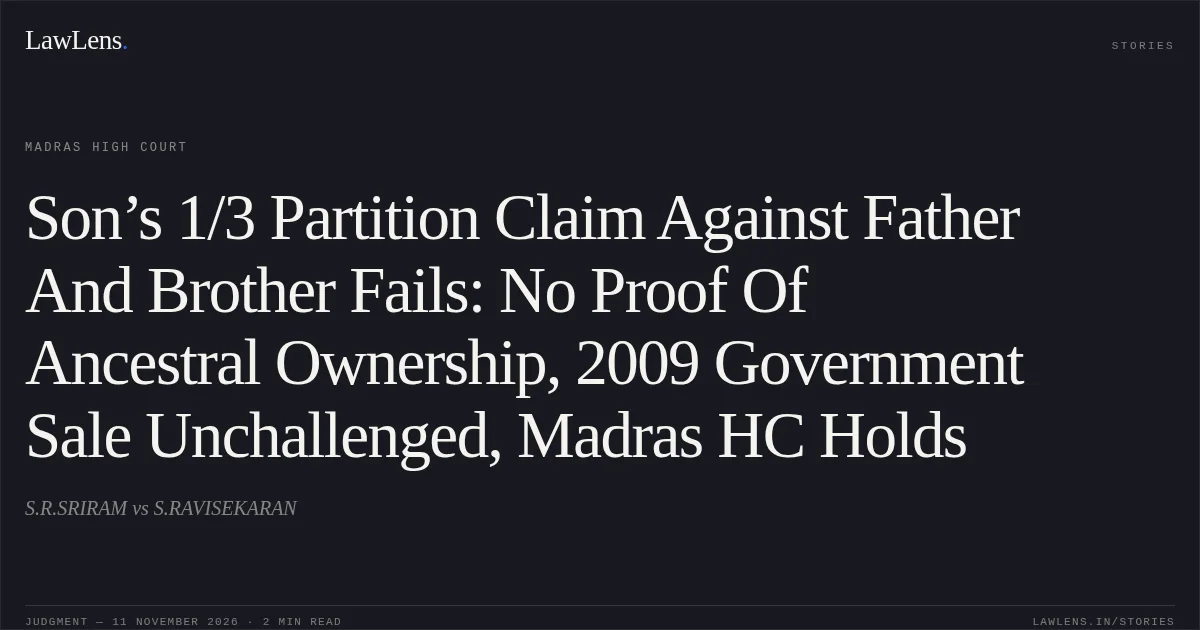
The plaintiff sued his father and brother for partition of a claimed one-third share in two properties, alleging that they were ancestral properties.
pp. 2–6The Government was joined as a defendant because the father and brother had sold the properties to it by a sale deed dated 25 August 2009. The father and brother were set ex parte; the Government contested the suit. The trial court dismissed the suit, finding, among other things, that the plaintiff had not established that the properties were joint-family properties and had not challenged the sale deed. The plaintiff appealed.
pp. 2–602Issues
i.Whether the trial court was correct in dismissing the plaintiff’s claim for a preliminary decree for partition of a one-third share
p. 4ii.Whether the plaintiff proved that the suit properties were ancestral properties
p. 4iii.Whether the partition suit was maintainable without seeking a declaration that the sale deed in favour of the Government was null and void
p. 503Law Applied
The appeal was brought under Section 96 and Order XLI Rule 1 of the Code of Civil Procedure, as stated in the appeal’s prayer.
p. 1It applied the evidentiary requirement that a plaintiff seeking partition must establish the asserted joint-family or coparcenary character of the property; it also considered the failure to challenge the sale deed in favour of the Government where that deed affected the property claimed to be joint.
pp. 5–7The trial court had held that a partition suit was not barred by limitation, and the appellate court did not disturb that finding.
p. 5Provisions in the judgment · 1 · Linked ones open on LawLens
Code of Civil Procedure, 1908 Section 96
04Reasoning
The plaintiff produced no evidence establishing that either suit property was joint-family property.
pp. 5–7The Court also noted that the 2009 sale deed in favour of the Government had not been challenged, although the suit was filed only in 2017.
pp. 5–7In those circumstances, and with the properties being used by the Government for public purposes, the Court found no basis to disturb the trial court’s conclusion that the plaintiff had not established entitlement to partition.
pp. 5–7It upheld the trial court’s findings, including its rejection of the claim that the properties were coparcenary property.
pp. 5–705Holding
The Court answered the appeal against the plaintiff, finding no infirmity in the trial court’s decision.
p. 7It dismissed the appeal suit and made no order as to costs.
p. 7Original Court PDF
S.R.SRIRAMvsS.RAVISEKARAN
Click to open original judgment
Original judgment, available to read, download and summarize on LawLens.in