01Facts
The second respondent alleged that A1–A3 promised to arrange a loan of ₹75 crores and obtained ₹1.5 crores and signed blank instruments from him.
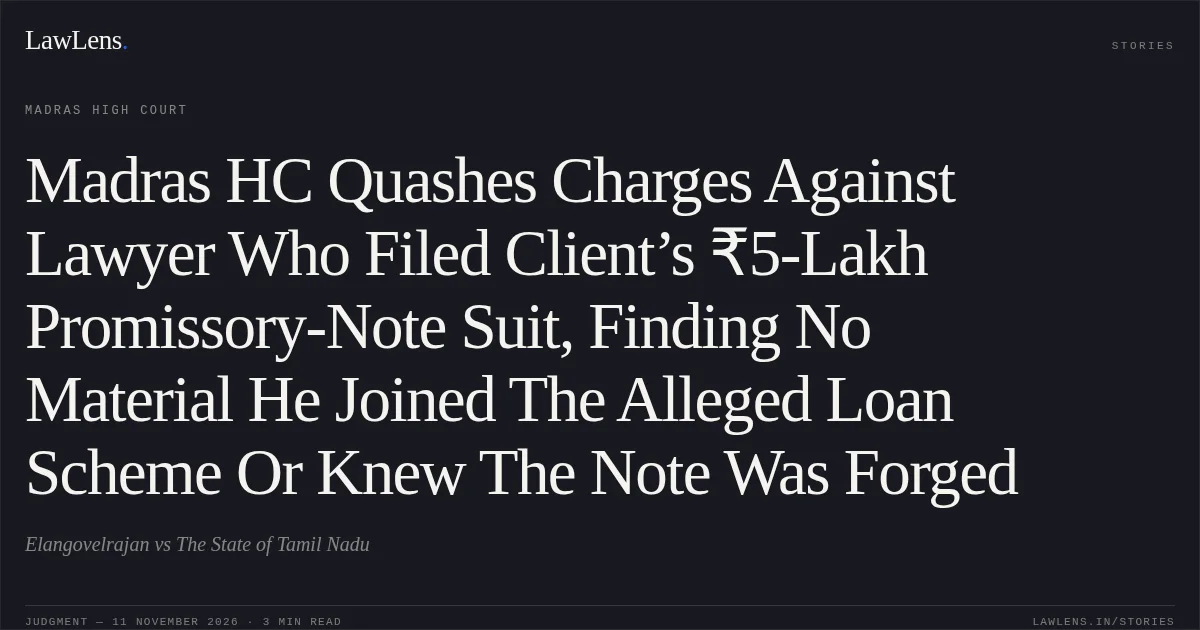
¶ 2–3The petitioner, A4, was not named in the FIR but was later charged on the allegation that he dictated the completion of a signed promissory note for ₹5 lakhs and used it in a suit filed for A1.
¶ 2–3The prosecution relied, among other things, on a witness statement that an advocate’s clerk filled in the note at the petitioner’s office on his instructions.
¶ 2–3The suit was dismissed for default, and no property was obtained through it.
¶ 2–3, 12The petitioner sought to quash the charge sheet under Section 528 of the BNSS.
p. 1 · ¶ 102Issues
i.Whether the prosecution materials, taken at face value, disclosed the ingredients of the charged offences against A4.
¶ 9ii.Whether A4’s alleged role in dictating and using the promissory note, and filing a suit for his client, disclosed forgery, fraudulent use of a forged document, cheating, or conspiracy.
¶ 9–1303Law Applied
The Court applied Sections 463 and 464 IPC, under which forgery requires the making of a false document.
¶ 9–11Sections 465, 467 and 468 IPC, concerning forgery and specified aggravated forms.
¶ 9–11Section 471 IPC, which requires fraudulent or dishonest use of a forged document with knowledge or reason to believe that it is forged.
¶ 9–11Section 20 of the Negotiable Instruments Act, which gives the holder of a signed and delivered instrument prima facie authority to complete it.
¶ 10The requirements of Section 420 IPC, including deception, dishonest inducement and delivery of property.
¶ 12The requirement of an agreement to commit an illegal act for criminal conspiracy under Section 120-B IPC.
¶ 13In exercising its inherent jurisdiction under Section 528 BNSS, the Court relied on the categories in State of Haryana v. Bhajan Lal, 1992 Supp (1) SCC 335, identified as categories (1) and (3).
p. 1 · ¶ 15Provisions in the judgment · 13 · Linked ones open on LawLens
Bharatiya Nagarik Suraksha Sanhita, 2023 Section 528
Indian Penal Code, 1860 9 provisions
Section 107Section 406Section 420Section 463Section 464Section 465Section 467Section 468Section 471Negotiable Instruments Act, 1881 Section 20
Code of Criminal Procedure, 1973 Section 164Section 161
04Reasoning
The Court found that the second respondent had signed and delivered the promissory note to A1, while the prosecution did not allege that A4 wrote or signed it; the blanks were completed by a witness.
¶ 9–10The materials did not show that A4 knew the terms on which the note was delivered or knew that no debt was due, so the Court found no basis for forgery charges against him.
¶ 9–10For Section 471, the final report stated that A4 had reason to believe the document was original, which the Court considered inconsistent with knowledge that it was forged; filing a client’s document in a suit, without more, was not fraudulent use.
¶ 11The alleged loan inducement and delivery of property predated A4’s alleged involvement, and the suit yielded no property, defeating the alleged basis for cheating.
¶ 12Nor was there material connecting A4 to an agreement or the loan scheme; the alleged act occurred after the object of the scheme had already been achieved.
¶ 13The Court accordingly held that the materials did not disclose the essential ingredients of the offences identified in its analysis.
¶ 1505Holding
The Court allowed the petition and quashed the charge sheet in P.R.C. No. 584 of 2024, subsequently numbered C.C. No. 654 of 2025, insofar as A4 was concerned.
¶ 17–18The Court directed that its observations were confined to A4 and should not affect the proceedings against the other accused.
¶ 16The connected miscellaneous petition was closed.
¶ 17–18Original Court PDF
ElangovelrajanvsThe State of Tamil Nadu
Click to open original judgment
Original judgment, available to read, download and summarize on LawLens.in