01Facts
The prosecution alleged that, following a land dispute, the accused waylaid PW1, a member of the Hindu Paraiyar community, abused him by reference to his caste, and threatened to kill him.
The Trial Court convicted Accused 1 and 2 under Section 506(i) IPC and Section 3(1)(x) of the SC/ST (Prevention of Atrocities) Act, 1989, but acquitted them under Section 341 IPC; it acquitted Accused 3 and 4 of all charges.
pp. 6–7, paras 9–12Accused 1 and 2 appealed their convictions, while PW1 appealed the acquittals of Accused 3 and 4.
p. 6 · ¶ 10The judgment refers to the alleged occurrence as 23.08.2012 in its summary but as 23.03.2012 in its account of PW1’s evidence and its discussion of delay.
pp. 7–8, paras 12–13 · p. 19 · ¶ 3002Issues
i.1. Whether the Trial Court was right to convict Accused 1 and 2 under Section 506(i) IPC and Section 3(1)(x) of the SC/ST (Prevention of Atrocities) Act.
p. 6 · ¶ 11(1)ii.2. Whether the Trial Court was right to acquit Accused 3 and 4 of the charges under Sections 341 and 506(i) IPC and Section 3(1)(x) of the Act.
p. 6 · ¶ 11(2)03Law Applied
Rule 7(1) of the SC/ST (Prevention of Atrocities) Rules, 1995 requires investigation of an offence under the Act by a police officer not below the rank of Deputy Superintendent of Police, appointed by the competent authority after considering the officer’s experience and ability.
pp. 11–12 · ¶ 22Relying on State of M.P. v. Chunnilal @ Chunni Singh, the Court stated that failure to appoint the investigating officer in accordance with Rule 7 vitiates the investigation insofar as offences under the Act are concerned, but not the investigation of IPC offences.
p. 12 · ¶ 23For Section 3(1)(x), the Court applied the requirement that the alleged insult or intimidation occur in a place within public view, distinguishing that concept from a public place, as explained in Swaran Singh and Hitesh Verma v. State of Uttarakhand.
pp. 13–16, paras 24–25For Section 506(i) IPC, it relied on Noble Mohandass v. State for the principle that the threat must be real and intended to cause alarm, rather than a mere angry utterance.
pp. 20–21 · ¶ 33Provisions in the judgment · 7 · Linked ones open on LawLens
Code of Criminal Procedure, 1973 Section 374Section 372Section 207Section 313
Indian Penal Code, 1860 Section 341Section 506
Scheduled Castes and the Scheduled Tribes (Prevention of Atrocities) Act, 1989 Section 3
04Reasoning
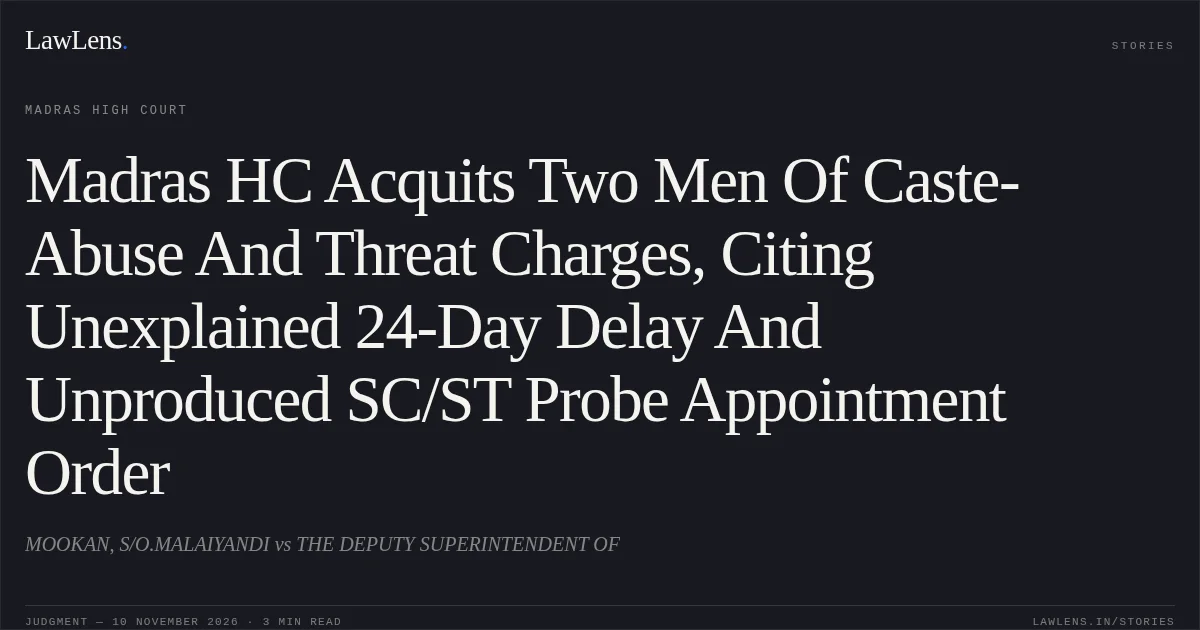
The prosecution did not produce the Superintendent of Police’s appointment proceedings for PW17, so the Court held that compliance with Rule 7 had not been established and that the investigation could not sustain the charge under the SC/ST Act.
pp. 11–12, paras 21–23The Court also found that PW1 did not say that members of the public were present when the alleged caste-based abuse occurred; PW2 arrived after the occurrence, and the other alleged eyewitness, Muthu, was not examined.
pp. 16–17, paras 25–28The Court further considered the differing accounts of the words allegedly used and the absence of evidence that Accused 3 and 4 uttered caste-based abuse.
pp. 17–18, paras 26–28As to criminal intimidation, it treated the delay in giving the complaint, the subsequent registration of the FIR after a court direction, and the absence of a request for police protection as circumstances undermining the allegation that the threats caused genuine alarm.
pp. 19–21, paras 29–33The evidence that Accused 3 and 4 chased PW1 with a stick was also unsupported by the complaint and by any recovery of a stick.
p. 21 · ¶ 3405Holding
The Court allowed Crl.A.(MD) No. 34 of 2019, set aside the convictions of Accused 1 and 2 under Section 506(i) IPC and Section 3(1)(x) of the Act, and ordered any fine paid to be refunded.
p. 22 · ¶ 35It dismissed Crl.A.(MD) No. 284 of 2021, leaving the acquittals of Accused 3 and 4 undisturbed.
pp. 22, paras 34–35The Trial Court’s acquittal of Accused 1 and 2 under Section 341 IPC was not challenged in PW1’s appeal.
p. 6 · ¶ 10Original Court PDF
MOOKAN, S/O.MALAIYANDIvsTHE DEPUTY SUPERINTENDENT OF
Click to open original judgment
Original judgment, available to read, download and summarize on LawLens.in