01Facts
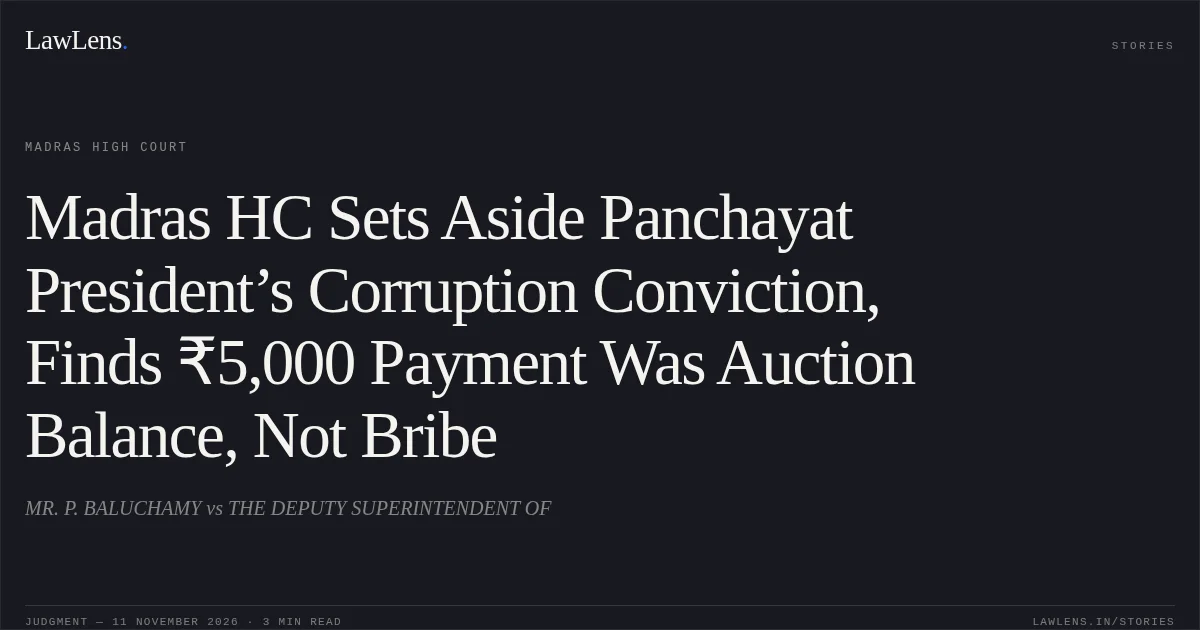
The appellant, President of Nenjathur Village Panchayat, was convicted by the Special Court under Sections 409, 466, 467, 471 and 201 IPC and Sections 13(1)(c) and 13(1)(d) read with Section 13(2) of the Prevention of Corruption Act, 1988.
pp. 2–6The prosecution alleged that, after a public auction of materials from a demolished school building, the appellant retained part of the sale proceeds and later demanded and accepted ₹5,000 from the complainant as a bribe to issue a receipt and permit collection of the remaining materials.
pp. 2–6The appellant maintained that the ₹5,000 received on 25 October 2000 was the unpaid balance of the auction price, not illegal gratification, and relied on evidence of prior disputes with the complainant.
pp. 10–14The High Court heard the appeal against conviction and sentence.
pp. 1–2, 1802Issues
i.1. Whether the evidence established that the ₹5,000 received by the appellant was illegal gratification, rather than the balance auction price owed to the Panchayat
pp. 18–25ii.2. Whether the evidence established criminal breach of trust or the alleged forgery, use of forged documents, and concealment offences under the IPC
pp. 21–25iii.3. Whether the convictions under the Prevention of Corruption Act and the IPC could safely be sustained on the evidence presented
pp. 24–2503Law Applied
The Court considered Section 405 IPC, which defines criminal breach of trust as the dishonest misappropriation, conversion, use or disposal of entrusted property—or property over which the accused has dominion—in violation of law or a legal obligation; Section 409 IPC applies that offence to specified persons, including public servants.
pp. 22–23The charges also invoked Sections 466, 467, 471 and 201 IPC concerning forgery of specified records or valuable security, use of a forged document as genuine, and causing evidence to disappear or screening an offender.
The Prevention of Corruption Act charges were under Sections 13(1)(c) and 13(1)(d), read with Section 13(2), concerning criminal misconduct by a public servant.
The judgment cites no precedent and does not set out a separate test for these offences; it assesses whether the prosecution evidence proved the alleged conduct.
Provisions in the judgment · 12 · Linked ones open on LawLens
Code of Criminal Procedure, 1973 Section 374
Indian Penal Code, 1860 Section 409Section 466Section 467Section 471Section 201Section 406Section 405
Prevention of Corruption Act, 1988 Section 13Section 7
Tamil Nadu Panchayats Act,1994 Section 119
Scheduled Castes and the Scheduled Tribes (Prevention of Atrocities) Act, 1989 Section 3
04Reasoning
The Court found that the complainant had agreed in an enquiry before PW10 to pay the outstanding ₹5,000 and collect a receipt, and that PW18 also testified that the complainant admitted owing that balance.
pp. 20, 23–24The receipt was issued and the amount was credited to the Panchayat account; the Court therefore treated the trap payment as the balance auction price, not a bribe.
pp. 24–25It also considered the history of disputes between the parties and the complainant’s prior complaints as relevant to the reliability of the prosecution case.
pp. 19–21, 25The prosecution did not examine the Panchayat Secretary, who was responsible for receipts and maintaining relevant records, or establish through the other signatories that the resolution-book entry had been interpolated by the appellant.
pp. 22–23In those circumstances, the Court held that the evidence did not safely establish misappropriation, forgery, or the other charged offences.
pp. 23–2505Holding
It concluded that, on the evidence available, the appellant could not safely be convicted of the charged offences.
p. 25The High Court allowed the appeal, set aside the conviction and sentence, and directed that the appellant’s bail bond be cancelled and any fine paid be refunded.
p. 25Original Court PDF
MR. P. BALUCHAMYvsTHE DEPUTY SUPERINTENDENT OF
Click to open original judgment
Original judgment, available to read, download and summarize on LawLens.in