01Facts
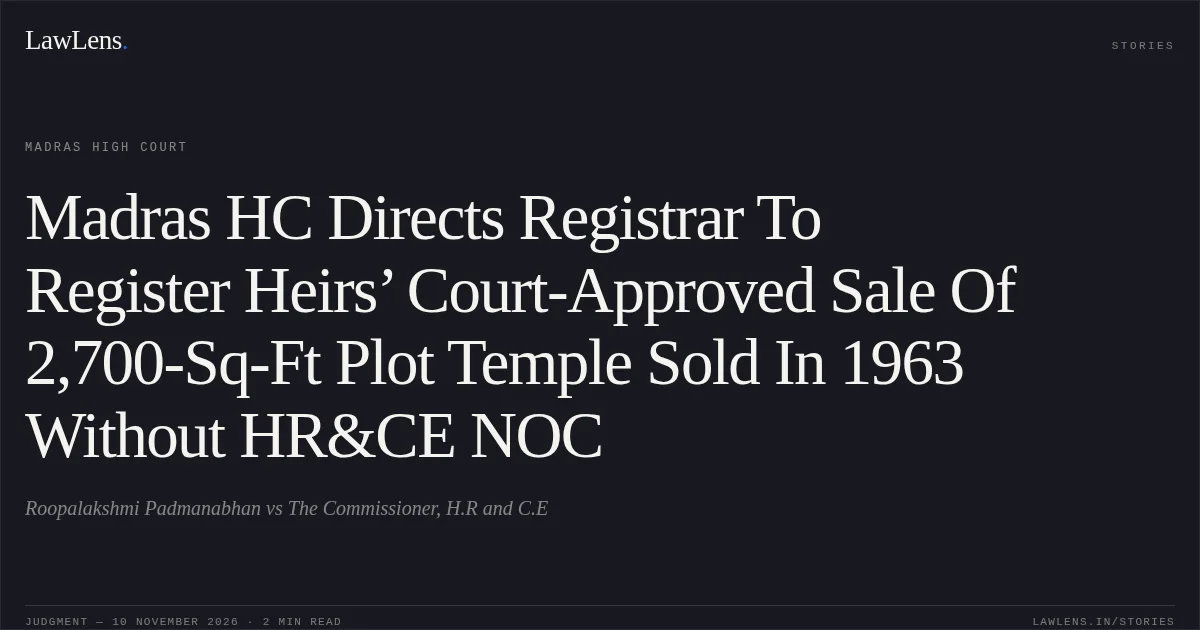
The subject property originally belonged to Arulmighu Arunachaleswarar Temple. In 1962, the H.R. & C.E. Commissioner sanctioned its sale to S. Kannammal; the Temple executed a sale deed in her favour in 1963.
p. 3, 14The property was later distributed among her children, and 2,700 sq. ft. was released to V. Vedavalli.
p. 3, 14After Vedavalli’s death, disputes among her heirs led to a partition suit. The civil court permitted the property’s sale, approved the sale price and draft sale deed, and appointed an Advocate Commissioner to supervise the sale.
pp. 4, 14–15The Sub-Registrar did not proceed with registration because the property was recorded as Temple property and an H.R. & C.E. No Objection Certificate (NOC) was sought.
pp. 4–5, 15The petitioner sought directions enabling registration of the court-approved sale deed.
02Issues
i.Whether the Sub-Registrar could require an H.R. & C.E. NOC before registering the court-approved sale deed, notwithstanding the Commissioner’s prior sanction and the Temple’s 1963 conveyance.
pp. 15–18ii.Whether the Temple or H.R. & C.E. authorities could object to registration where the sanction order and sale deed remained in force and had not been set aside by a competent court.
p. 1803Law Applied
Section 34(1) of the Tamil Nadu Hindu Religious and Charitable Endowments Act provides that a sale, exchange or mortgage of immovable property belonging to a religious institution is void unless sanctioned by the Commissioner as necessary or beneficial to the institution; the statutory provisos also prescribe publication, consideration of objections and prior Government approval.
pp. 15–17The Court noted the First Bench’s clarification that the direction in the 2021 suo motu proceedings concerning Temple lands could be treated as per incuriam if it conflicted with statutory provisions.
p. 15It also referred to the Division Bench’s 2023 review order, which discussed Section 34 and the safeguards applicable to alienation of Temple property.
pp. 9–13The operative principle was that, where the competent authority had sanctioned the sale and the Temple had conveyed the property, the conveyance remained effective unless set aside by a competent court.
pp. 17–18Provisions in the judgment · 3
Madras Hindu Religious and Charitable Endowments Act, 1959 Section 34
the Act of 1997 (alias, unresolved) Section 3
Tamil Nadu Act 39 of 1996 Section 2
04Reasoning
The Commissioner had sanctioned the sale in 1962 under Section 34, and the Temple executed the sale deed in 1963 pursuant to that sanction.
p. 14, 17The Court therefore found no violation of Section 34 in the original sale.
p. 17The property was subsequently dealt with through registered documents, and the civil court had authorised its sale and approved the sale arrangements.
pp. 14–15Because neither the sanction order nor the Temple’s sale deed had been set aside, the respondents had no basis to object to registration or insist on a further NOC.
p. 18The general directions concerning protection of Temple property did not displace the statutory framework or invalidate the specific, sanctioned conveyance.
p. 1505Holding
The Court allowed the writ petition.
p. 18It directed the petitioner and the other legal heirs to re-present the sale deed approved by the civil court and directed the Sub-Registrar to register it forthwith, provided it was otherwise in order.
p. 18No order as to costs was made.
p. 18Original Court PDF
Roopalakshmi PadmanabhanvsThe Commissioner, H.R and C.E
Click to open original judgment
Original judgment, available to read, download and summarize on LawLens.in