01Facts
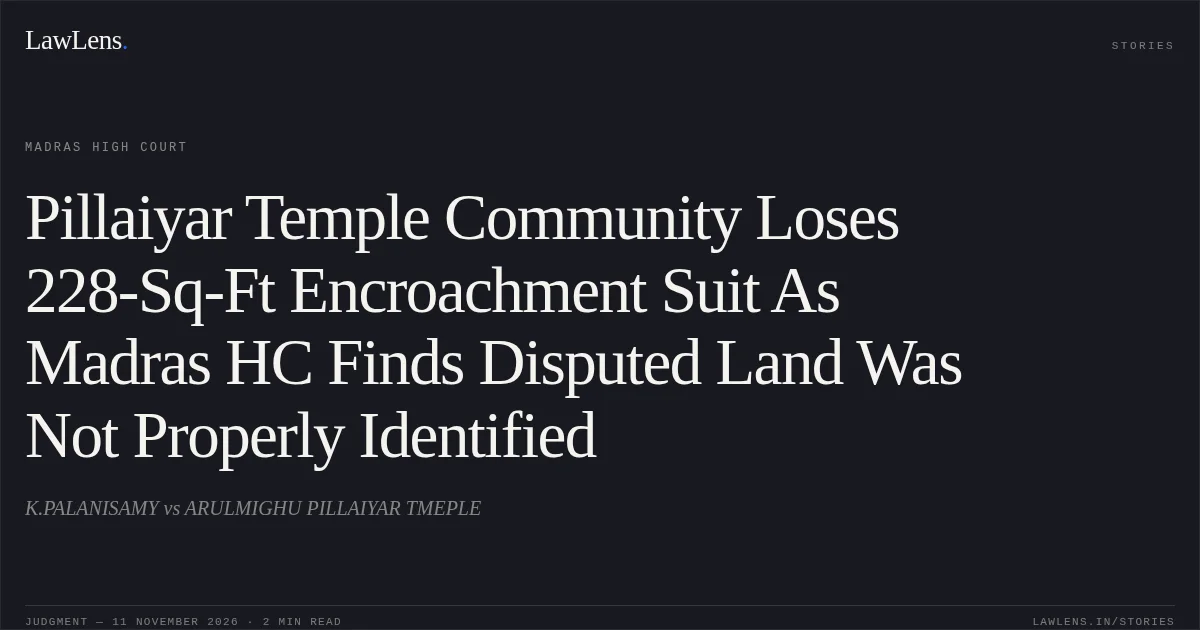
The plaintiffs sued for declaration, possession and permanent injunction, alleging that the defendants had encroached on 228 sq. ft. of temple land.
pp. 1–2, 5–7The trial court dismissed the suit, finding the plaintiffs had not proved their claim; the first appellate court reversed and decreed the suit.
pp. 1–2, 5–7The defendants brought this second appeal under Section 100 CPC.
pp. 1–2, 5–7The dispute concerned, among other matters, the plaintiffs’ proof of title and the identification and extent of the alleged encroached land.
pp. 10–1602Issues
i.1. Whether the first appellate court, when reversing the trial court, gave adequate reasons for departing from its findings.
p. 6 · pp. 17–18ii.2. Whether the suit property, including the alleged encroached portion, was sufficiently identified by survey number, extent and boundaries.
p. 6 · pp. 15–18iii.3. Whether the first appellate court wrongly placed the burden of proof on the defendants, when the plaintiffs had to establish their entitlement to the reliefs sought.
p. 6 · pp. 16–18iv.4. Whether the first appellate court could grant recovery of possession despite the alleged portion not being clearly described and identified.
p. 7 · pp. 17–1803Law Applied
The appeal was brought under Section 100 of the Code of Civil Procedure, which provides the procedural basis for a second appeal on a substantial question of law.
pp. 1, 6–7The Court applied the principles that a first appellate court reversing a trial court’s judgment must give reasons for disagreeing with the trial court’s findings; a plaintiff seeking declaratory and possessory relief must prove the case independently of any weakness in the defence; and land claimed in a suit for possession must be sufficiently identified by its survey particulars, extent and boundaries.
pp. 16–18No precedent was cited in the judgment.
Provisions in the judgment · 1 · Linked ones open on LawLens
Code of Civil Procedure, 1908 Section 100
04Reasoning
The Court found that the plaintiffs’ documentary description and measurements did not establish the extent claimed: the recorded survey extents differed materially from the dimensions stated in the property description, and the alleged 228 sq. ft. encroachment was not clearly identified.
pp. 11–12, 16–18The Commissioner’s report did not resolve the dispute because it omitted the concrete road and did not measure the plaintiffs’ property.
p. 12The defendants, by contrast, produced sale documents supporting their claim to the adjoining property.
pp. 13–14The first appellate court granted relief despite these evidentiary and identification deficiencies and, in the High Court’s view, failed to give adequate reasons for reversing the trial court.
pp. 17–18The plaintiffs had therefore not discharged their burden of proof.
pp. 17–1805Holding
The Court answered the substantial questions of law in favour of the defendants, holding that the first appellate court’s reversal and decree were unsustainable given the inadequate reasons and the plaintiffs’ failure to prove and properly identify the property claimed.
pp. 17–18It allowed the second appeal, set aside the first appellate court’s judgment and decree, and restored the trial court’s dismissal of the suit; there was no order as to costs, and the connected miscellaneous petition was closed.
p. 18Original Court PDF
K.PALANISAMYvsARULMIGHU PILLAIYAR TMEPLE
Click to open original judgment
Original judgment, available to read, download and summarize on LawLens.in