01Facts
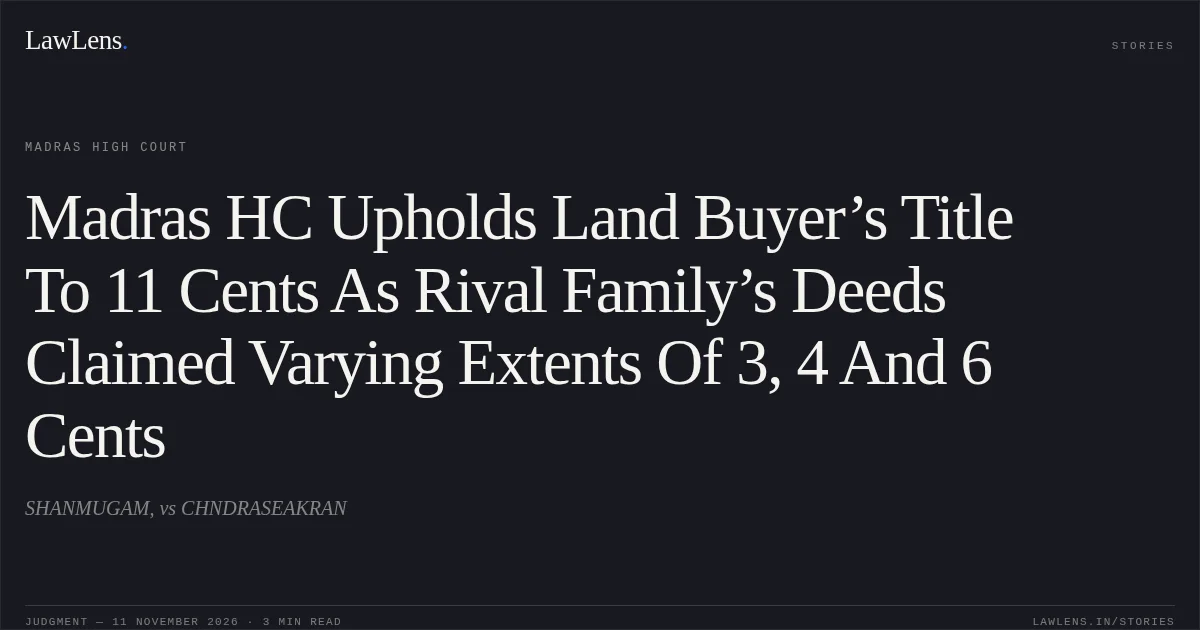
The plaintiff sought a permanent injunction over land purchased in 2000, relying on a title chain beginning with a 1928 registered sale deed executed by a court-auction purchaser.
pp. 3–4, 12–13The defendants denied his title and claimed under family partition deeds, as well as revenue records.
pp. 3–4, 12–13The suit was initially decreed, but in an earlier second appeal the High Court set aside the decrees and permitted the plaintiff to amend the plaint to seek a declaration of title.
p. 4The amendment was allowed in 2016; the trial court then decreed the suit, and the first appellate court affirmed that decree.
pp. 5–7The defendants appealed again, arguing, among other things, that the declaration claim was time-barred and that the plaintiff’s title failed because the sale certificate underlying the 1928 deed had not been produced.
pp. 7–1002Issues
i.1. Whether the plaintiff’s amended claim for declaration of title was barred by limitation, given that the defendants had denied his title in their 2004 written statement and the amendment was allowed in 2016.
pp. 7–8, 17–19ii.2. Whether the absence of the court-sale certificate undermined the title conveyed under the plaintiff’s 1928 parent deed.
pp. 7–8, 19–21iii.3. Whether the defendants’ partition deeds and patta established a better title or possession than the plaintiff’s documentary chain.
pp. 8–9, 22–24iv.4. Whether the first appellate court’s treatment of additional evidence without remanding the matter vitiated its decision.
pp. 9–10, 28–3003Law Applied
Section 105(1) CPC permits an interlocutory order affecting the merits of a decree to be challenged in an appeal against that decree, but the alleged error, defect, or irregularity must be set out as a ground of objection; Section 105(2) concerns challenges to remand orders.
pp. 14–16Under the doctrine of relation back, an amendment ordinarily operates from the date of the original pleading unless the court directs otherwise; Sampath Kumar v. Ayyakannu and Siddalingamma v. Mamtha Shenoy support that principle.
pp. 17–18The court treated a court-sale certificate as a ministerial act evidencing title already perfected upon confirmation of sale, relying on Pattam Khader Khan v. Pattam Sardar Khan and United Finance Corpn. v. M.S.M. Haneefa.
pp. 25–27Order XLI Rules 27 and 28 CPC govern additional evidence and the procedure for taking it; Corporation of Madras v. M. Parthasarathy requires a fair opportunity to rebut additional evidence.
pp. 28–30Revenue mutations do not confer or extinguish title; they principally identify the person from whom revenue may be collected, as stated in Prahlad Pradhan v. Sonu Kumhar.
p. 25In civil proceedings, the court assesses competing claims on a preponderance of probabilities.
p. 13Provisions in the judgment · 2 · Linked ones open on LawLens
Code of Civil Procedure, 1908 Section 105Section 104
04Reasoning
The defendants had not challenged the 2016 amendment order as a ground in either appeal, as Section 105(1) requires; moreover, the earlier second-appeal order had expressly permitted the amendment and was not challenged.
pp. 16–19The amendment therefore related back to the 2004 plaint, which the court held was filed within time following the alleged interference in 2004.
pp. 16–19On title, the court found that the plaintiff’s registered documents formed a continuous chain from 1928, and that non-production of the sale certificate did not invalidate the auction purchaser’s title because the certificate was ministerial.
pp. 19–22, 25–27By contrast, the defendants’ documents reflected inconsistent extents, lacked the asserted underlying purchase deed, and did not explain the 11-cent patta; the court therefore found their claim less probable.
pp. 22–25Although the appellate court ought to have followed Order XLI Rule 28 in receiving additional evidence, the document did not assist the defendants, so the procedural error did not affect the result.
pp. 29–3005Holding
The High Court answered the substantial questions of law against the defendants and dismissed the second appeal.
pp. 30–31It confirmed the decrees granting the plaintiff relief, awarded him costs in the appeal, and closed the connected miscellaneous petition.
pp. 30–31Original Court PDF
SHANMUGAM,vsCHNDRASEAKRAN
Click to open original judgment
Original judgment, available to read, download and summarize on LawLens.in