01Facts
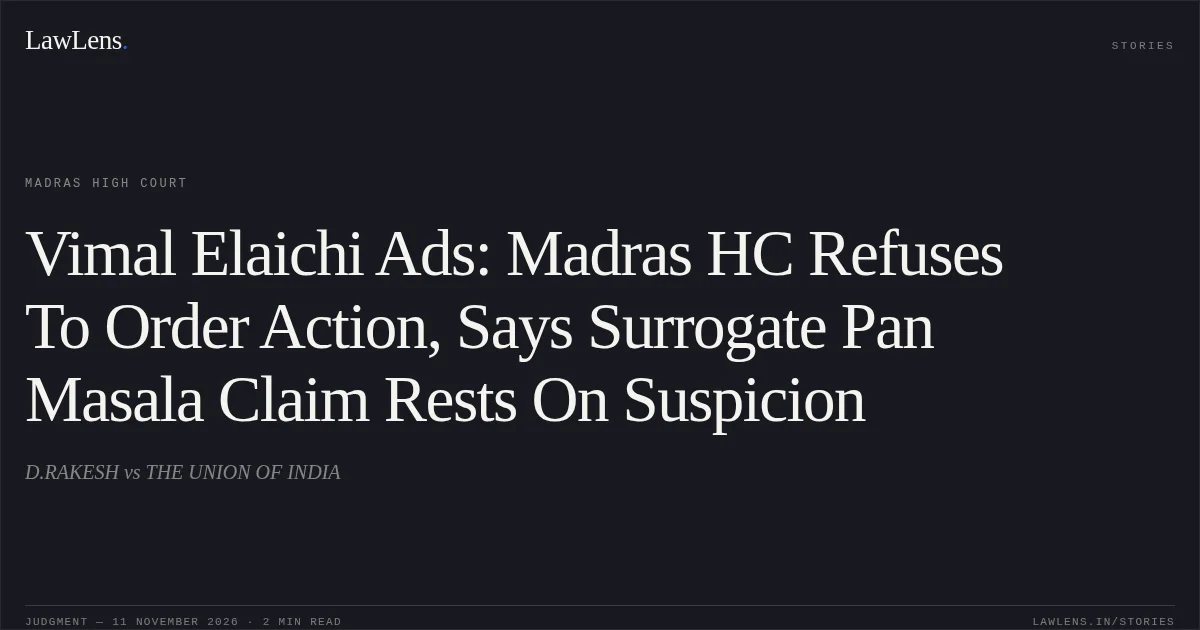
The petitioner alleged that advertisements for “Vimal Elaichi” were surrogate advertisements for Vimal Pan Masala and sought directions for an inquiry and for the advertisements to be stopped.
pp. 2–4He relied principally on media reports of show-cause notices issued to actors in Maharashtra, and alleged violations of food-safety, consumer-protection, tobacco-control and cable-television laws.
pp. 2–4The Court noted that the petitioner accepted that Elaichi was a recognised, FSSAI-registered food product, identified no Vimal-branded gutka or tobacco product sold by the sixth respondent, and had not first made a representation to the relevant authorities.
pp. 6–702Issues
i.Whether the petitioner produced sufficiently credible and concrete material to warrant public-interest intervention into the alleged surrogate nature of the “Vimal Elaichi” advertisements.
pp. 5–7ii.Whether mandamus could issue against the authorities where the petitioner had made no prior representation and had not established that they failed to perform a legal duty.
p. 703Law Applied
Public-interest jurisdiction is an extraordinary remedy and requires rigorous, credible material; speculation, internet rumours and unverified reports do not suffice.
p. 5A writ of mandamus requires both a legal duty and a failure to perform that duty.
p. 7The Court observed that the Food Safety and Standards Act, 2006, the Consumer Protection Act, 2019, and the other laws invoked provide competent authorities with powers to examine the relevant facts, hear the advertiser and decide whether a breach has occurred.
p. 7Provisions in the judgment · 4 · Linked ones open on LawLens
Food Safety and Standards Act, 2006 Section 53Section 30
Cigarettes and Other Tobacco Products (Prohibition of Advertisement and Regulation of Trade and Commerce, Production, Supply and Distribution) Act, 2003 Section 5Section 22
04Reasoning
The Court found that the Maharashtra notices were preliminary show-cause notices, not findings, and rested on an order specific to that State; they therefore did not establish a basis for action in Tamil Nadu.
p. 6The petitioner’s allegation rested on suspicion, including a possibility that a Vimal tobacco product might exist, rather than substantiated evidence.
pp. 6–7Whether the advertisement was surrogate depended on factual matters—including the product’s genuine sale, packaging, marketing, the advertisement’s content and the advertiser’s intent—which the competent authorities could assess after hearing the advertiser; the Court would not decide that question on the petitioner’s affidavit alone.
p. 7Nor was inaction established, because the petitioner had not brought the grievance to the authorities before seeking mandamus.
p. 705Holding
The Court held that the petition was premature and lacked merit.
p. 8It dismissed the writ petition and closed the connected miscellaneous petition, with no order as to costs.
p. 8Original Court PDF
D.RAKESHvsTHE UNION OF INDIA
Click to open original judgment
Original judgment, available to read, download and summarize on LawLens.in